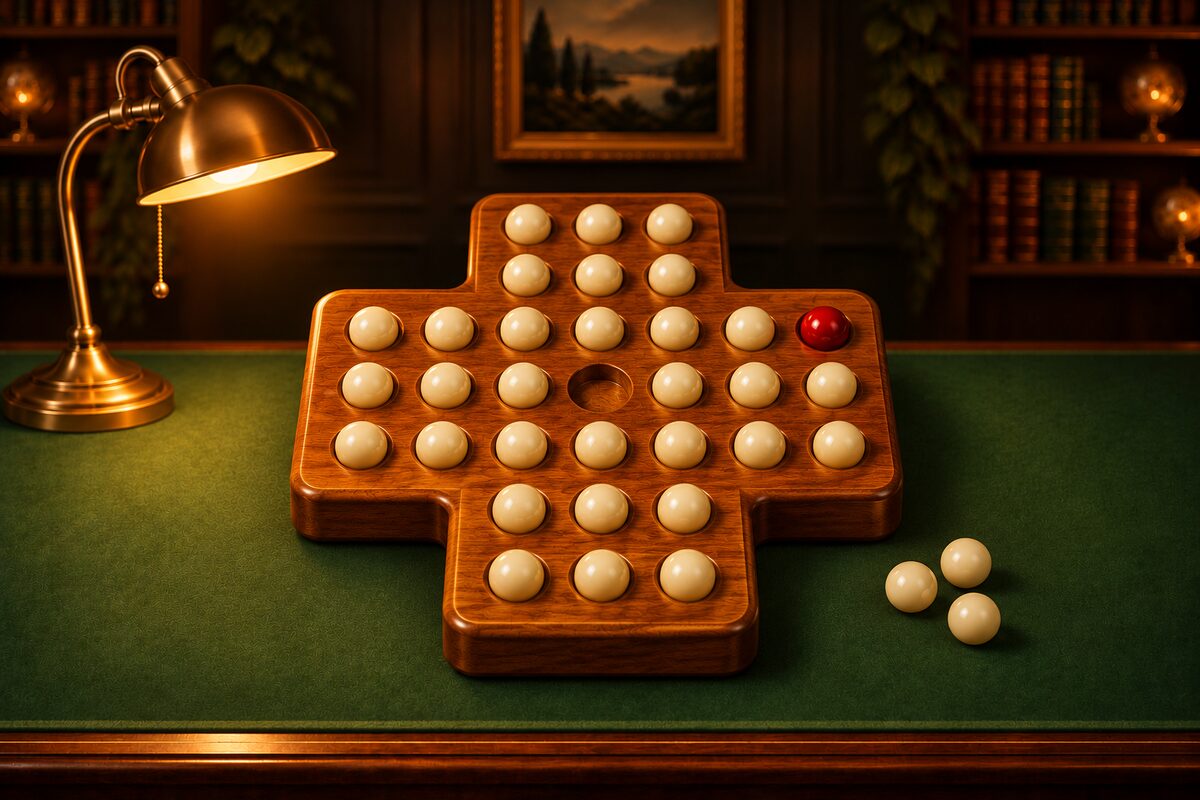
Here are the questions people ask most often about peg solitaire. If you want to know more, read the article each link points to.
Rules
What is peg solitaire?
It is a one-player puzzle in which you jump over pegs on a board with holes, capturing them as you go, until only one is left. It is also called marble solitaire (What Is Peg Solitaire?).
What are the rules?
You move a peg up, down, left, or right, jumping over one neighboring peg into the empty hole right behind it, and you remove the peg you jumped over. You clear the board when one peg is left (the rules article).
Can you jump diagonally?
On boards with square grids of holes, such as the English 33-hole board, you can’t. On the triangular board, you can also jump diagonally.
How many moves does it take to clear?
Each move removes one peg, so the English 33-hole board takes exactly 31 moves (How Many Moves Does a Game Take?).
How to Solve It
What is the answer for the English 33-hole board?
The 31-move answer that starts with the center empty and ends with one peg in the center is shown move by move, with diagrams, in the solving article.
Any tips?
Move the pegs in the corners at the tips of the arms early, and remove pegs in groups so none get isolated (the tips article). For a shape that clears the 6 pegs of an arm at once, see How to Clear an Arm, and for endgame practice, see the endgame practice problems.
How do I leave the last peg in the center?
When you start from the center, the last peg can only be left in 5 holes. Think backward from the shape of the final move (Leaving the Last Peg in the Center). The reason some holes are impossible is in the three-color coloring article.
What is the best first move?
The four possible first moves are all the same if you rotate the board (the first move).
What if I get stuck?
Go back to the move where you made the mistake. Often the cause is a move made much earlier (How to Undo When You’re Stuck).
Boards and History
What is the answer for the triangular board?
The 13-move answer for the 15-hole triangle is in Solving the Triangle. You can get down to one peg no matter which hole you start from.
Can the French board be solved?
On the French 37-hole board, you can’t get down to one peg if you start from the center (the French board and other board shapes). The English board is covered in the English 33-hole board.
How long has the game been around?
It is said to have been played in France around the end of the 17th century (The History of Peg Solitaire). For how to play on a wooden board, see the wooden board article.
How many ways are there to solve it?
The 15-hole triangle has 29,760 ways if you start with the top empty (How Many Solutions Are There?).
The App
Can I play it for free?
You can play right away in your browser on this site’s page about where to play. The Peg Solitaire app can also be downloaded without charge (it shows ads).
How do I use the app?
The screens, the five buttons at the bottom, and Settings are covered in How to Use the App.
What’s the difference between Puzzles and Classic?
Puzzles uses a board with a different shape every time, and you leave the red boss ball last. Classic is the English 33-hole board, and you clear it if one peg is left in any hole (How to Play). For boss ball tips, see Tips for Leaving the Boss Ball Last.
What are the difficulty levels?
There are five levels, from ★1 Easy (6 to 9 pegs) to ★5 Grandmaster (27 to 32 pegs) (the difficulty article).
Can every puzzle be solved?
Yes. They are built by jumping backward from a board with just one boss ball, so there is always an answer (How We Make Puzzles That Can Always Be Solved). For how answers are found, see Solving It with a Computer.
Are there hints?
Hint makes the next move glow. If the board can no longer be solved, it tells you how many moves to go back (How to Use Hint).
Can I dress it up?
Yes. You can buy pegs, boards, tables, effects, and boss balls with coins, or find them by exploring, and dress up your game (Dress-Up and Exploration).
Can kids play?
Yes, if you start with a small board (Playing with Kids). If you want to make one by hand, see How to Make One, and for brain training, see Is It Good Brain Training?.