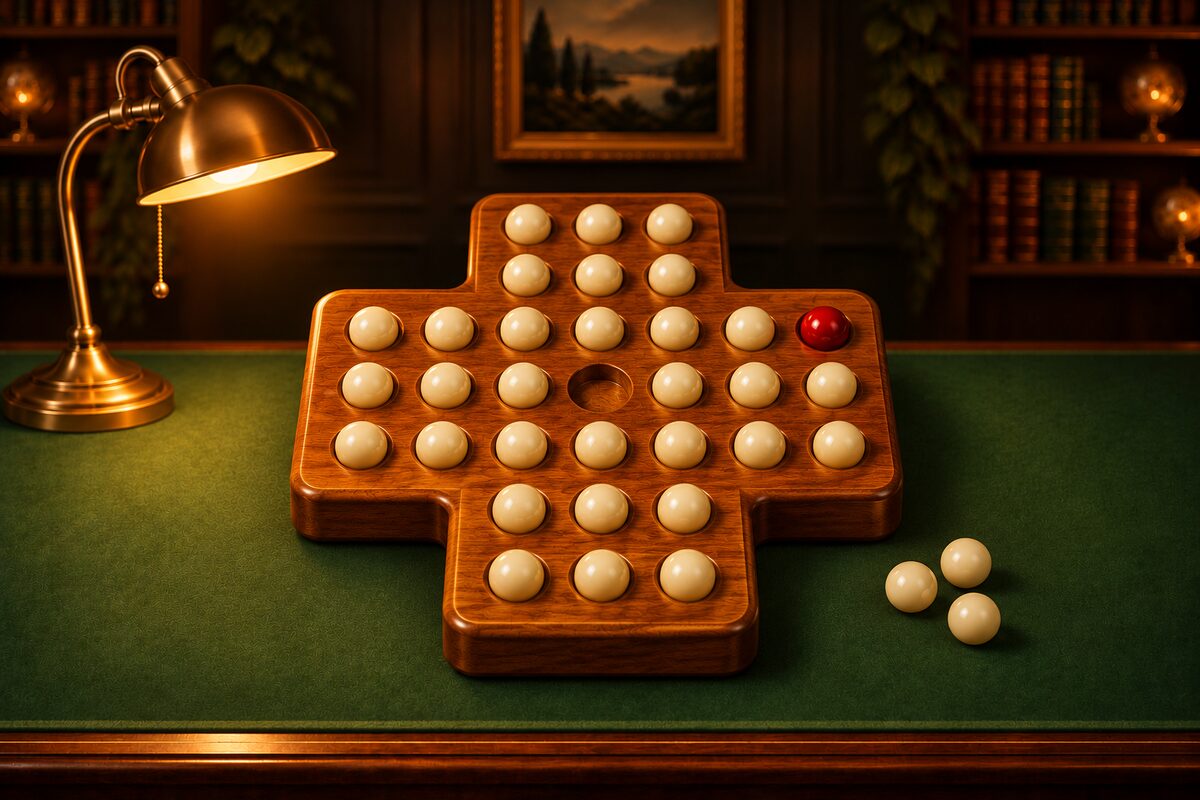
Peg solitaire is a one-player puzzle in which you set up pegs on a board with holes and jump over pegs, capturing them as you go, until only one is left. You don’t need an opponent, and there’s no luck involved. It’s a game of nothing but thinking about which peg to move, and in what order.
What the Name Means
- Peg: A pin or dowel that fits into a hole. The name comes from boards where you play by putting wooden pegs into holes. Boards that use pegs instead of marbles follow the same rules.
- Solitaire: It means playing alone.
Put together, the name means “a game of pegs, played alone.”
How It Relates to Marble Solitaire
The version where you set marbles in the dents of a wooden board is also called marble solitaire. The only difference is pegs versus marbles, and it plays the same. The Peg Solitaire app also looks like marbles set on a wooden board.
In other countries it also goes by other names, such as Kongming Qi in Chinese, Senku in Spanish, Steckhalma in German, and Resta Um in Portuguese. The app’s name in each language uses these names too.
Just One Rule
You move a peg up, down, left, or right, jumping over a neighboring peg into the empty hole right behind it. You remove the peg you jumped over.
Repeat this until you get down to one peg to clear the board. The detailed rules, and the points where people tend to get confused, are covered in the rules article.
Different Board Shapes
There are several kinds of board shapes.
English 33 Holes
A board with 33 holes arranged in a cross shape. It’s the shape you see most often, and “Classic” in the app uses this board too. You start with only the center empty.
French 37 Holes
A 37-hole board that adds one hole at each of the four inner corners of the English cross. It has a slightly rounder shape than the English board.
Triangular 15 Holes
A small board with 15 holes arranged in a triangle. On this board, you can jump in six directions, horizontally and diagonally.
For more about board shapes, see the articles on the English 33-hole board and the French and triangular boards.
How It Differs from Card Solitaire
The “Solitaire” familiar from computer games is a one-player game of rearranging playing cards (Klondike and others). The name shares the same “playing alone,” but it’s a different game from peg solitaire.
- Equipment: Peg solitaire uses a board and pegs; card solitaire uses playing cards.
- Luck: There is none in peg solitaire. In card solitaire, whether it can be solved depends on how the cards are dealt.
- Goal: In peg solitaire, you get down to one peg; in card solitaire, you put the cards in order.
Because the starting board of peg solitaire is always the same, another feature is that once you learn the answer, you can clear it every time (for the English board’s answer, see the solving article).
In the Peg Solitaire App
The app has two modes.
- Puzzles: A board with a different shape is made each time you tap “New Game.” You clear it when the colored boss ball is the last peg left. You can choose a difficulty from ★1 to ★5.
- Classic (English 33 holes): The cross-shaped board people have played for ages, where you get down to one peg.
The app’s screens are covered in How to Play. To play right away in your browser, go to the page about where to play. For when it started being played, see The History of Peg Solitaire.