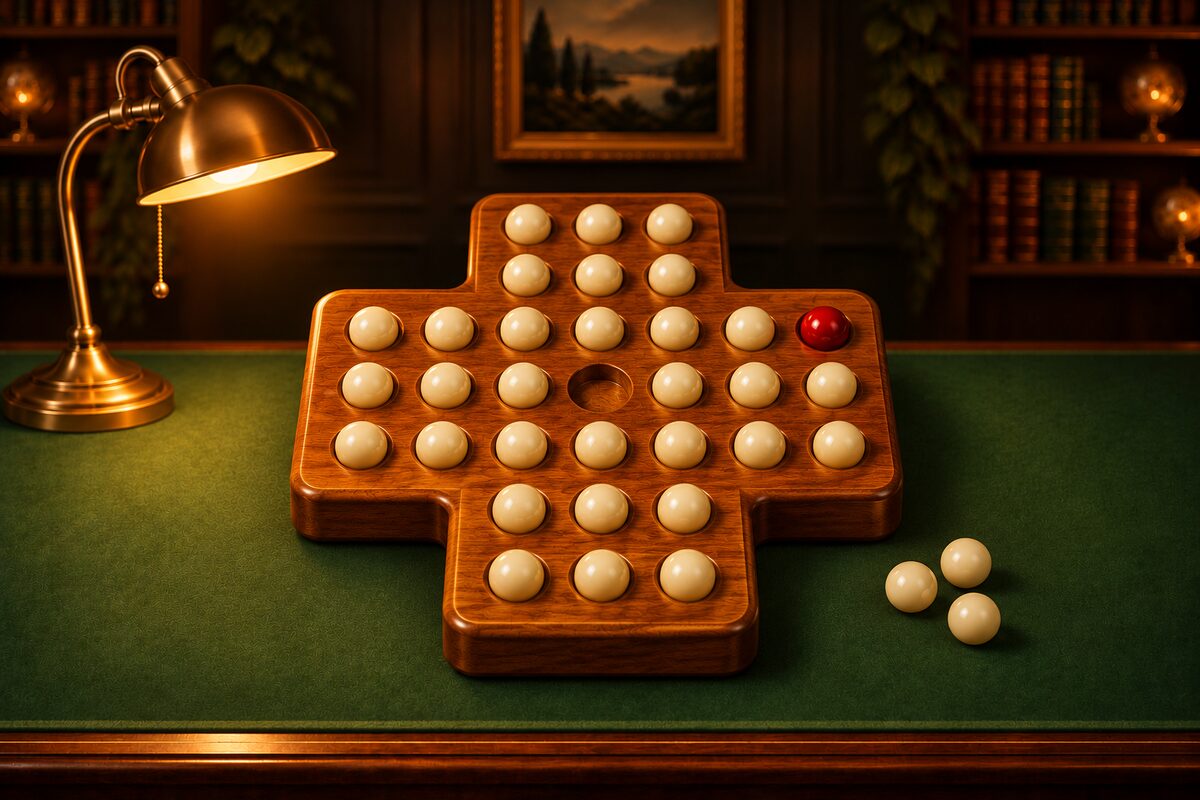
Peg solitaire is a puzzle that people have been playing for hundreds of years. But exactly when and where it began isn’t clear. This article introduces the well-known stories, noting how certain each one is.
17th-Century France
One of the oldest records of peg solitaire is a print from France in the late 17th century. It is said to show a woman at court playing on a board with holes. It is thought that by this time, the game was being played among the upper class in France.
There is also a story that “a nobleman put in prison came up with it,” but there’s no solid evidence for it, and it is regarded as just one legend.
Two Board Shapes
In Europe, two board shapes spread.
French 37 Holes
This is a 37-hole board made by adding holes at the inner corners of the cross.
English 33 Holes
This is a 33-hole board in the shape of a cross. Today it is probably the shape you see most often in the world. “Classic” in the Peg Solitaire app uses this board too.
The difference between the two boards, and why the French board can’t be solved from the center, are covered in the French board and other board shapes.
Research by Mathematicians
Peg solitaire has also drawn the interest of mathematicians.
- The 17th-to-18th-century mathematician Leibniz is said to have written about this puzzle.
- The idea of coloring the board diagonally to find “holes the last peg can’t end in” later became widely known (the three-color coloring article).
- In the 20th century, researchers studied the fewest moves when a run of consecutive jumps by the same peg counts as one move (18 on the English board), and it is said to have been shown that it can’t be done in fewer (How Many Moves Does a Game Take?).
- Once computers became available, it became possible to check every possible move and count the number of solutions (How Many Solutions Are There?).
From Wooden Boards to Apps
Peg solitaire has long been loved as a toy played with a wooden board and pegs or marbles. In Japan, too, you can find versions with a wooden board and marbles at toy sections and variety stores (Wooden Boards and How to Play).
Today, you can also play it in a phone app or a browser. In addition to “Classic,” the traditional English 33-hole board, the Peg Solitaire app has a “Puzzles” mode in which a computer makes a board with a different shape every time. To make sure every board can be solved, they are built backward from the answer (How We Make Puzzles That Can Always Be Solved).
A court pastime from hundreds of years ago is still being played today in the palm of your hand, in changed forms.