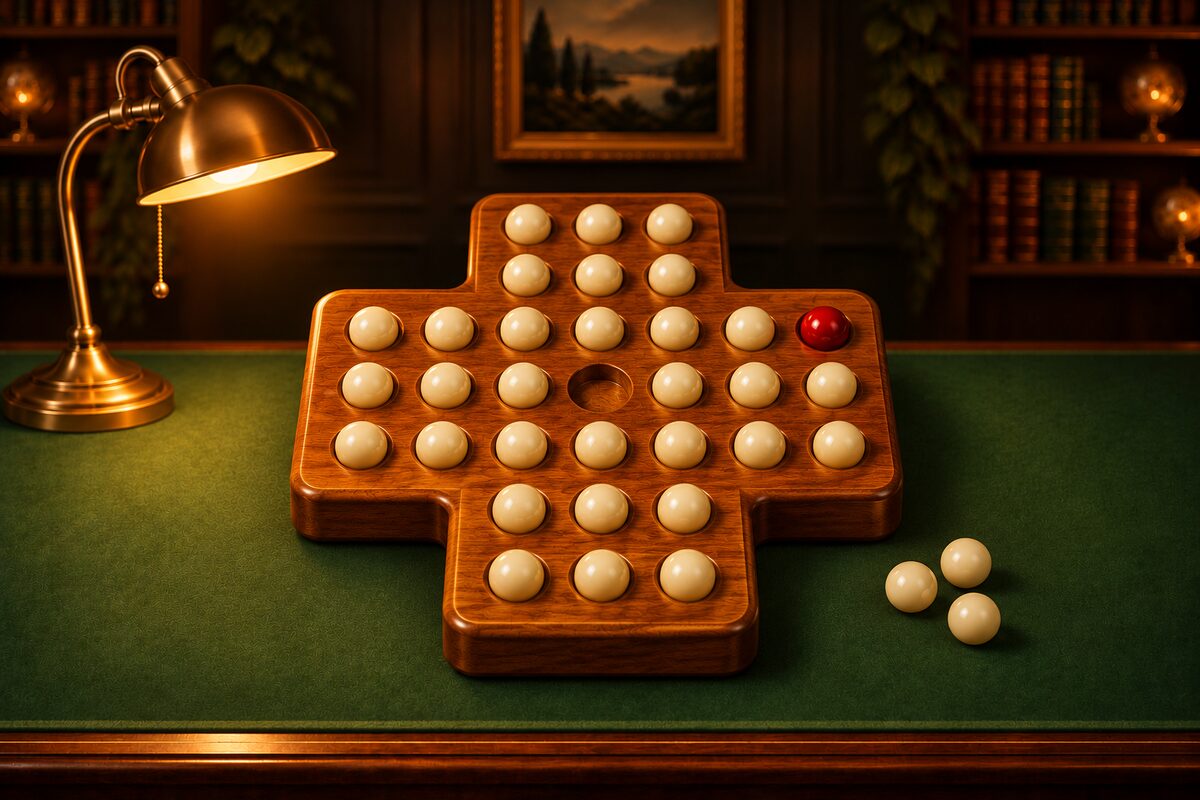
Peg solitaire is a puzzle with just one rule. It uses no reading or math, so you can play it together with kids. But even adults have a hard time getting down to one peg on the English 33-hole board. If you’re playing with kids, we recommend starting with a small board with few pegs.
How to Explain the Rules
Start by telling them just these three things.
- A peg moves by hopping over the neighboring peg into the empty hole on the other side.
- The peg that was hopped over is taken.
- You can only jump up, down, left, or right. No diagonals.
It’s easier to get across if you use a comparison, such as “a frog hops over the next frog.”
Start with a Small Board
Don’t set up all 32 pegs right away. Get used to jumping and capturing on a board with 3 or 4 pegs.
First, 3 Pegs
You can get down to one peg in 2 moves. Think together about which peg to move first. The answer is that b2 jumps over c2 and lands on d2, and then the same peg jumps over d3 and lands on d4. If you move a different peg first, two pegs are left.
Next, 8 Pegs
The board below is a practice problem where you leave the red boss ball as the last peg. It has 8 pegs and can be solved in 7 moves.
If you get stuck, you can go back with Undo. The answer is in Tips for Leaving the Boss Ball Last.
Ways to Play Together as Parent and Child
- Take turns, one move each: An adult and a child alternate making one move each, and the two of you solve one board together. Talking it over as you go is good practice for thinking ahead.
- Record how many are left: It’s fine if you can’t get down to one at first. Write down “Today, 3 left,” and enjoy bringing the number down little by little.
- Don’t rush to the right answer: Rather than telling the answer as an adult, try asking, “If you move that peg, what happens next?”
The Order for Moving to Bigger Boards
- A small board with 3 to 8 pegs (the boards on this page)
- The 15-hole triangle (14 pegs, Solving the Triangle)
- ★1 Easy in the app’s “Puzzles” (6 to 9 pegs), then on to ★2 and ★3 (the difficulty article)
- The English 33-hole board (32 pegs, How to Solve It)
In the Peg Solitaire app’s “Puzzles,” a board with a different shape is made every time, and every one can be solved. When you’re stuck, Hint makes the next move glow, which is a big help when a child plays alone.
Things to Watch For
- When you play with a wooden board or marbles, take care that small children don’t put the pegs in their mouths.
- When you play on a phone or tablet, it’s reassuring to decide on a playing time in advance.
How to make a board by hand is covered in the article on making one.