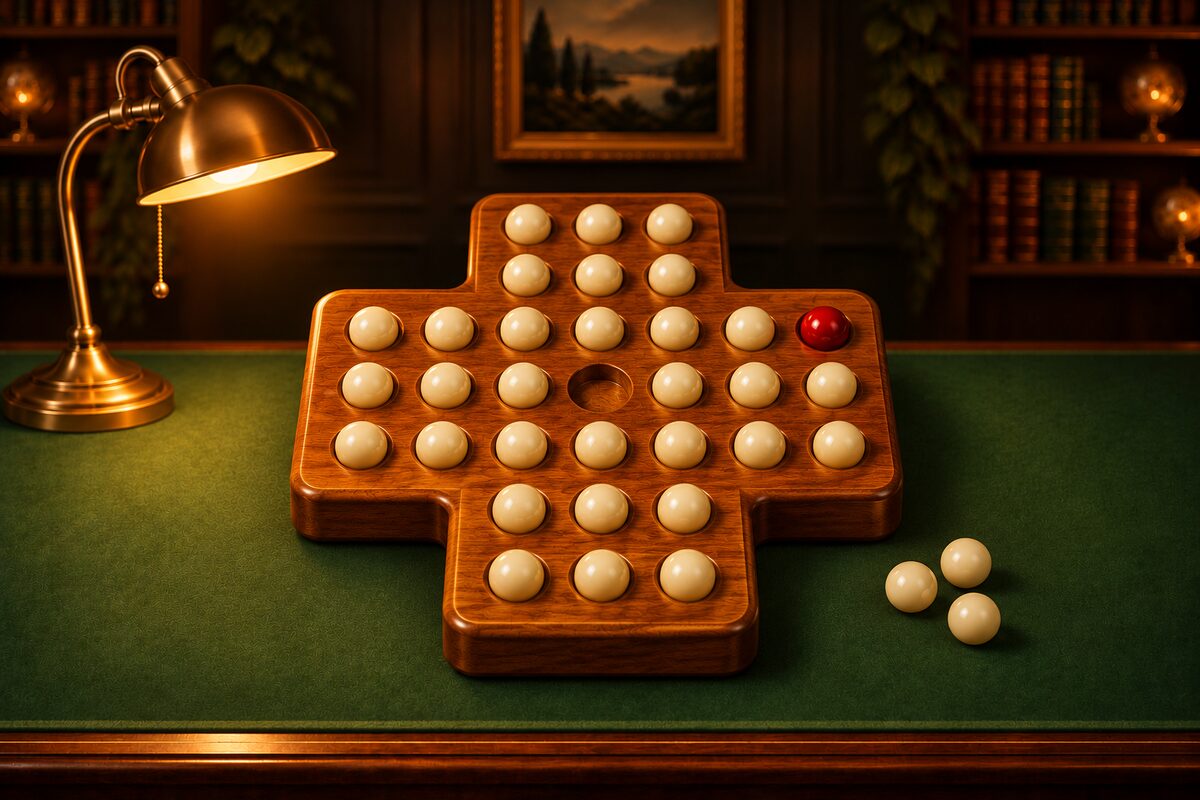
Peg solitaire is a puzzle where, in the last few moves, you often think “I was so close to one.” Here we use the most commonly played board, the English 33-hole board, as an example to introduce tips for getting down to one peg. The hole names (columns a to g, rows 1 to 7) are the same as in the solving article.
Tip 1: Pegs in the Arm-Tip Corners Have to Move Themselves
Look at the 8 holes (the gold rings) at the two outer edges of the tips of the cross’s four arms.
Pegs in these 8 holes can’t be jumped by other pegs. For example, to jump over the peg on c1, there would need to be holes lined up on both sides of c1, but b1 to the left and the space above are off the board. Looking vertically too, there is no hole above c1.
In other words, a corner peg has no choice but to jump out on its own. The peg on c1 can only jump over c2 to c3, or over d1 to e1. For that, a peg has to still be on the neighboring c2 or d1, with the hole beyond it empty.
- Move the corner pegs early, while the neighboring pegs are still there.
- If two corner pegs are left at the end, they can no longer be captured (see the example below).
Tip 2: One Move Can Mean 1 Peg Left or 4
This is the board right after move 24 of the answer in the solving article. There are 8 pegs left.
You have 5 possible moves here. For each one, we checked every possible continuation to find how many pegs are left when you play as well as possible afterward.
| Move 25 | Pegs left at best |
|---|---|
| d5→f5 | 1 |
| e5→c5 | 2 |
| e6→c6 | 2 |
| e5→e3 | 3 |
| d6→d4 | 4 |
Only d5→f5 gets you down to one. For example, if you choose e5→c5, two pegs are left even if you play as well as you can afterward. Below is one example of that continuation, which ends with two corner pegs, c7 and e7, left.
- Move 25 e5→c5
- Move 26 d7→d5
- Move 27 e7→e5
- Move 28 e4→e6
- Move 29 c5→e5
- Move 30 e5→e7
- After move 30 Pegs left: 2
The corner pegs c7 and e7 can’t be jumped, so if they are left apart, they can’t be moved. As Tip 1 says, you can see how important it is to clear the corner pegs first.
Tip 3: Don’t Isolate Pegs
A peg left all alone, with no pegs around it, can neither jump nor be jumped. You can’t capture it unless you go out of your way to bring other pegs close.
- Remove pegs while keeping them in clusters. Moves that jump a single peg toward the edge of the board often cause trouble later.
- After you jump, check “Is there still a peg next to this one?” before you choose the next move.
- In the table above, d6→d4 is a move that leaves 4 pegs even when played as well as possible. In that continuation, one peg is left apart at g4 in the right arm.
Tip 4: Use Shapes as Landmarks, and Go Back to Check
In peg solitaire, it’s easy to notice a mistake late. As in the example above, you can already be on a board that can’t be reduced to one when 8 pegs are left.
- Use shapes along the way as landmarks: When you memorize the answer, remember the shape at the end of each stage (in the solving article, the shapes with 24, 16, and 8 pegs left), and you’ll notice sooner when you’ve drifted off.
- Go back and try a different move: Undo in the Peg Solitaire app lets you go back as many moves as you like. When you’re stuck, go back a few moves and try a different move.
- Check with Hint: Hint in the app makes the next move glow. If the board can no longer reach the goal, it tells you how many moves to go back.
In Puzzles Mode, Watch the Boss Ball
In the app’s “Puzzles” mode, any peg won’t do: you clear the board when the colored boss ball is the last peg left. If the boss ball is jumped, the game is over right there (you can go back with “Undo”).
- When a peg is next to the boss ball and the hole on the opposite side of the boss ball is empty, the boss ball can be captured. Before choosing a move, check around the boss ball.
- The board has a different shape every time, but every one of them is built so that it can always be solved.
The rules of the two modes are in How to Play, and the ideas for protecting the boss ball are in Tips for Leaving the Boss Ball Last.
What to Read Next
- A shape that clears the 6 pegs of an arm at once: How to Clear an Arm
- How to go back from being stuck: How to Undo When You’re Stuck
- Endgame practice: the endgame practice problems