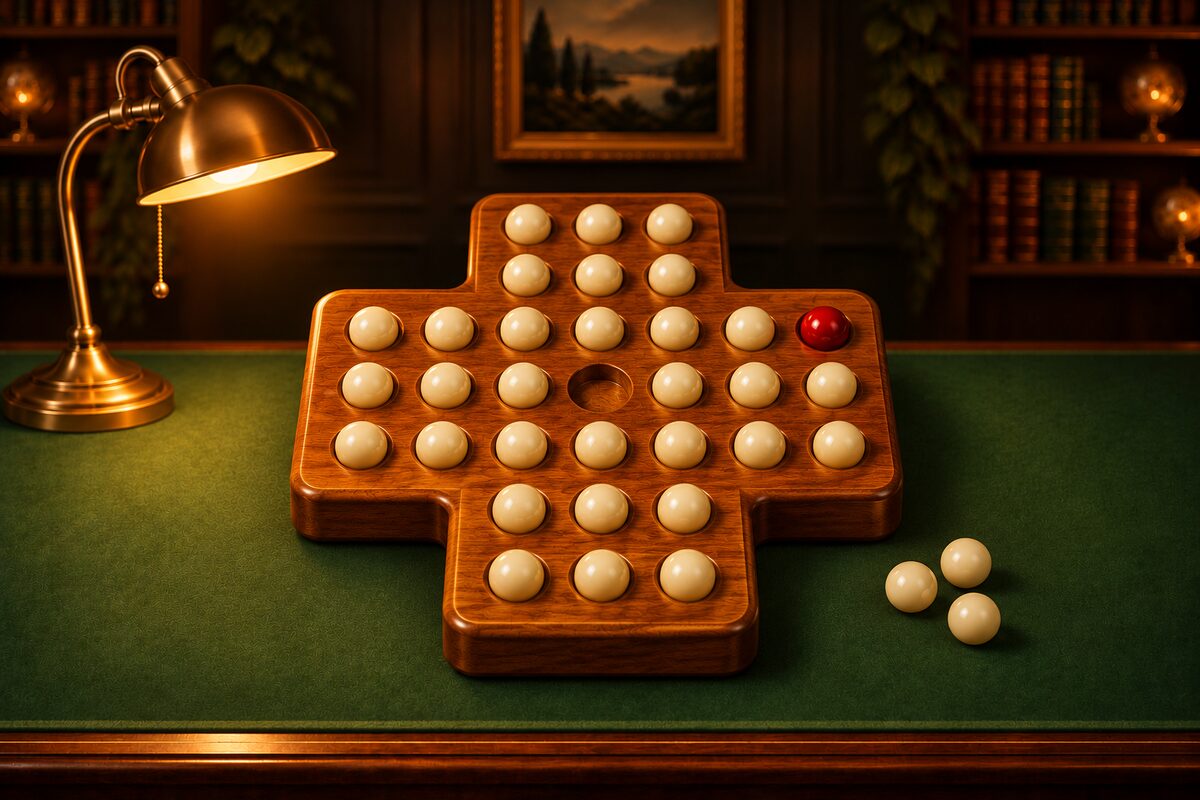
All you need to play peg solitaire is a board with holes and some pegs. Even without a wooden board, you can make one from things you have at home, such as cardboard or paper and marbles.
What You’ll Need
- Board: Cardboard or thick paper. Just drawing on paper is fine too.
- Pegs: 32 marbles (14 for the 15-hole triangle). Game counters, Go stones, buttons, and small rolled-up balls of paper also work.
- Drawing tools: A ruler and a pen.
- If you want to make dents: A tool for making holes (for an adult to use).
Laying Out the English 33-Hole Board
Draw a 7×7 grid and cross out the 2×2 squares (4 squares each) at the four corners, and you get the cross shape of the English 33-hole board.
- On thick paper, draw a 7×7 grid. Make each square a little larger than the diameter of the pegs you’ll use.
- Mark an × on the 2×2 squares at the four corners so they’re not used. That leaves 33 squares.
- Draw a circle in the middle of each square, or make a dent. This makes the pegs less likely to roll.
- Leave just the center square empty and put pegs on the other 32 squares, and it’s done.
Laying Out the Triangular 15-Hole Board
If you want to make a smaller one, we recommend the triangular board. Draw circles in rows of 1, 2, 3, 4, and 5 from the top, staggering each row.
- If you shift the circles outward by half a space for each lower row, you get a neat triangle.
- On the triangular board, you can jump in six directions: horizontally and along two diagonals.
- Leave the top one empty and start with 14 pegs.
Examples of Making the Dents
- Cardboard board: If you cut out just the top paper layer in circles, you get shallow dents.
- Egg carton: If you cut up egg cartons and join them, you get a board with dents. Arrange them so the squares line up in rows and columns.
- Paper board: Just drawing circles is enough to play. If marbles roll around, use flat pegs such as buttons or Go stones.
Cautions When Making It
- An adult should handle blades such as cutters.
- Take care that small children don’t put marbles or other small pieces in their mouths.
- If the rows of squares are crooked, it’s hard to tell which pegs are lined up in a row or column. Draw them straight with a ruler.
Playing on Your Board
- The rules: You move a peg up, down, left, or right, jumping over a neighboring peg into the empty hole right behind it, and you remove the peg you jumped over (the rules article).
- Make it possible to undo: A handmade board doesn’t have “Undo.” If you line up the pegs you’ve captured in order, it’s easier to see what to put back when you want to go back.
- Play with the answer in view: The English answer is in the solving article, and the triangle’s answer is in the article about solving the triangle. If you write the hole names (columns a to g, rows 1 to 7) along the edge of the board, it’s easier to follow the moves.
If you want to play right away, there is also a page you can play in your browser.