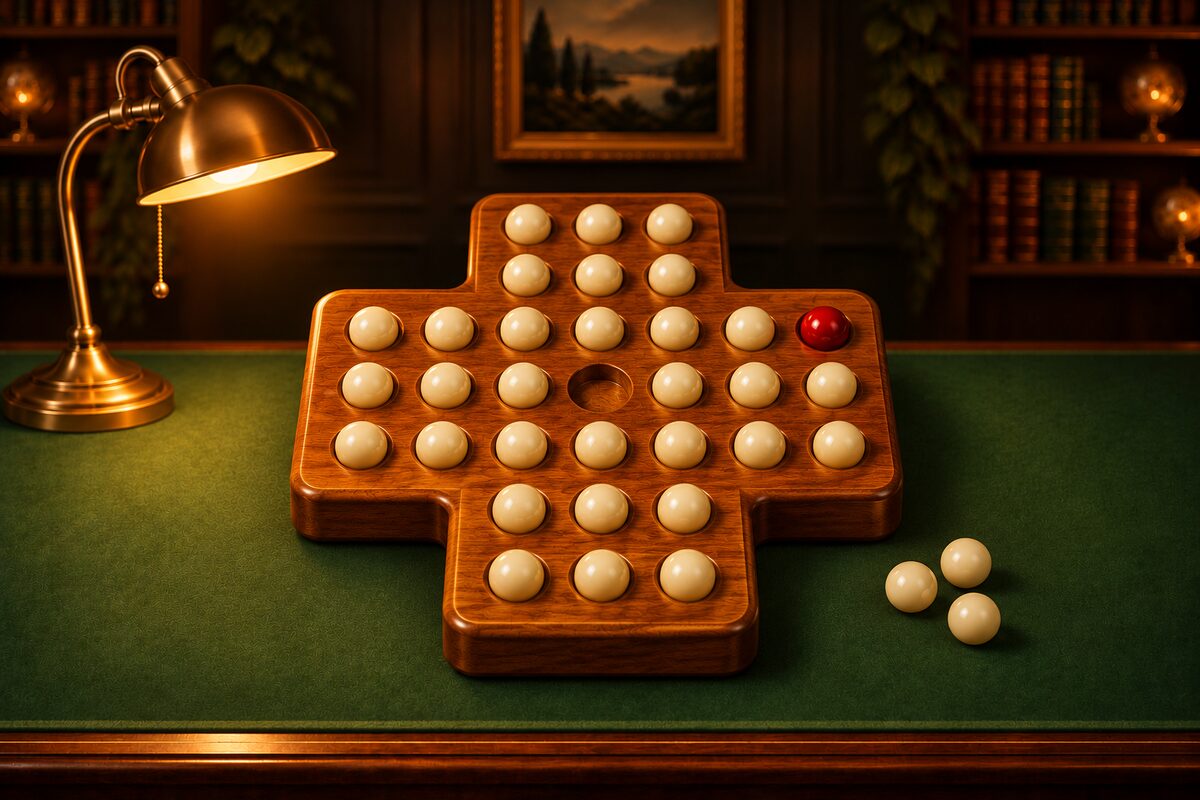
Peg solitaire is a puzzle that people often say “sounds like good brain training.” This article looks at the kinds of thinking you use while you play.
First, a disclaimer: we can’t promise any effect, such as better memory or judgment, or protection against dementia. The Peg Solitaire app is a game for enjoyment, and it is not meant for testing or treatment. If you are worried about your physical or mental health, please talk to a doctor or another professional.
Ways of Thinking You Use While Playing
Thinking a few moves ahead
As you play, you ask yourself, “If I jump this peg, which peg can jump next?” and “Which peg will end up all alone?” You picture the board not just one move ahead, but two or three.
Working backward from the goal
To end with one peg, the last move has to be a case where one of two neighboring pegs jumps over the other. From there you go back one move at a time, asking, “What did the board need to look like before this to make that shape?” (Leaving the Last Peg in the Center).
Remembering shapes
As you get better, you start to remember common shapes as a whole, such as “this shape clears in 6 moves” (How to Clear an Arm). That lets you move much faster than thinking one move at a time.
Going back from a mistake to try again
When pegs are left over, you look for where you went wrong, go back, and try again. Finding the cause, such as “That move left the corner peg stranded,” is part of the fun (How to Undo When You’re Stuck).
What Makes It Easy to Keep Playing
- Only one rule: There is little to learn, so you can start right away.
- Alone, at your own pace: With no opponent, you can think as long as you like or stop partway through.
- No time limit: The Peg Solitaire app has no time limit.
- From small boards to big ones: Puzzles in the app run from ★1 (6 to 9 pegs) to ★5 (27 to 32 pegs), so you can raise the difficulty bit by bit (the difficulty article).
Tips for Enjoying It
- Don’t look at the answer right away: Think for yourself first, and if you get stuck, use Hint or read the answer articles.
- Keep it short: On a small board, a game takes only a few minutes. You can fit in one game during a break.
- Rest when you’re tired: If your eyes get tired or the puzzle starts to feel too hard, don’t push yourself. Take a break.
The most important thing about peg solitaire is that you find it fun. If you’re new, start with the rules article and the page about where to play.