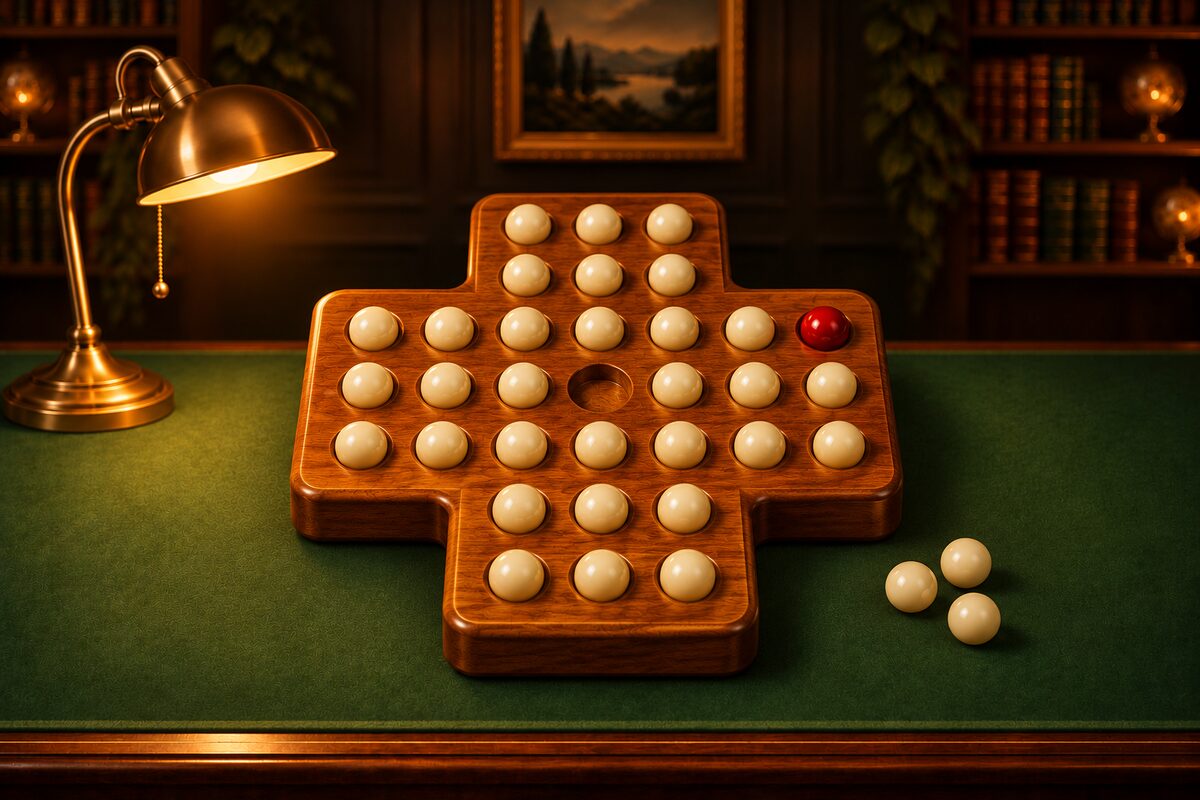
In Puzzles mode of the Peg Solitaire app, you leave the red boss ball as the last peg on a board with a different shape every time. You can choose from five difficulty levels, ★1 to ★5.
Pegs and Board by Difficulty
| Difficulty | Pegs | Board | Coins |
|---|---|---|---|
| ★1 Easy | 6 to 9 | 5×5 | 15 |
| ★2 Normal | 10 to 14 | 6×6 | 25 |
| ★3 Hard | 15 to 20 | 7×7 | 40 |
| ★4 Master | 21 to 26 | 8×8 | 60 |
| ★5 Grandmaster | 27 to 32 | 8×8 | 80 |
- The board is the size of the grid used when a puzzle is made. The holes are arranged inside it in a different shape each time.
- Coins is the number you get for clearing a board. The harder it is, the more you get. Even for a game you didn’t clear, you get 5 coins if you made at least 4 moves.
- The number of moves is one less than the number of pegs. At ★1 you clear it in 5 to 8 moves, and at ★5 in 26 to 31 moves.
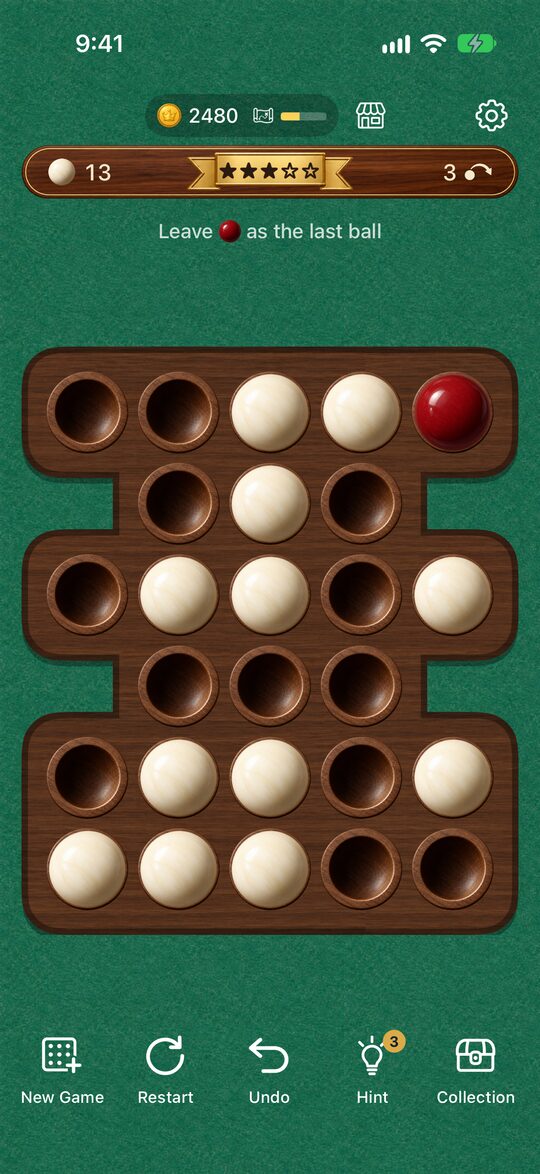
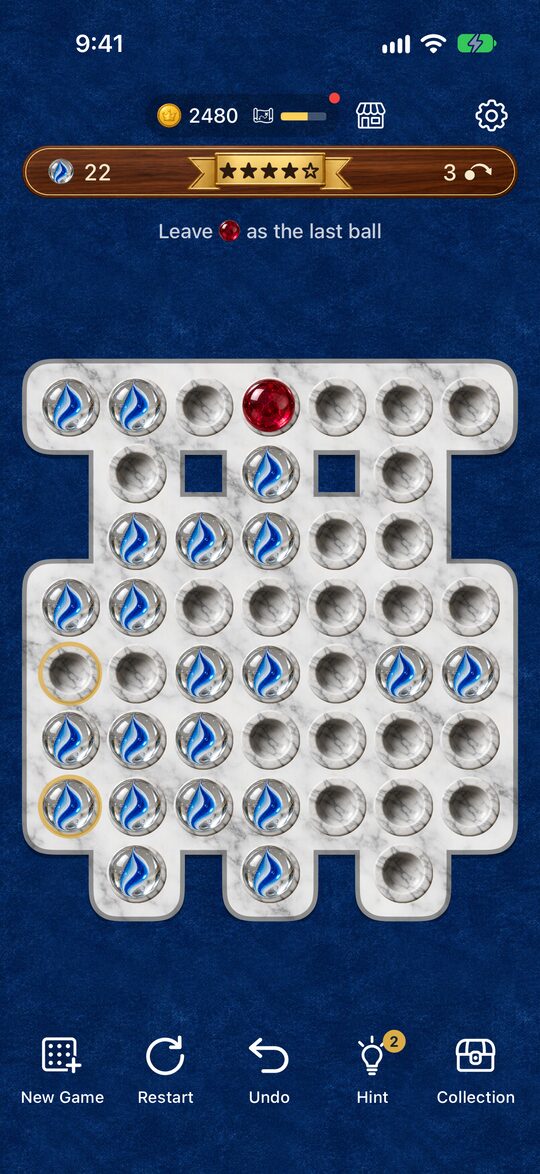
Difficulty Is Set by “Trap Moves”
Difficulty isn’t set by the number of pegs alone. Each time it makes a puzzle, the app checks how many of the moves you can choose along the solution path are moves that make it impossible to save the boss ball once you play them (trap moves).
| Difficulty | Share of trap moves |
|---|---|
| ★1 Easy | Up to 42% |
| ★2 Normal | 30% or more |
| ★3 Hard | 42% or more |
| ★4 Master | 50% or more |
| ★5 Grandmaster | 55% or more |
The app rebuilds the puzzle until the share of trap moves falls in that range (up to 24 times; if it never does, it uses the closest puzzle). At ★5 Grandmaster, more than half of the moves you can choose along the way are traps. Step off the right path, and you can no longer save the boss ball.
The idea of trap moves is also covered in How Many Solutions Are There?.
Choosing in Settings
You choose difficulty with “Mode” at the very top of Settings. When you choose “Puzzles,” five buttons from ★1 to ★5 appear below it. Each button shows the number of stars, the number of pegs, and the coins you get for clearing.
- If you haven’t made a move yet, or after a game has ended, closing Settings gives you a board at the new difficulty right away.
- If you change it in the middle of a game, you can choose “Switch Now” or “From Next Game.”
- Puzzles are prepared in advance a few at a time for each difficulty, so you can start without waiting even after changing the difficulty.
Recommendations for First-Timers
- ★1 Easy: With only 6 to 9 pegs, this is a good board for getting used to jumping and capturing.
- ★2 and ★3: There are more pegs, and more trap moves. If you read the tips before you try them, you’ll pick up the idea of protecting the boss ball.
- ★4 and ★5: These are big 8×8 boards. When you’re stuck, use Hint to check the next move. If the board can no longer reach the goal, it tells you how many moves to go back.
The Classic English 33-Hole Board Is a Separate Mode
The English 33-hole board that people have played for ages is in “Classic,” a mode separate from difficulty levels. You clear it if one peg is left in any hole, and the coins for clearing are 30 for the first clear of the day and 5 from the second clear on the same day. It’s the same board every time, so once you remember the answer you can clear it again and again. The answer is in the solving article.