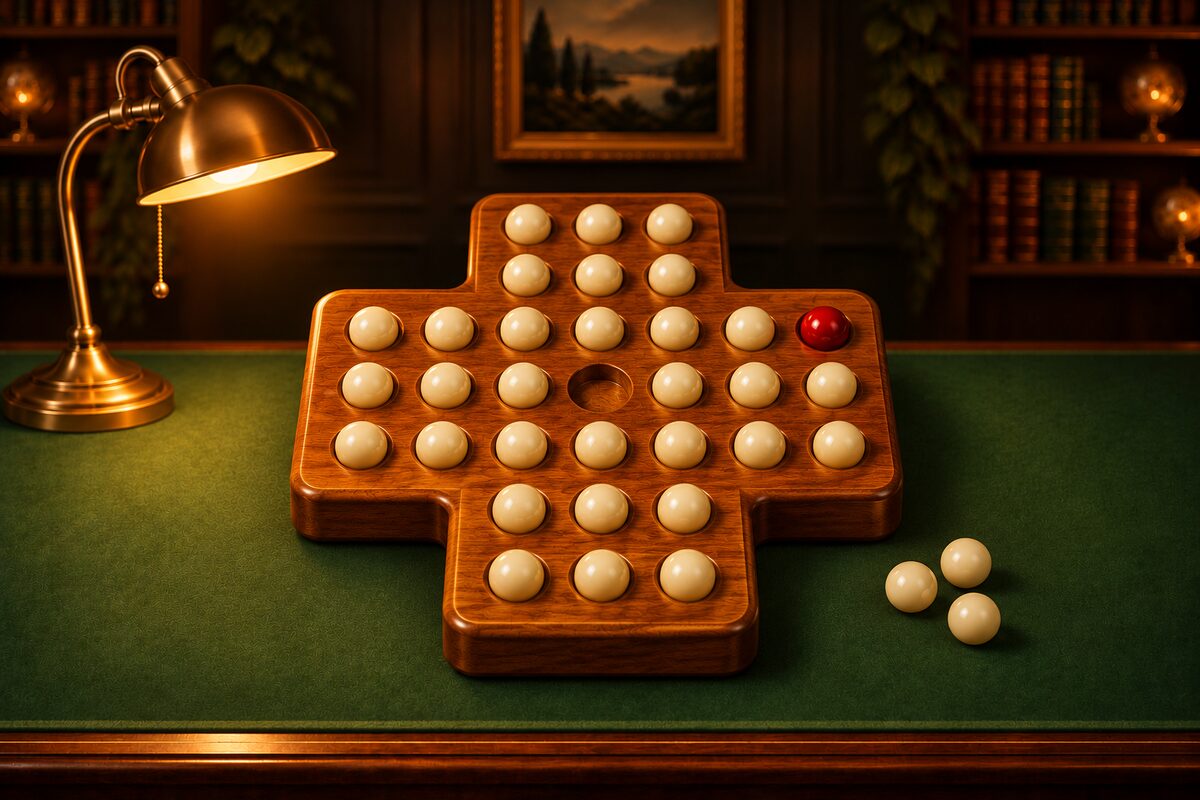
In Puzzles mode of the Peg Solitaire app, there is exactly one colored boss ball on the board. Any peg won’t do: you clear the board when the boss ball is the last peg left.
- If the boss ball is jumped over and captured, the game is over right there. You can take it back with Undo.
- The board changes shape every time you tap New Game, but every one of them is built so that it can always be solved (How We Make Puzzles That Can Always Be Solved).
In the board diagrams in this article, the boss ball is drawn as a red peg. Holes are named by column and row: columns are a, b, c… from the left, and rows are 1, 2, 3… from the top.
The Final Jump Is Always Made by the Boss Ball
Think about the moment when two pegs are left. On the last move, one peg jumps over the other, and what remains is the peg that jumped.
So to leave the boss ball last, the boss ball has to make the final jump. As the end approaches, plan to leave a peg next to the boss ball for it to jump over.
The Boss Ball Keeps the Same Row and Column Parity
Each time the boss ball jumps, it moves two holes, up, down, left, or right. It never moves just one. So for the hole the boss ball is on,
- whether its row number is even or odd
- whether its column number is even or odd
never changes, no matter how many times it jumps. For example, a boss ball on row 2, column 2 (b2) can only reach holes in even rows and even columns. The hole where it ends up is one of those.
This narrows down the possible goal holes, which makes it easier to decide early on where the boss ball should finish.
Shapes That Put the Boss Ball at Risk
If a peg is next to the boss ball and the hole on the other side of the boss ball is empty, that neighboring peg can jump over the boss ball. If you make that move carelessly, the boss ball is captured.
In the diagram above, the peg on c3 can jump over the boss ball (b3) into the empty hole a3. If you make that move, the boss ball is captured and the game is over.
- Before you pick a move, make a habit of checking above, below, left, and right of the boss ball.
- When a hole next to the boss ball becomes empty, check whether a peg on the opposite side could now jump it.
Try It on a Practice Board
This is the “Boss ball practice (8 pegs)” board from the page about where to play. The boss ball is on b3.
Here is the 7-move answer that leaves the boss ball. We checked the moves by playing them one at a time.
- Move 1 a2→c2
- Move 2 c3→c1
- Move 3 e3→c3
- Move 4 e4→c4
- Move 5 c4→c2
- Move 6 c1→c3
- Move 7 b3→d3
- After move 7 Pegs left: 1
- Moves 1 to 6 clear away the pegs around the boss ball while setting up the peg next to it (c3) and the empty hole beyond it (d3).
- On the final move 7, the boss ball jumps over c3 into d3, and only the boss ball remains.
- The boss ball goes from b3 (row 3, column 2) to d3 (row 3, column 4). The row stays odd, and the column stays even.
This board has 19 different solutions. Of the 6 moves you can make first, 4 leave a way to win, and the other 2 are trap moves that make it impossible to save the boss ball the moment you play them (How Many Solutions Are There?).
Try It Yourself
When You Get Stuck
- Undo: You can undo as many moves as you like, even after the boss ball has been captured.
- Hint: The next move glows. If the board is in a position where the boss ball can no longer be saved, it tells you how many moves to go back, as in “Go back 3 to save the boss ball” (How to Use Hint).
In the shop, you can change the boss ball into a prettier one, such as glass or a gemstone, with the “Boss Ball” items. Only the look changes, and the rules stay the same.