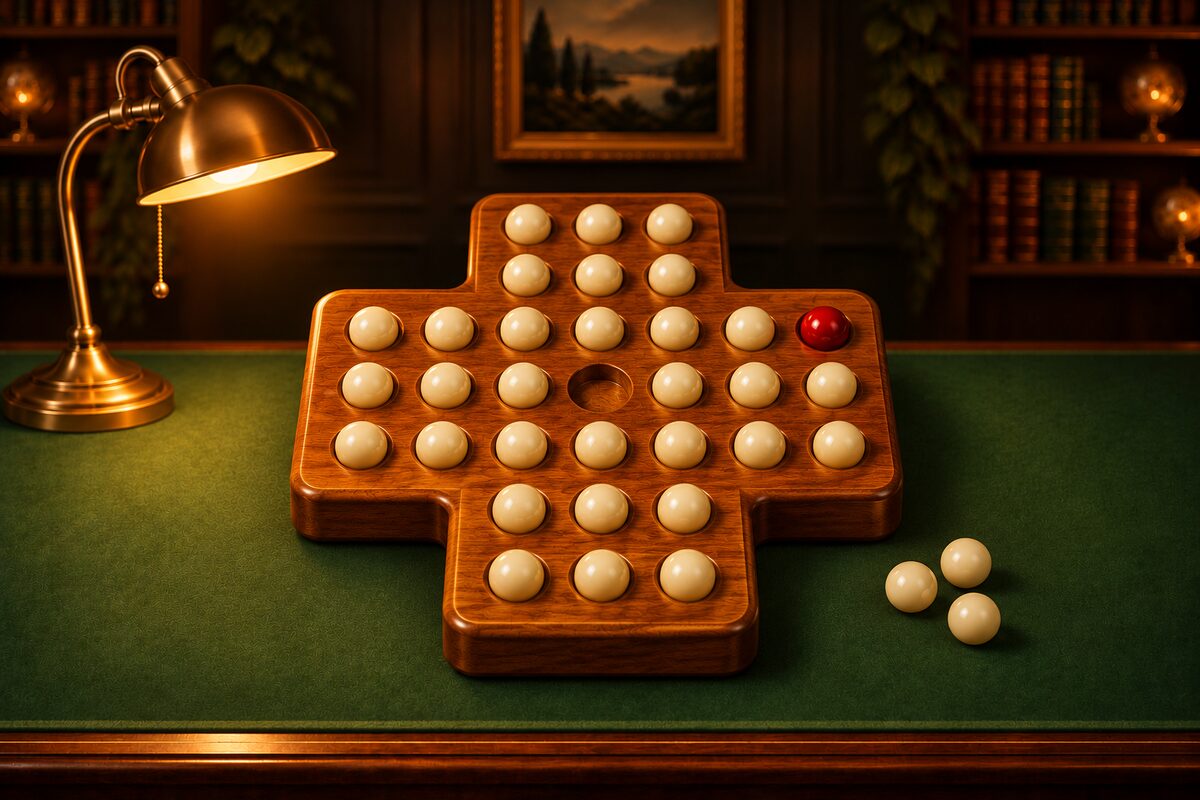
On English 33-hole peg solitaire, if you start with the center empty, the last peg can end in only 5 holes (the article on leaving the last peg in the center). No matter how well you play, it can’t end in the other 28 holes.
Why can we say that so firmly? This article explains the reason by coloring the board in three diagonal colors.
Coloring the Board in Three Diagonal Colors
Color the holes in three colors, red, blue, and gold, in diagonal bands that run from upper right to lower left. Moving from the upper left toward the lower right, the band colors repeat: red, blue, gold, red, blue, gold…
The color of the rim of each hole is the color it’s painted. If you look at any three holes in a row, horizontally or vertically, there is always one red, one blue, and one gold.
Each Move Changes the Count of All 3 Colors by One
One move in peg solitaire uses three holes in a row, horizontally or vertically (the peg that moves, the peg it jumps over, and the hole it lands in). Those three holes are exactly one of each of the three colors.
When you make a move,
- the color of the peg that moves: goes down by one
- the color of the peg that is jumped over: goes down by one (it’s captured)
- the color of the hole it lands in: goes up by one
For every color, the number of pegs either goes up by one or goes down by one. In other words, with each move, the odd/even parity of the peg counts of all three colors flips.
What Doesn’t Change
The parities of the three colors flip together, all at once, with each move. So the “combination of parities of the three colors” can only be
- the same combination as at the start, or
- the combination with all three of the starting ones flipped.
If you start the English 33-hole board with the center empty, the peg counts are 10 red, 11 blue, and 11 gold (the center, d4, is a red hole). Written as even and odd,
| When | Red | Blue | Gold |
|---|---|---|---|
| Start | Even | Odd | Odd |
| Flipped | Odd | Even | Even |
No matter how far you play, the board is always in one of these two combinations.
The Last Peg Can Only End in a Red Hole
When just one peg is left at the end, only that peg’s color has 1 peg (odd), and the other two colors have 0 (even).
- If it ends in a red hole, it’s “odd, even, even,” the same as the second row of the table. It’s possible.
- If it ends in a blue or gold hole, it’s “even, odd, even” or “even, even, odd,” which matches neither row of the table. It’s impossible.
So the last peg can only end in a red hole.
The Same Goes for the Opposite Diagonal
Think about the same thing with three colors painted in diagonal bands in the opposite direction (bands running from upper left to lower right).
Here too the center, d4, is a red hole, and for the same reason, the last peg can only end in a red hole.
The holes that are red in both colorings are only these 5.
The center, d4, and the middle holes at the tips of the arms: d1, a4, g4, and d7. These are the 5 holes where the last peg can end. We confirmed with a solution-finding program that all 5 can really be reached.
Why the French 37-Hole Board Can’t Be Solved
It is known that the French 37-hole board, made by adding 4 holes at the inner corners of the English board, can’t be reduced to one peg no matter what you do if you start with the center empty. The same coloring shows this too.
The 36 pegs with the center empty are 12 red, 12 blue, and 12 gold. All three colors are even. As you play, it becomes either “even, even, even” or “odd, odd, odd.”
But a board with just one peg left is, for any hole, “only one color odd, the other two even.” It matches neither, so the French board started from the center can’t be reduced to one.
If you start by emptying another hole, you can check it with the same calculation. On the French 37-hole board, for 21 of the 37 holes, the two diagonal colorings alone show that you can’t get down to one if you start by emptying that hole.
An Idea the App Uses Too
When Hint in the Peg Solitaire app searches for the next move, it uses this three-color coloring. A board where the peg can’t end in the goal hole no matter how you play can be recognized as “unsolvable” before reading ahead, so it doesn’t have to search any further.
Summary
- If you color the board in three diagonal colors, each move flips the odd/even parity of the peg counts of all three colors.
- So the holes where the last peg can end are decided by the starting board.
- If you start the English 33-hole board from the center, the last peg can end in only 5 holes: d4, d1, a4, g4, and d7.
- If you start the French 37-hole board from the center, you can’t get down to one.
However, a hole that the coloring says is “possible” can’t always really be reached. The coloring is a tool for finding what is impossible, and to know whether a hole can really be reached, you need to find the moves and check.