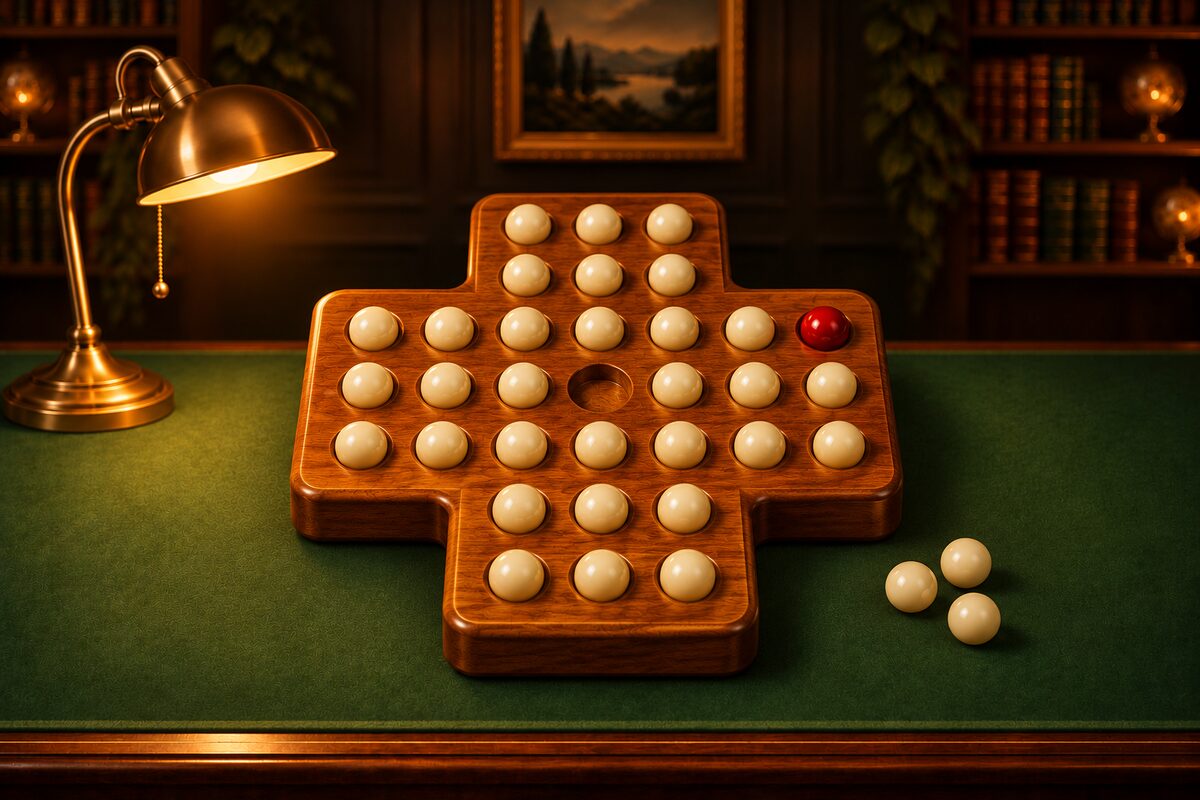
Here is a short summary of the rules of peg solitaire.
Move a peg up, down, left, or right, jumping over one neighboring peg into the empty hole right behind it. Remove the peg you jumped over from the board. You clear the board when you get down to one peg.
It’s a puzzle you play alone, with no opponent. The version played with a wooden board and marbles is also called “marble solitaire,” but the rules are the same.
Jump and Capture
In the diagram below, the peg on b2 jumps over the peg on c2 and lands on the empty d2. The peg on c2 that was jumped over (the red ×) is removed from the board.
To jump, all three of these must be true.
- There is a peg next to the peg you’re moving (up, down, left, or right).
- The hole right behind that peg is empty.
- The peg you’re moving, the peg you jump over, and the hole you land in are in a straight line, vertically or horizontally.
Each jump always removes exactly one peg.
How to Start
On the most commonly played English 33-hole board, you set up 32 pegs in the cross-shaped board of 33 holes, leaving only the center hole empty.
The only moves you can make first are the four jumps into the center, d4 (d2→d4, b4→d4, f4→d4, d6→d4).
Frequently Asked Questions
Can you jump diagonally?
On boards with square grids of holes, such as the English 33-hole board, you can’t jump diagonally. The Peg Solitaire app also allows only up, down, left, and right.
However, on the triangular board, where the holes are arranged in a triangle, it’s normal to jump in six directions: horizontally and along two diagonals (the app doesn’t have a triangular board).
Can you jump over two or more pegs at once?
No. You can only jump over one peg at a time. The hole you land in is always the one right behind the neighboring peg.
Can you move to a neighboring empty hole without jumping?
No. A peg can move only when it jumps over another peg.
Can the same peg jump again and again?
Yes. If, after landing, the peg is in a position to jump again, you can move the same peg on your next move. In the app, even chained jumps count as one move per jump.
What if there are several possible jumps?
You’re free to choose which peg to move. However many jumps are available, you can pick any one. But you can’t pass. As long as there is a jump available, you keep choosing one and jumping.
When does the game end?
It ends when no peg can jump anymore. If only one peg is left at that point, you clear the board. If two or more are left, they can’t move anymore.
In the app, when you’re stuck, it shows “No pegs can move.” You can go back as many moves as you like with “Undo,” so you can go back and try another move.
Does the last peg have to end in the center?
It depends on how you play. On the English 33-hole board, a well-known way to play is to aim to leave the last peg in the center. In the app’s “Classic (English 33 holes),” you clear the board if one peg is left in any hole.
The moves that leave it in the center are in the solving article.
How many moves does it take to clear?
On the English 33-hole board, the 32 pegs are removed one per move, so to leave one it takes exactly 31 moves. No matter how you play, if you clear it, it takes 31 moves.
What is the boss ball?
It’s the colored peg in the app’s “Puzzles” mode. Any peg won’t do: you clear the board when the boss ball is the last peg left. If the boss ball is jumped and captured, the game ends right there (you can go back with “Undo”).
What to Read Next
Once you know the rules, look at the tips for ways to think about getting down to one peg. To play right away in your browser, go to the page about where to play. The app’s screens and its two modes are covered in How to Play. For other questions, see the FAQ.