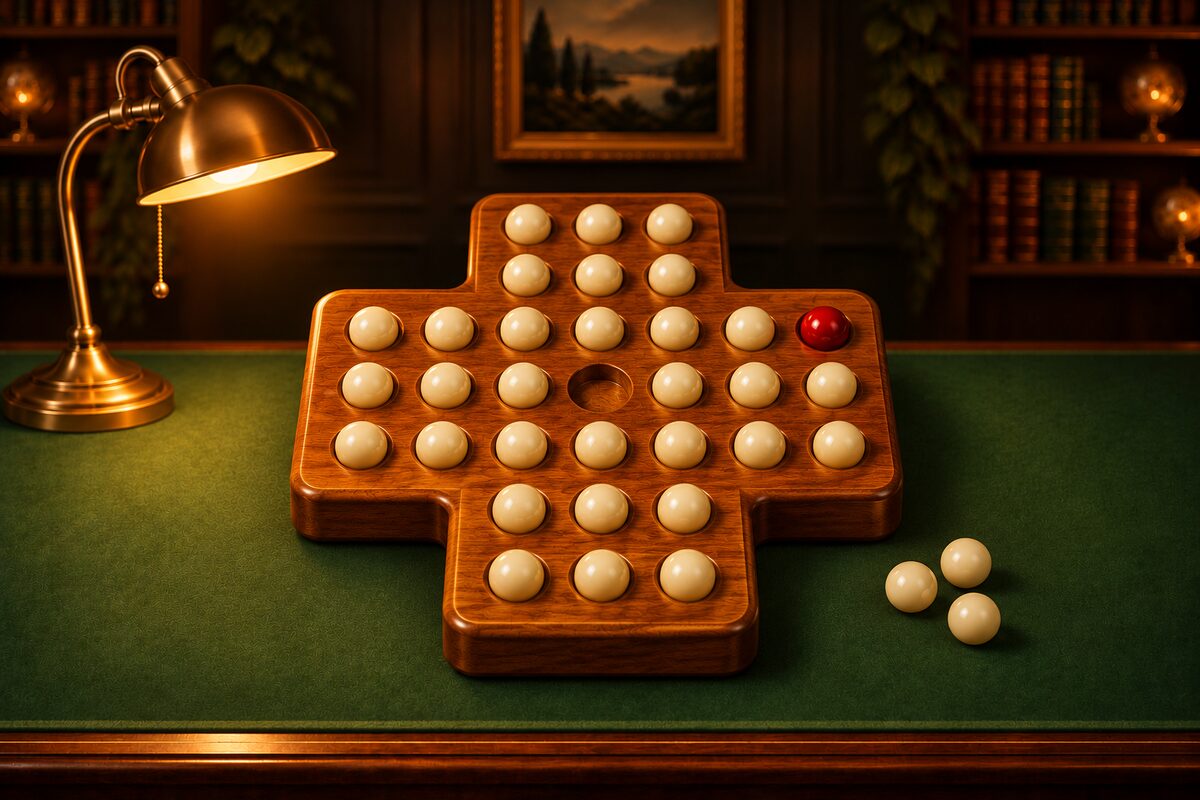
On the English 33-hole board, the long-standing goal is to start with the center hole empty and leave the last peg in the center. That is a step harder than just getting down to one peg.
In Classic (English 33 holes) in the Peg Solitaire app, you clear the board if one peg is left in any hole. Leaving it in the center is a way of playing that you set as your own challenge. The hole names (columns a to g, rows 1 to 7) are the same as in the solving article.
Only 5 Holes Can Hold the Last Peg
If you start with the center hole d4 empty, the last peg can end up in only these 5 holes (the gold rings).
- The center, d4
- The middle hole at the tip of each of the four arms: d1, a4, g4, and d7
No matter how you play, the last peg can’t end up in any of the other 28 holes. If you color the board in three diagonal colors and track how the peg counts change, you can see that nothing other than these 5 holes is possible (for the idea, see the three-color coloring article). We confirmed with a program that searches for solutions that all 5 holes can really be reached.
So the last peg of a board you get down to one is always in one of these 5 places. Even if you couldn’t leave it in the center, it should be at the middle of the tip of one of the arms.
The Shape of the Final Move
To finish in the center, d4, the last move is a peg jumping over a peg next to the center from outside and landing in d4.
There are four versions of this shape: from above, left, right, and below (d2→d4, b4→d4, f4→d4, d6→d4). It helps to play the last few moves so that you leave one peg next to the center and one peg just outside it.
The Answer That Ends in the Center
The 31-move answer that ends in the center is shown move by move, with diagrams, in the solving article.
The Answer That Ends at the Top (d1)
Here is a 31-move answer that ends not in the center but at d1, the tip of the top arm. We found it with a program that searches for solutions, and checked by playing each move that the last peg ends up on d1.
See the 31 moves that end on d1
- 1 d2→d4
- 2 b3→d3
- 3 c1→c3
- 4 e1→c1
- 5 d3→b3
- 6 a3→c3
- 7 f3→d3
- 8 d3→b3
- 9 a5→a3
- 10 a3→c3
- 11 c4→c2
- 12 c1→c3
- 13 b5→b3
- 14 b3→d3
- 15 d4→d2
- 16 d5→b5
- 17 e5→e3
- 18 e2→e4
- 19 f4→d4
- 20 g5→e5
- 21 g3→g5
- 22 c7→c5
- 23 b5→d5
- 24 d5→f5
- 25 g5→e5
- 26 d7→d5
- 27 d5→f5
- 28 e7→e5
- 29 f5→d5
- 30 d5→d3
- 31 d3→d1
If you rotate or flip the board, the same moves also give you ways to end on a4, g4, and d7.
Tips for Ending in the Center
- Think from the ending shape: If the last move is “d6→d4,” then just before it, there are pegs on d5 and d6. Trace the last few moves backward and decide on the shape you’re aiming for, and it becomes easier to choose the moves along the way.
- Don’t leave pegs in the arm corners: The pegs in the 8 holes at the two outer edges of the arm tips (such as c1) can’t be jumped by other pegs. Move them early (the tips article).
- Go back and try again: If you got down to one peg but not in the center, go back a few moves from the end and try a different order. The app’s Undo lets you go back as many moves as you like.