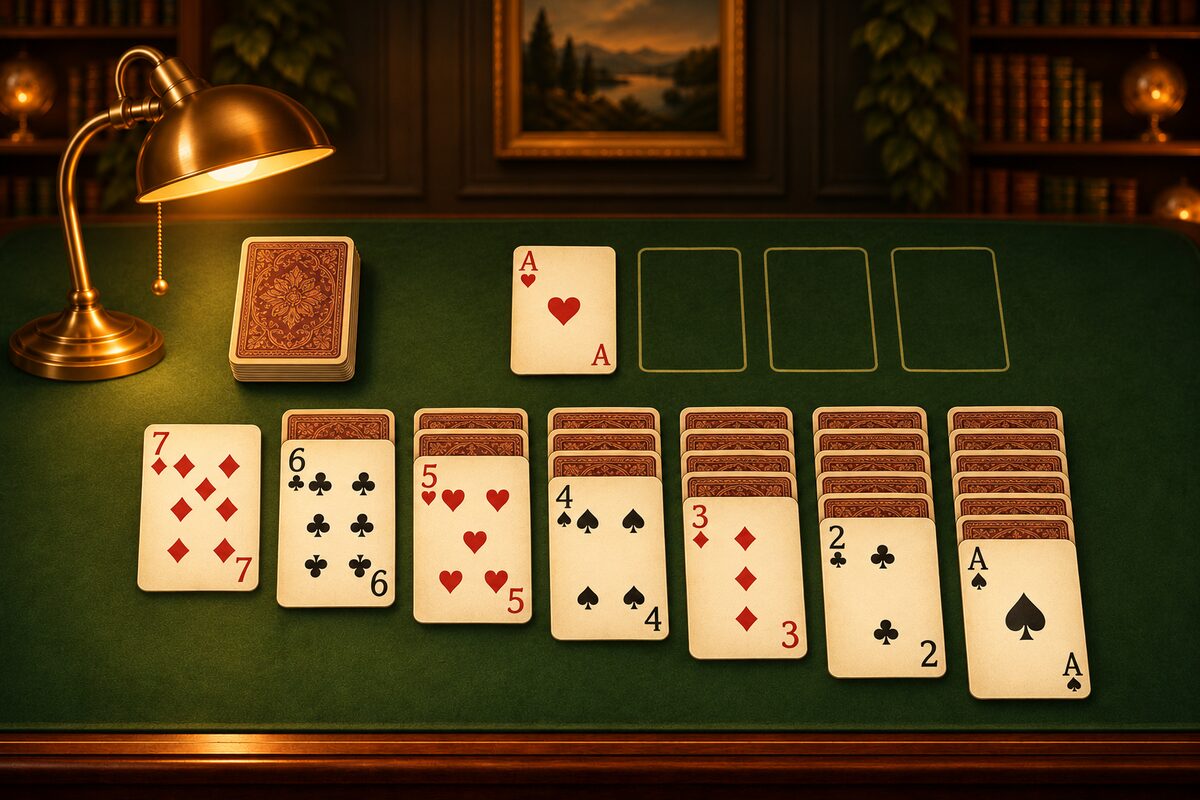
Here are short answers to common questions about Solitaire. Links to articles with more detail are included.
What is Solitaire?
It’s a game of laying out playing cards by yourself. The English word “solitaire” means a game for one person. In Japan, the name usually refers to the game where you break down seven columns of cards and build four foundations from A to K. The official name of that game is “Klondike” (What Is Solitaire?, What Is Klondike?).
Can you explain the rules simply?
In the tableau, stack cards in alternating red and black, going down one number at a time, and put only a K in an empty column. Turn over the stock and use it as you go, and you clear the game when you’ve built all four foundations by suit from A to K (Rules and How to Play, Common Questions About the Rules).
How do you set it up?
Deal seven columns of 1, 2, … 7 cards from the left, and turn over only the top card of each column. That’s 28 cards in all. The remaining 24 cards are the stock (Setup). For how to play with a real deck, see How to Play with a Real Deck.
Can I play for free?
The Solitaire app (iPhone, iPad, and Android) can be downloaded for free (ads are shown). On a computer, you can also play Microsoft Solitaire Collection on Windows (Where to Play, Solitaire on Windows).
What’s the difference between draw one and draw three?
It’s whether you turn the stock over one card at a time, or three at a time and use only the top one. Draw three is much harder. The Solitaire app draws one card at a time, and you can go through the stock as many times as you like (What Is Draw Three?).
Is there a guaranteed way to win?
There is no method that wins every deal, because ordinary Solitaire has deals that can’t be solved no matter what you do. Still, ideas like starting with the columns that have the most face-down cards and not emptying a column until you have a K to place will raise how often you win (Tips, Winning Strategies).
What is the win rate?
In research where a computer solved deals as if all the face-down cards were visible, it’s estimated that about 80% of deals have a solution. When people play, the rate is lower (Win Rates).
Are the deals in the app always solvable?
Yes. Every deal that comes up with “New game” in the Solitaire app has been checked by a computer to make sure it has a solution. Even if you get stuck partway, you can always find a way to clear the game by using “Undo” or “Restart” (How We Make Solvable Deals).
How can I tell if I’m stuck?
If no moves are left among the tableau columns, and going through the stock once brings up no usable card, you’re stuck. In the app, “Undo” takes you back as many times as you like, all the way to the start of the deal (When You’re Stuck).
What should I put in an empty column?
Only a K can go there. Choosing a K that sits on top of face-down cards, or one you can follow with a Q and a J, opens up the game (Empty Columns and Kings).
Should I move cards to the foundations right away?
Aces and 2s can go up right away. High-numbered cards can be useful in the tableau for catching other cards, so sometimes it’s better not to rush (When to Move Cards to the Foundations). In the app, you can also move the top card of a foundation back to the tableau.
What’s the fewest moves to clear a game?
It takes at least 76 moves: 52 to move the cards to the foundations, and 24 to turn over the stock (How Many Moves Does It Take to Clear?).
How many ways can the game be dealt?
As many as there are ways to arrange 52 cards, 52 factorial, roughly 8 × 10⁶⁷ (How Many Ways Can Solitaire Be Dealt?).
Can I play without an internet connection?
The Solitaire app doesn’t use the network to make solvable deals. An internet connection is needed for ads and for the bonuses you get by watching them.
Is Solitaire good brain training?
While you play, you use your head: telling colors and numbers apart, and thinking about the order of your moves. We can’t promise any benefit, though, and the app is not for testing or treatment (Is It Good Brain Training?).
Can kids play?
If they can put numbers in order and tell red from black, they can start playing with an adult (Solitaire with Kids).
What other kinds of Solitaire are there?
There are many, including Spider, FreeCell, Pyramid, Golf, and TriPeaks (Types of Solitaire, Card Games for One). For the history, see The History of Solitaire.