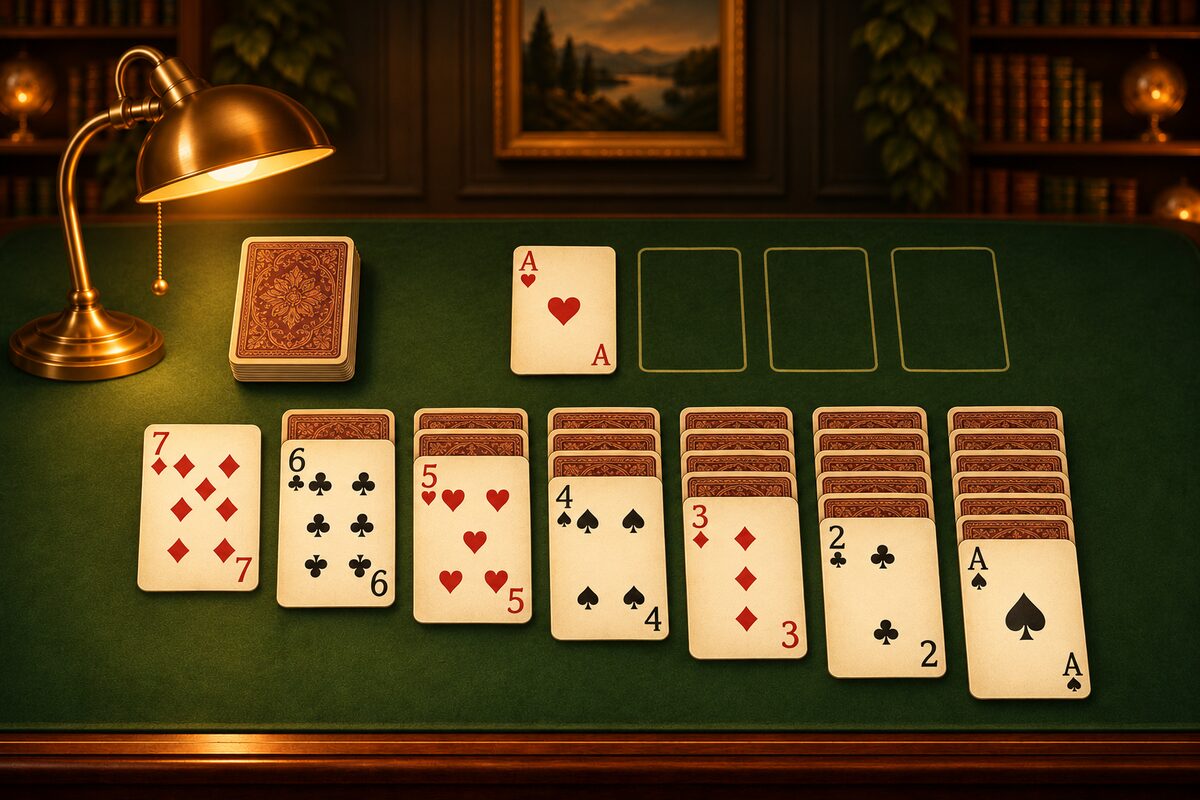
Many people look for a “winning method for Solitaire,” but unfortunately there is no method that wins every deal. In ordinary Solitaire, depending on the deal, some games can’t be solved however you move. Even so, how you choose your moves clearly changes how often you win. Here are some ways to think about strategy.
For easy tips for beginners, see Solitaire Tips.
Priorities for Choosing Moves
When you have several moves available, thinking in this order makes it easier not to get stuck.
- Move aces and 2s to the foundations: They have no use in the tableau, so move them up as soon as you find them.
- Moves that turn a face-down card face up: Cutting down the face-down cards in the tableau is the main goal.
- Moves that break down a column with many face-down cards: If there are several moves from step 2, choose the column with more face-down cards still in it.
- Moves that put a K in an empty column: Empty a column only when you have a K you can place.
- Turn over the stock: Rely on the stock after you’ve run out of moves among the tableau columns.
- Move other cards to the foundations: Do it once you no longer expect to need them as holders in the tableau.
Cards That Are Safe to Move to the Foundations
You hesitate to move a card up to a foundation because it might be a “holder” in the tableau. For example, a red 5 can be used to hold a black 4.
But what if both black 4s are already on the foundations? Then there are no more cards for the red 5 to hold that could appear in the tableau. In that case, there’s no harm in moving the red 5 up.
In the diagram above, both the 4 of spades and the 4 of clubs are on the foundations. Even if you left the 5 of hearts in the tableau, there is no black 4 for it to hold, so you can move it up without hesitating.
To sum up, a red card of number n is safe to move up if both black cards of number n−1 are on the foundations (for a black card, if both red cards of number n−1 are).
Two Cards of the Same Color: Which One You Use Makes a Difference
Cards of the same number and color come in pairs: the red 7s are the hearts and diamonds, and the black 8s are the spades and clubs. Which one you use changes what happens next.
- If you move the one in the column with more face-down cards, you keep the chance of turning more cards face up.
- Also look at how far the foundations have gone. If the hearts foundation is far along, you can move the 7 of hearts up and use the 7 of diamonds in the tableau.
Remember What’s in the Stock
The stock in the Solitaire app is draw one with unlimited passes. If you roughly remember what cards were in the stock on the first pass, you can look ahead: “If I move this in the tableau, I can use that stock card.”
Open Up the Hidden Cards Rather Than Planning Far Ahead
In Solitaire you can’t see the face-down cards, so you can’t plan many moves ahead. No matter how much you think, your plan changes depending on the next card to turn face up. When in doubt, the move that turns over even one more face-down card is usually the best shortcut.
If You Get Stuck
If you really run out of moves, one of your earlier choices may have backfired. How to tell, and how to start over, are covered in When You’re Stuck in Solitaire. Every deal in the Solitaire app is confirmed to have a solution, so if you go back and try again, there is always a way to clear the game.