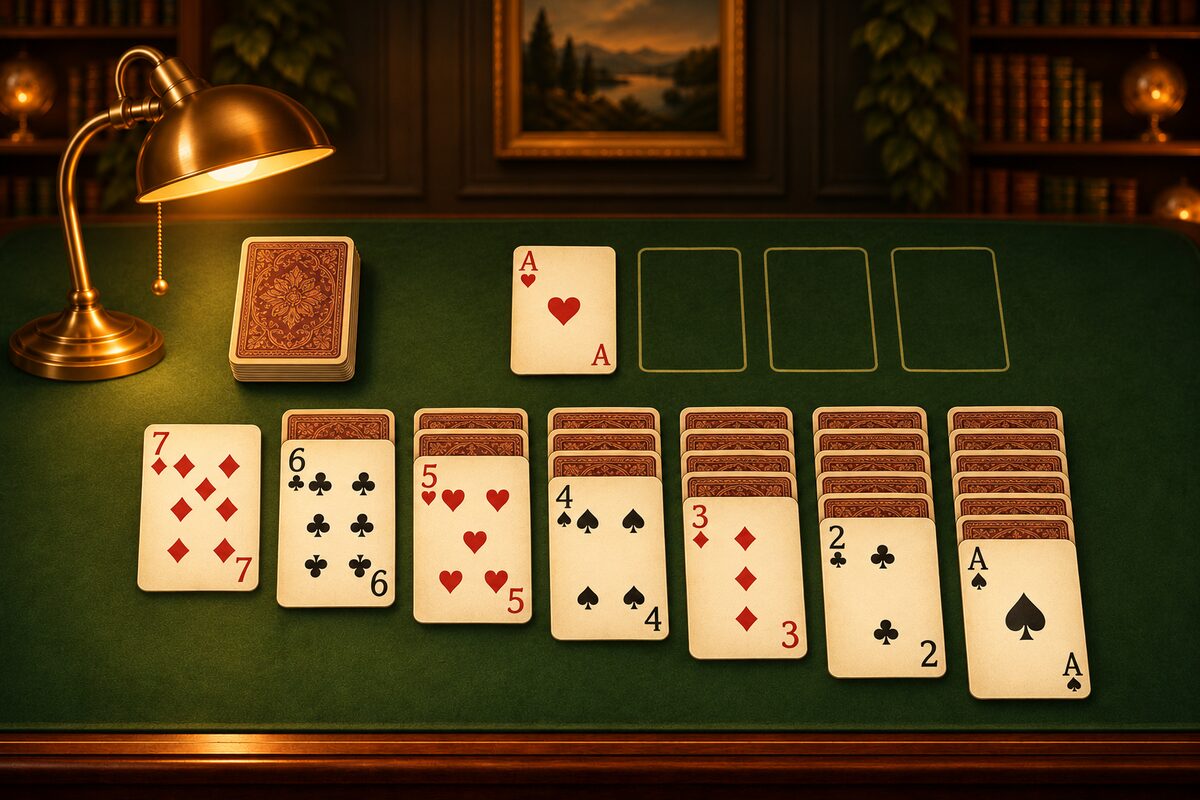
You can play cards by yourself. Card games for one are collectively called “solitaire” (or “patience” in Britain), and there are a great many kinds. Here we introduce the well-known ones, from the easiest on up.
Choosing by How Easy They Are
| Game | Difficulty | Decks |
|---|---|---|
| Clock | ★ | 1 |
| Pyramid | ★★ | 1 |
| Golf | ★★ | 1 |
| Klondike | ★★★ | 1 |
| FreeCell | ★★★ | 1 |
| Spider | ★★★★ | 2 |
Difficulty is a rough guide based on how easy the rules are to learn and how much thinking is involved. Spider gets easier if you reduce the number of suits.
Clock: Play on Luck Alone, with No Thinking
Deal the 52 cards face down into 13 piles of 4, and place 12 piles in the shape of a clock face with one in the middle. Turn over the top card of the middle pile, tuck it face up under the pile for the hour matching its number (ace is 1 o’clock, jack is 11, queen is 12, and king goes to the middle), then turn over the top card of that pile, and repeat. You win if all the cards are face up before the fourth king appears.
There are no moves for you to choose, so it’s a good way to learn the rules. The chance of winning is about 1 in 13 (when we tried it 2 million times on a computer, it came to about 7.7%).
Pyramid: Remove Pairs That Add Up to 13
Lay out 28 cards in a pyramid shape and remove pairs of face-up cards whose numbers add up to 13. A king is 13, so it can be removed alone. It’s just arithmetic, so you can play it with kids. For details, see How to Play Pyramid.
Golf: Link Numbers That Differ by One
Lay out the cards face up in 7 columns of 5, and make the rest the stock. If the front card of a column has a number one away from the top card of the waste pile (either higher or lower), place it on the waste pile. When you can’t link any more, turn over one card from the stock and place it on the waste pile. You win when you’ve cleared every column.
Klondike: The Best-Known Solitaire
In Japan, “Solitaire” usually means this Klondike. In seven tableau columns, you stack cards in alternating red and black, going down one number at a time, and build four foundations from A to K. The skill is in how you turn the face-down cards face up. For where the name comes from, see What Is Klondike?, and for the rules, see Solitaire Rules and How to Play.
FreeCell: Everything Is Visible, and Thinking Solves It
All 52 cards are dealt face up into 8 columns, and you build from A to K while using four “free cells” (places where you can park one card at a time). There’s almost no luck involved, and it suits people who like to think things through. For details, see How to Play FreeCell.
Spider: The Serious One That Uses Two Decks
Using two decks (104 cards), you make runs of one suit from K down to A within the 10 tableau columns and remove them. You clear the game when you’ve collected 8 runs. It gets harder as you go from one suit to two and then four. For details, see How to Play Spider.
Memory Can Be Played Alone Too
Memory (Concentration), usually played with other people, becomes a game for one if you aim for “how many tries it takes to match them all” or “how many seconds it takes.” For details, see How to Play Memory.
At a Table or on a Phone?
Playing with a real deck lets you enjoy the time spent laying out and putting away the cards. With a phone app, on the other hand, dealing and cleaning up take no time, and you can take back a mistaken move. The app is handy when you want to play casually many times. The rules of games similar to Klondike, such as Golf, TriPeaks, Scorpion, and Yukon, are in Types of Solitaire. Places where you can play Klondike for free are collected in Where to Play Solitaire.