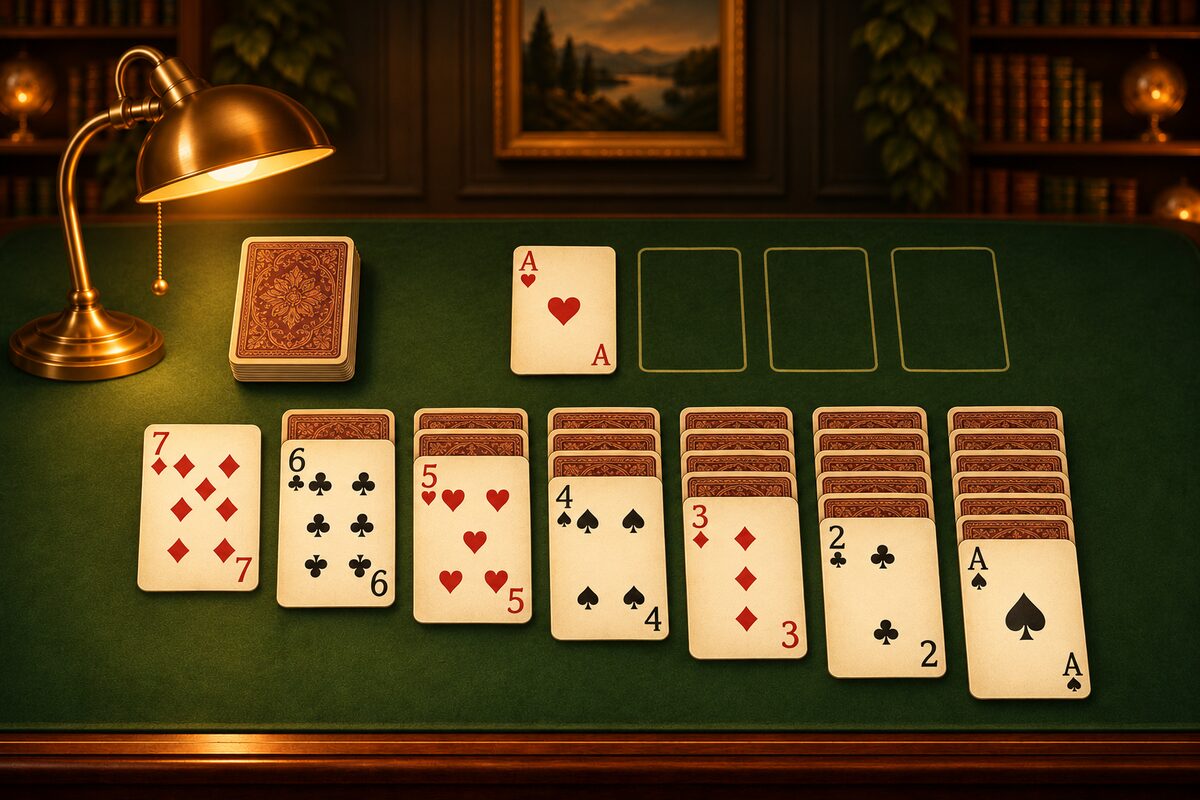
When you clear a game in the Solitaire app, it shows your time and “Move Count.” So what is the fewest moves in which Solitaire can be cleared? Let’s think about move counts here.
How the App Counts “Move Count”
The Solitaire app counts each of the following as one move.
- Moving a card to the tableau or a foundation (moving several at once still counts as one).
- Tapping the stock to turn over one card.
- After the stock runs out, tapping to return the waste pile to the stock.
- Using “Undo” (the count doesn’t go down. It goes up by one).
- A card going up to a foundation during Auto Complete.
At Least 76 Moves
No matter how lucky the deal, these moves are always needed.
- 52 moves to the foundations: Every one of the 52 cards ends up on a foundation. Cards go to the foundations one at a time, so that’s at least 52 moves.
- 24 moves to turn over the stock: The 24 stock cards can’t be used without turning them over. One tap turns over one card, so that’s at least 24 moves.
Together, 52 + 24 = 76 moves is the minimum needed to clear the game. But a game can be cleared in exactly 76 moves only with a very rare deal, where every card can go to a foundation without ever making a detour through the tableau. In practice, moves that shift cards between tableau columns are added, so the total is higher.
Counting the Solutions to the App’s 100 Deals
The Solitaire app contains 100 deals that are confirmed to be solvable, along with their solutions. We replayed those solutions one move at a time under the same rules as the app and counted the moves.
| What we counted | Fewest | Average | Most |
|---|---|---|---|
| Moves in the solution | 123 | 250.5 | 506 |
| Moves turning over the stock | 31 | 57 | 137 |
| Moves returning the stock | 1 | 5 | 41 |
The shortest solution was 123 moves, and the average was about 250. Every solution returns the stock at least once and goes into a second pass.
These solutions were found by a computer to confirm that a deal has a solution, so they are not the shortest possible sequences. They include roundabout moves, such as moving an ace from one foundation to another empty one. A skilled player can clear a game in fewer moves (How We Make Solvable Deals).
How to Use Fewer Moves
- Don’t cycle the stock needlessly: Each pass through the stock costs one move for every card left to turn over, plus one to return it (25 moves for 24 cards). Make the moves available between tableau columns first, then turn over the stock.
- Don’t overuse “Undo”: Each undo adds one move.
- Cut down on detours: If you place a card on the tableau and then move it to another column again, that adds moves.
For more, see Clearing the Game Fast and in Few Moves.