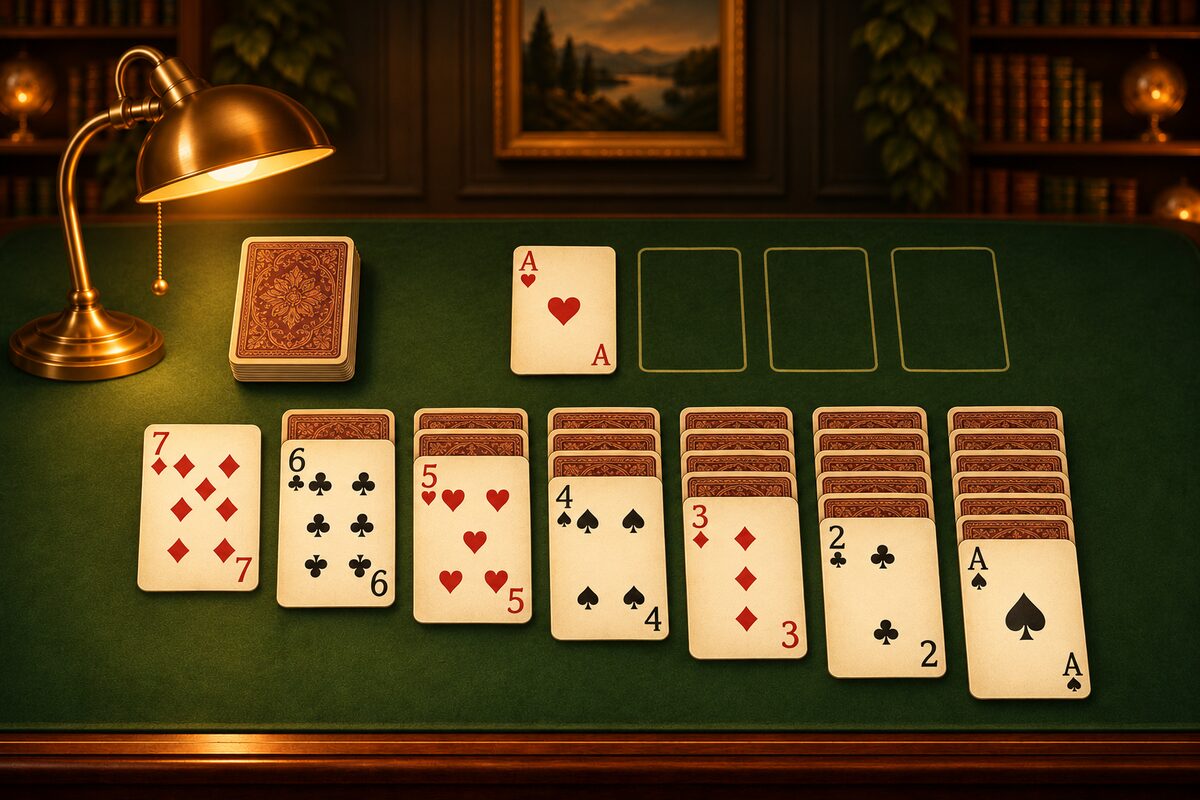
Solitaire is known as a computer and phone game, but it began as a card game for one. With a single deck of cards, you can play it on a table. Here is how to play with real cards, step by step.
What You Need
- One deck of cards: You use 52 cards, with the jokers taken out. It’s a good idea to count first and make sure none are missing.
- Table space: You lay out seven columns side by side, so for ordinary playing cards (about 6 cm, or 2.4 in, wide), a space about 50 cm wide and 40 cm deep (20 by 16 in) is comfortable. Columns can grow long, so leave a little extra depth.
1. Shuffle Well
Shuffle the cards well. If you don’t shuffle enough, the order from your last game can linger, and cards of the same suit or in sequence tend to clump together. Spreading the cards on the table and mixing them with both hands works well even if you aren’t used to handling cards.
2. Deal the Layout
Deal the seven columns of the tableau.
- From left to right, deal one card to each of 7 spots. Only the leftmost card is face up.
- Deal one card to each of the 6 spots from the 2nd column to the right. Only the card in the 2nd column is face up.
- In the same way, move one column to the right each round, until you reach the 7th round.
Each column ends up as a face-up card sitting on top of face-down cards. Stack the remaining 24 cards face down as the stock. There is a diagram in How to Set Up Solitaire.
Leave room above the tableau for the four foundations.
3. Turning Over the Stock
Hold the stock face down in your hand, or set it on the table.
- Turn over: Turn the top card face up and set it to the side (this is the waste pile). The next card you turn over goes on top of the waste pile.
- Use: You can move only the top card of the waste pile to the tableau or a foundation.
- Return: When the stock runs out, flip the waste pile over without shuffling and make it the stock again. The rule is that you don’t change the order.
Decide before you start whether to turn over one card or three, and how many times you may go through the stock. If you’re new, one card at a time with any number of passes is recommended (What Is Draw Three?).
4. Stack the Tableau
On a face-up tableau card, stack cards in alternating red and black, going down one number at a time. Offset each card a little so the number above is visible. When the top card of a column is gone, turn over the face-down card under it. Only a K can go in an empty column.
5. Build the Foundations
When an ace comes up, place it on the foundation spot, then build the same suit up with the 2, 3, 4, and so on. You clear the game when all 52 cards are built up.
What to Watch Out for Compared with the App
Real cards don’t have “Undo.” Keeping these things in mind will reduce mistakes.
- Check the color and number once more before stacking: If you stack with red and black mixed up, it’s hard to fix once you notice later.
- Offset the stack: If the numbers of the cards below stay visible, it’s easier to check when you move a run together.
- Don’t shuffle when you return the stock: If you shuffle by accident, the rules change.
With the app, dealing and cleaning up are automatic, and a mistaken move can be taken back with “Undo.” When you can’t spread out a table, such as when you’re out and about or before bed, playing on the app is handy. For a refresher on the rules, see Solitaire Rules and How to Play.