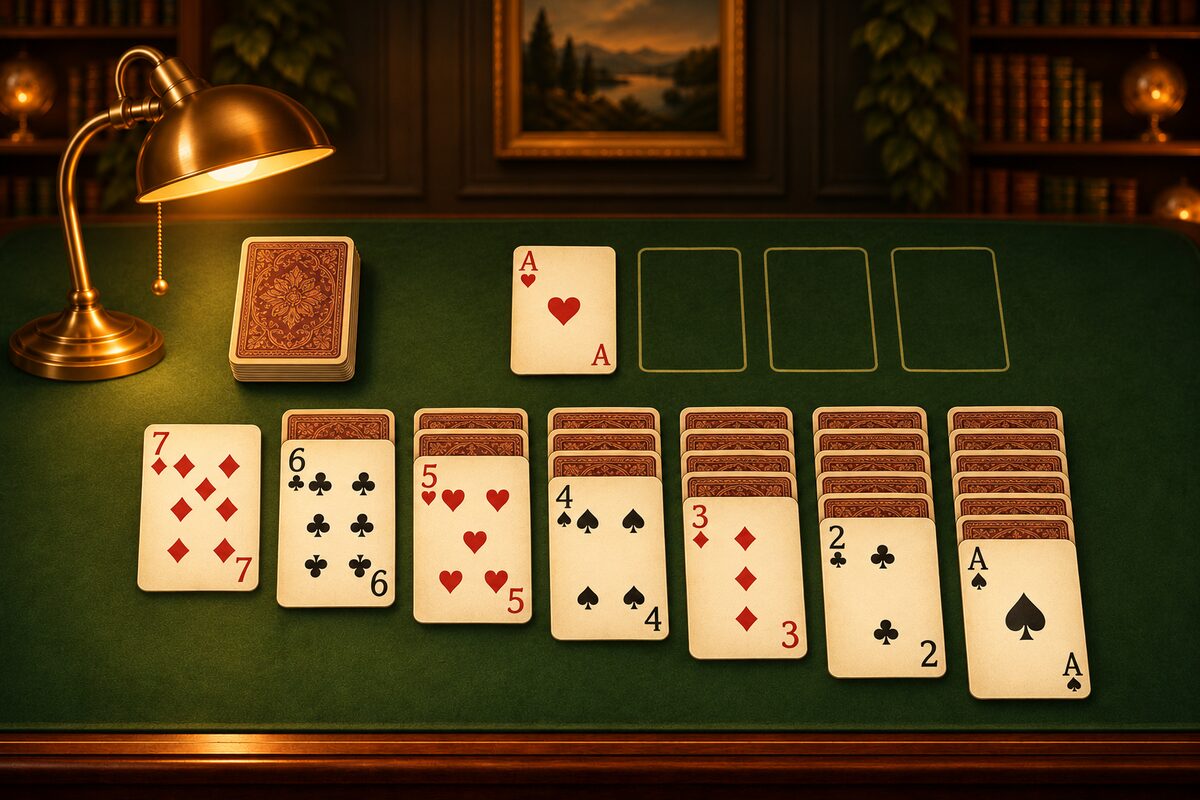
Solitaire (Klondike) isn’t a game of pure luck. Even with the same deal, you may or may not clear it depending on the order in which you move the cards. Here are 10 tips you can use right away as a beginner. If you’re still shaky on the rules, read the rules and how to play first.
1. Make Turning Face-Down Cards Face Up Your Top Priority
The most important thing in Solitaire is to turn the face-down tableau cards face up. At the start, 21 of the 28 tableau cards are face down, and until you can see them, you don’t know what’s where. When in doubt, choose by asking, “Will this move turn a face-down card face up?”
2. Break Down the Columns with the Most Face-Down Cards First
The further right the column, the more face-down cards are piled up in it. Turning over a single card takes one move in any column, but the more face-down cards a column has, the more unseen cards are sleeping beneath it. When you have movable cards in two places, the basic rule is to move the one in the column with more face-down cards.
3. With Two Cards of the Same Color, Pick the One with More Hidden Cards
In the diagram below, for example, a black 7 can go on the red 8 in column 1. There are two black 7s: the 7 of clubs in column 3 and the 7 of spades in column 6.
Whichever you move, one face-down card turns face up. But under the one in column 3, one face-down card is left, while under the one in column 6, four are left. Moving the 7 of spades in column 6 leaves more cards to turn over later, and it’s easier to open up your options.
4. Empty a Column When You Have a K to Place
Only a K can go in an empty column. If you empty a column when you have no K to place, that column has no use. Worse, the cards you moved to empty it can block other columns. Before you empty a column, decide “which K I’ll place next” (Empty Columns and Kings).
5. When Choosing a K, Think About Color Too
Whether you put a red K or a black K in an empty column changes which cards can follow it. A black Q goes under a red K, and a red Q goes under a black K. Look at which Qs are face up or likely to come up on the waste pile, and choose the K that’s easier to link.
6. Don’t Rush Cards Up to the Foundations
Aces and 2s can go up to the foundations as soon as you find them, because they have no use in the tableau. Cards higher than a 5 or a 6, on the other hand, can be useful in the tableau for holding other cards. For example, if you move a red 6 up to a foundation, you lose one place to stack a black 5. Move cards up when it won’t leave you short of places in the tableau (When to Move Cards to the Foundations).
In the Solitaire app, you can also move the top card of a foundation back to the tableau. If you think you moved one up too early, you can move it back and use it.
7. A Run of Face-Up Cards Can Be Moved Together
A run of face-up cards stacked by the rules, like “black 9, red 8, black 7,” can be moved together to another column. You can also move just the part from the middle down. If you move a run sitting on top of face-down cards all at once, the card under it turns face up.
8. You Can Use the Stock Any Number of Times, So Look at the Tableau First
The stock in the Solitaire app turns over one card at a time, and when it runs out you can go through it any number of times. A waste card you can’t use now comes around again on the next pass. Before you turn over the stock, first look for moves you can make among the tableau columns. If you set up the tableau and then turn over the stock, more cards become usable (How to Cycle the Stock).
9. When in Doubt, Try It and Use Undo
When you can’t tell which move is better, you can try one and, if it doesn’t work, take it back with “Undo.” You can rethink after seeing the card that turned face up. Every deal in the Solitaire app is confirmed to have a solution, so even if you get stuck, there is always a way to clear the game if you go back and try again.
10. Leave the Finish to Auto Complete
When the stock and waste pile are empty and all the tableau cards are face up, you’ve as good as won. In the Solitaire app, you can use “Auto Complete” at this point to send the remaining cards up to the foundations automatically.
Summary
- When you have two possible moves, move the one in the column with more face-down cards.
- Empty a column only when you have a K to place.
- Move aces and 2s up right away. Think about whether higher cards could be useful in the tableau.
- Before turning over the stock, look for moves among the tableau columns.
Once you’ve got the hang of it, try it out in the app described in Where to Play Solitaire.