Here are answers to common questions about Memory and the Memory Cards app. Each topic has its own article with more detail.
Rules
What kind of game is Memory?
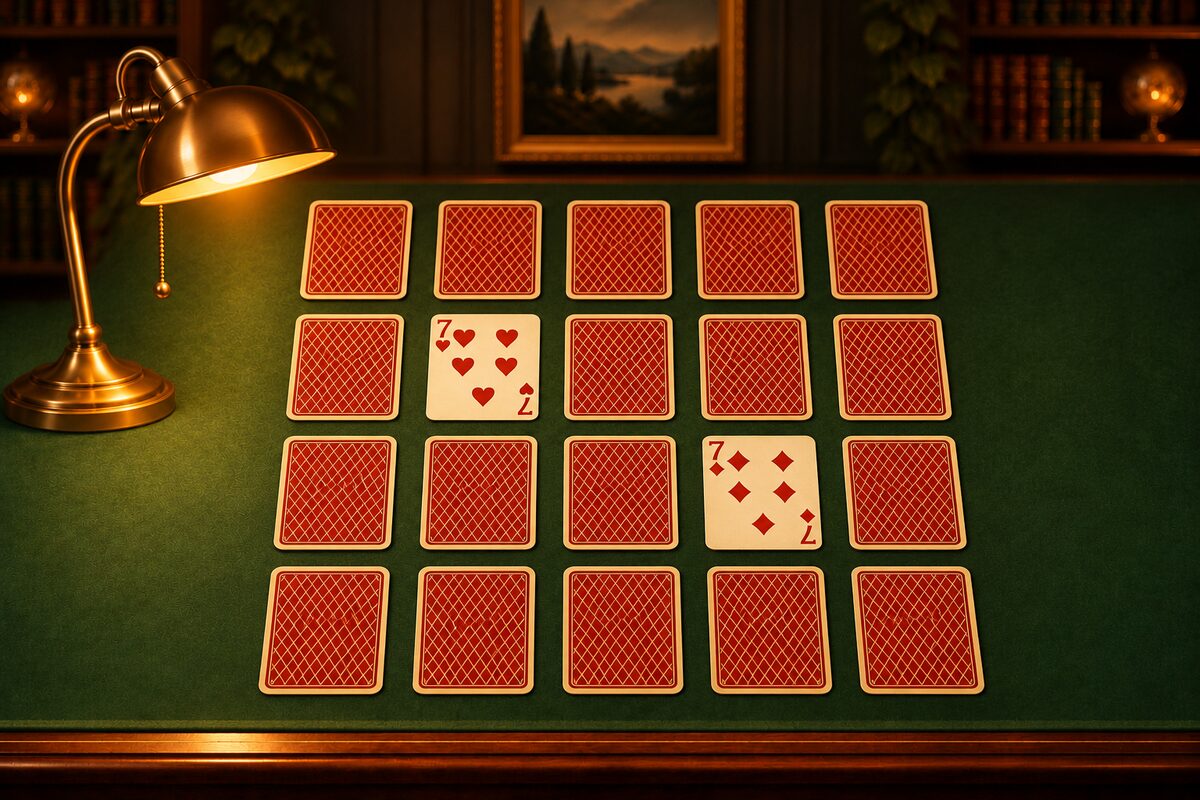
It’s a memory game where you flip face-down cards two at a time and take them if the numbers match. When playing with others, whoever collects the most cards wins (The Rules of Memory).
Are the app’s rules different from regular playing cards?
In the Memory Cards app, you play alone with 20 cards (10 pairs). Each number appears on just two cards, and a pair is one red-suit card and one black-suit card (How to Play Memory).
How many cards should I use, and how should I lay them out?
With 52 cards, you can lay them out as 13 cards by 4 rows. For a shorter game, use 20 cards, for example 5 by 4 (Layouts and Card Counts).
Can I keep flipping after a match?
Many people play that you can keep flipping, but it differs by family and region. Agree on it before you start (Fun House Rules).
Name and History
Why is it called “shinkei-suijaku” in Japan?
The usual explanation is that it’s so hard on the nerves to keep remembering, but nobody knows for sure who named it or when. It’s “shinkei-suijaku,” not “shinken-suijaku” (Where the Name Comes From, The History of Memory).
What is it called in English?
It goes by Concentration, Memory, Pairs, and other names (What Is Memory Called?).
Who to Play With
What age can kids start?
There’s no set age. If you cut the deck to about 12 cards or use picture cards, even small children can play (What Age Can Kids Start? Tips for Playing With Children).
Can I play alone?
Yes. You can challenge your own record for tries or time to match everything (Playing Memory Alone). For how to think about a two-player match, see Playing Memory With Two Players.
Is it a brain game?
It’s a game of remembering, recalling, and focusing over and over, but it doesn’t promise any benefit. The app is not a test or a treatment (Is Memory a Brain Game?).
Tips
What are good ways to remember cards?
Flip a card you haven’t seen for both your first and second flip. If you remember the partner, take it right away. Put positions into words. There are more ideas in Tips for Memory and Memory Techniques for Positions.
Should my first card be one I’ve seen or one I haven’t?
One you haven’t seen. With 20 cards, the average number of tries is about 15.6 versus about 25.4, which is a big difference (What Should You Flip First?).
I forget cards right away.
Everyone forgets more easily when there are many cards to remember, when similar cards come up in a row, or when they’re in a hurry (Why Do We Forget Flipped Cards?).
Odds and Tries
What are the odds that the first two cards match by luck?
With 20 cards it’s 1/19 (about 5.3%), and with 52 playing cards it’s 1/17 (about 5.9%) (The Odds in Memory).
How few tries is good?
If you remember all 20 cards and play well, it averages about 15.6 tries, with a minimum of 10 and a maximum of 19. If you flip at random, it averages 100 (How Many Flips With Perfect Memory?, How Many Flips With Pure Luck?).
The Memory Cards App
How are misses counted?
You get a miss only when you fail to match a pair you could have remembered. Missing on a card you’re seeing for the first time doesn’t count (The Math of Counting Misses).
What are the bonus conditions?
+10 coins for no misses, +10 coins for clearing within 30 seconds, and +5 coins within 40 seconds (Clearing With No Misses, Clearing Within 30 Seconds).
Can I take back a flipped card?
No, there’s no way to take a flip back. The screens and settings are covered in How to Use the Memory Cards App.
Can I play with pictures instead of playing cards?
If you equip a “Pictures” set in the Collection, you can play with pictures such as sweets and animals. There are 21 sets in all (Memory With Pictures, Dress-Up and Exploration).
Does it cost anything to play?
The app can be downloaded at no charge, and it shows ads. You can also play on this site (Where to Play Memory).
I want to play other card games too.
There’s Old Maid, and solitaire games like Solitaire and Pyramid (Other Card Games to Play, Memory Beyond Playing Cards).