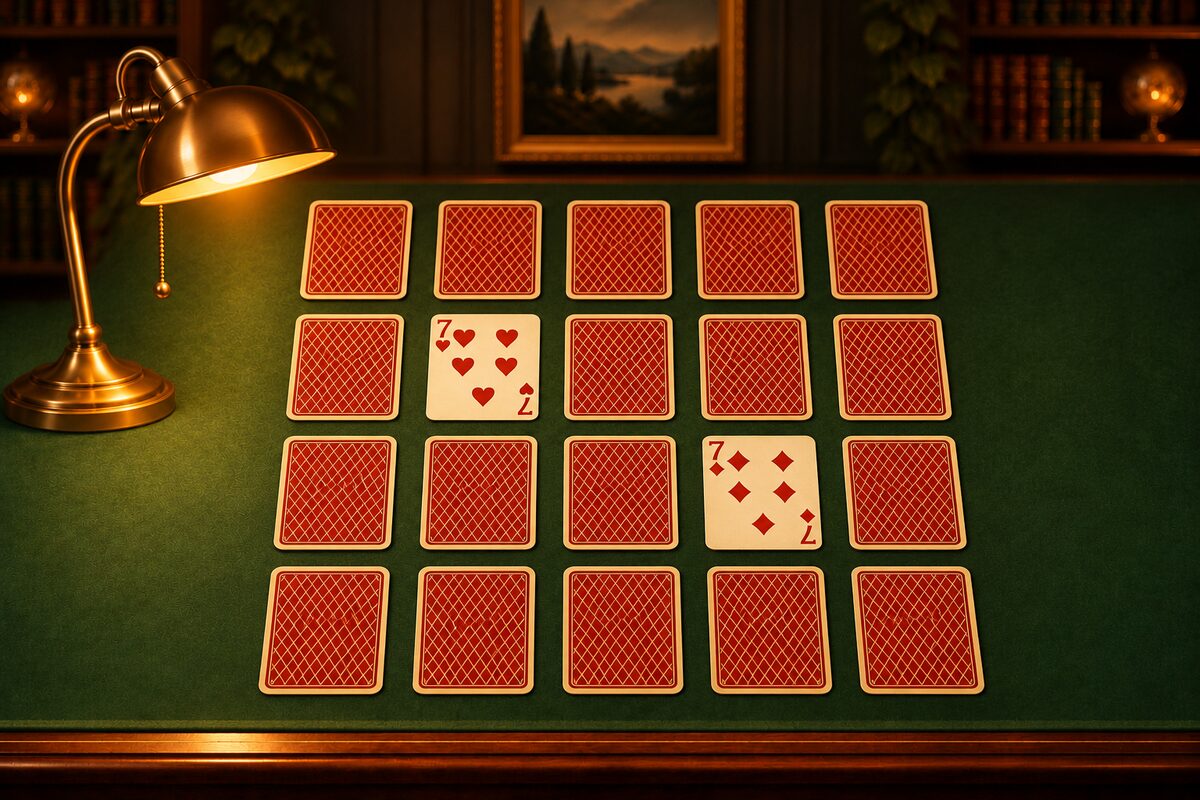
In the Memory Cards app, a failed match is not always a miss. A miss is counted only when you fail to match a pair you could have remembered. Here we check how that works, with examples and calculations.
The Rule for Misses
When you flip two cards and they don’t match, a miss is counted if either of the following is true.
- You had already seen the partner of your first card (flipping that spot would have made a match)
- Your second card was one you’d seen before (you knew it wouldn’t match)
If neither is true, it isn’t a miss even though the cards don’t match. For example, when you flip two cards you’re seeing for the first time.
In the figures below, the faded cards are ones you’ve seen and remember (J, 6, and 10), and the gold-outlined cards are the two you just flipped (in the order 1, 2).
Examples That Count as Misses
You saw the partner of the first card, the J, at the top left. You could have flipped the top left and made a match, but you flipped a different card instead, so it’s a miss.
You haven’t seen the partner of the first card, the 3. But for your second card, you flipped the 6 you’d seen before. You already knew the 6 wasn’t the 3’s partner, so it’s a miss.
Examples That Don’t Count as Misses
You flipped the 6 you’d seen before as your first card. You haven’t seen the 6’s partner yet, so the second card is a matter of luck. Failing to match with a card you’re seeing for the first time is not a miss.
Failing to match with two cards you’re seeing for the first time is also not a miss.
If You Remember, It’s Always 0 Misses
Someone who remembers flips like this (the same strategy as in How Many Flips With Perfect Memory?).
- If you know where a pair is, take it.
- If not, flip a card you haven’t seen as your first card.
- If you’ve seen its partner before, flip that spot as your second card and take the pair.
- If you haven’t, flip another unseen card as your second card.
With this strategy, you only fail to match in case 4. In that case, you haven’t seen the partner of the first card, and the second card is also one you’re seeing for the first time. It meets neither of the two conditions for a miss, so it can never be a miss.
In other words, the miss rule is designed so that anyone who remembers can always get 0 misses. We ran 200,000 simulations using the same deals as the app’s 20 cards, and this strategy never produced a single miss.
Flipping at Random Averages About 85
On the other hand, if you remember nothing and flip two random cards every time, you got an average of about 85 misses per game (again from 200,000 simulations). Flipping at random takes 100 tries on average to match everything, and most of those are misses.
If you clear the game with no misses, the app gives you more coins. Enjoy your miss count as a record of how well you remembered.