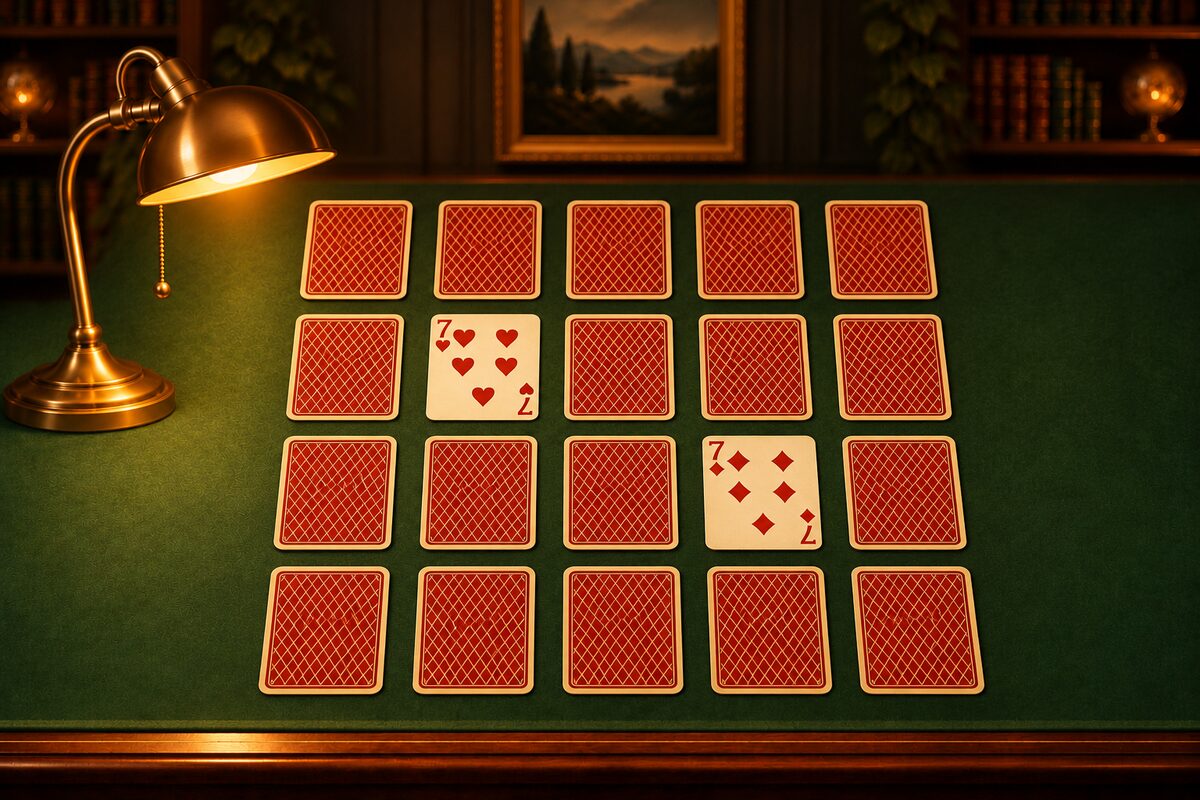
Memory is a game where you flip face-down cards two at a time and match pairs of the same number. It can look like a game of luck, but what you flip and how you remember make a big difference to your tries and misses. Here are eight tips, using the Memory Cards app (20 cards, 5 columns by 4 rows) as the example. If you don’t know the rules yet, read How to Play Memory first.
1. Start With a Card You Haven’t Seen
For your first card, flip a card you haven’t seen even once. If you saw the partner of the card you flipped, you can flip that spot second and take the pair. If you didn’t, you learn one more new card. Either way, you don’t lose anything.
2. If You Remember the Partner, Take It Right Away
The faded cards are ones you flipped before that turned back face down (cards you remember). Now you flipped the far left of row 2, which you hadn’t seen yet, and it was a J. You saw a J at the top left. If you flip the top left as your second card, you match the pair.
If you remembered but flipped a different card and missed, the app counts it as a miss.
3. Flip an Unseen Card Second, Too
When you haven’t seen the partner of your first card, flip a card you haven’t seen as your second card, too. You might match by luck, and even if you miss, you learn the positions and numbers of two cards.
Flipping a card you’ve seen before as your second card teaches you nothing new. You already know it won’t match, so the app counts it as a miss, too.
4. Decide an Order for Flipping
Flip unseen cards in a set order, like from the top left to the right, one row at a time. That way, you know “I haven’t seen anything past this point,” and all you have to remember is the numbers of the cards you’ve seen. If you flip at random, you also have to remember where you’ve looked.
5. Put Positions Into Words
If you say positions and numbers in your head, like “the 3rd card in row 2 is an 8” or “the top right is a Q,” they’re easier to remember. On a 5-column by 4-row board, you can name any position briefly by its row and its count from the left.
6. In the App, a Pair Is One Red and One Black
In the app’s deal, the two cards in a pair are the same number, and always one red-suit card (Hearts, Diamonds) and one black-suit card (Spades, Clubs). If you see a red 7, the partner is a black 7. Also, the numbers used are 10 of the 13 types from A to K, and each number has only two cards.
However, with “Pictures,” which use pictures instead of playing cards, two cards with the same picture make a pair.
7. You Only Need to Remember 6 to 8 Cards at Most
You only need to remember cards whose partner hasn’t been found yet. Once a pair is matched, you can forget those cards. When you play 20 cards with tips 1 to 3 above, here is how many cards you had to remember at once at the busiest point, by our calculation (200,000 simulations).
| Most cards remembered | Share of games |
|---|---|
| 5 or fewer | about 29% |
| 6 | about 37% |
| 7 | about 18% |
| 8 | about 15% |
| 9 or more | about 2% |
On average it’s about 6. You don’t need to remember all 20 cards.
8. Speed Comes After the Misses Are Gone
In the app, you earn more coins for clearing with no misses, and for clearing within 30 or 40 seconds. But if you flip in a rush, the cards turn back over before you’ve remembered them. First get rid of misses with tips 1 to 7, and then go for speed.
Even with perfect memory, there’s some luck involved, so the number of tries to match 20 cards varies from game to game. By our calculation, the average is about 15.6 tries, and matching them in 10 tries happens about once in 650 million games.