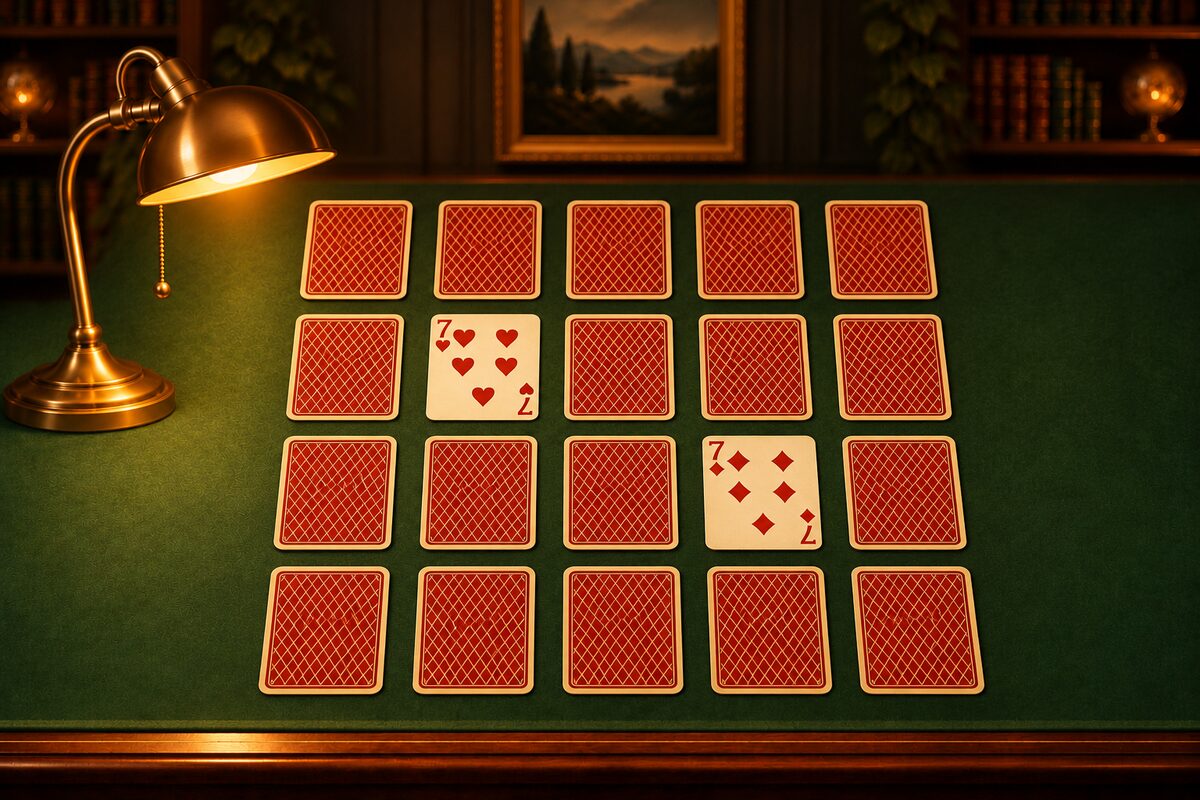
Memory is usually thought of as a game to play with others, but you can enjoy it alone too. Instead of competing with an opponent over how many cards you take, you challenge your own record for how many tries it took and how many seconds it took.
Playing Alone With Playing Cards
- Prepare the number of cards you’ve decided on. To start, about 10 pairs, or 20 cards, is a good choice (Layouts and Card Counts).
- Shuffle well and lay them out face down in rows and columns.
- Flip two cards at a time and take them if the numbers match. If not, flip them back.
- Count one try for every two cards you flip, and record the number of tries until you’ve matched them all.
If you also time yourself with a clock or stopwatch, keeping records is even more fun.
A Guide to the Number of Tries
With 20 cards (10 pairs), if you remember every card you flip, the number of tries to match them all works out as follows by our calculation (How Many Flips With Perfect Memory?).
| Guide | Tries |
|---|---|
| Fewest | 10 |
| Average | about 15.6 |
| At most | 19 |
First aim for the 20s, and once you’re used to it, aim for around 16. Luck is part of it, so it’s better to compare the average of several games than a single game’s record.
Play on This Page
The board below uses the same 20 cards as the Memory Cards app, and counts your tries, misses, and time.
Playing Alone in the App
The Memory Cards app is a version of Memory made for playing alone.
- The time and number of tries appear at the top of the screen.
- When you fail to match a pair you could have remembered, it counts a miss. The number of misses is shown on the clear screen.
- You earn more coins for clearing with no misses, or within 30 or 40 seconds.
With tries, time, and misses to track, you can keep changing your goal, like “no misses today” or “within 30 seconds next.” Tips for going after them are in Clearing With No Misses and Clearing Within 30 Seconds.