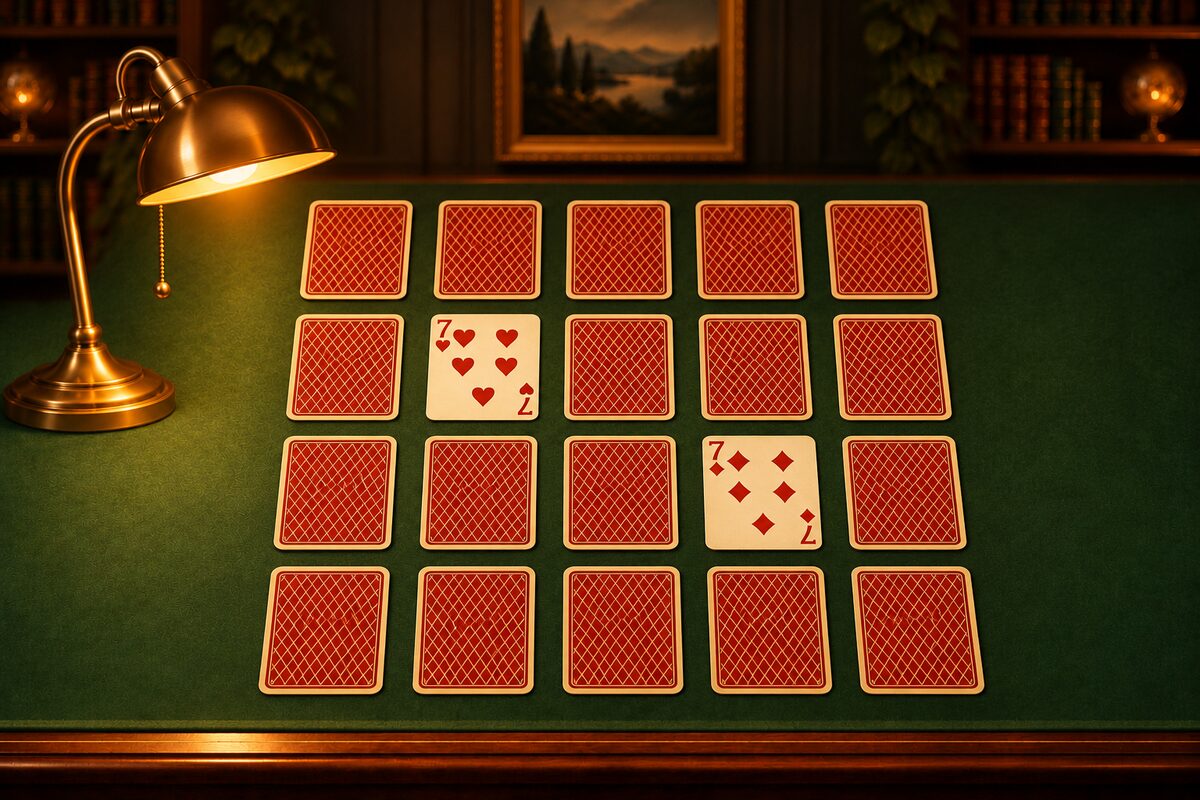
Suppose you remembered nothing in Memory and flipped two random cards every time. How many tries would it take to match them all? We worked it out for 20 cards (10 pairs), the same as in the Memory Cards app.
The Average Is 100
The answer is 100 tries on average.
As we saw in The Odds of a Lucky Match, when k pairs are left, the chance of a match on one try is 1/(2k − 1). Something with a 1/m chance happens once every m tries on average. So when k pairs are left, it takes 2k − 1 tries on average to get the next pair.
| Pairs left | Average tries to the next pair |
|---|---|
| 10 pairs | 19 |
| 9 pairs | 17 |
| 8 pairs | 15 |
| … | … |
| 2 pairs | 3 |
| 1 pair | 1 |
Add them all up: 19 + 17 + 15 + … + 3 + 1 = 100 tries. The sum of the first 10 odd numbers starting from 1 is 10 × 10 = 100. With n pairs, the average is n × n tries. Doubling the number of pairs makes it 4 times as many tries, which shows how inefficient random flipping is.
How Much It Varies
The average is 100, but the actual number varies a lot depending on luck. Here is what we got from the calculation.
| Tries | Share of games |
|---|---|
| 50 or fewer | about 4.5% |
| 95 or fewer | about 50% |
| More than 150 | about 8.7% |
Half of all games end within 95 tries, but about 1 game in 10 takes more than 150.
With Memory, About 15.6
On the other hand, if you remember every card you flip and play well, you clear all 20 cards in about 15.6 tries on average. That’s about one sixth of the 100 tries you’d need with luck alone.
The strategy for someone who remembers, and the distribution of tries, are covered in How Many Flips With Perfect Memory?.
Without Memory, Misses Add Up
In the Memory Cards app, you get a miss when you fail to match a pair you could have remembered. If you flip at random all the way through, the calculation gives about 85 misses per game on average (from 200,000 simulations). Someone who plays by remembering can always get 0 misses (The Math of Counting Misses).