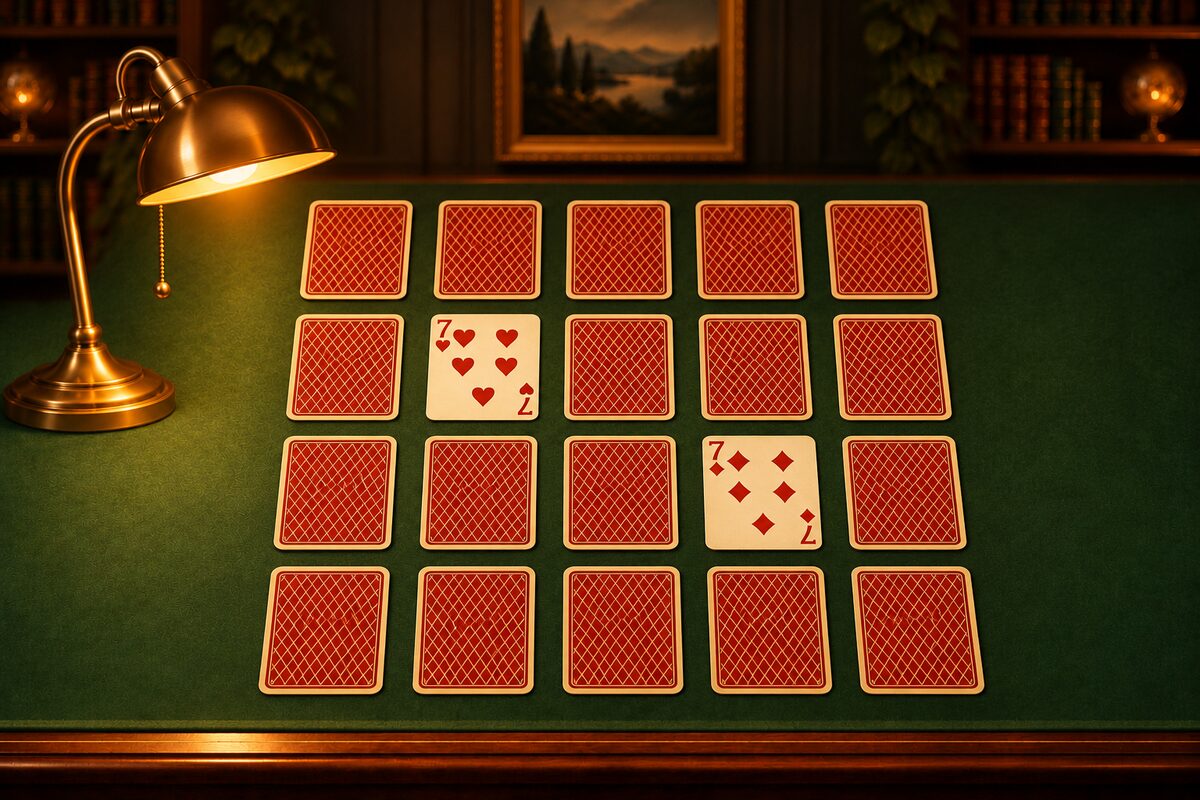
Memory has no official rules. Because of that, families, regions, and groups of friends all play with slightly different rules. Here are some ideas you can add to your usual game. These aren’t official, named rules, so agree on them with everyone before you start.
The basic rules are covered in The Rules of Memory.
Ideas to Make It Harder
- Pairs must match in color: Even with the same number, a pair only counts if both cards are red (Hearts and Diamonds) or both are black (Spades and Clubs). That leaves only one possible partner for each card, which makes it harder.
- Match the suit too: Mix two decks together, and only cards with the same number and the same suit make a pair. With 104 cards, this is very tough.
- Call your card before you flip: Before you flip your second card, say “I’m flipping a 7.” If it isn’t the number you called, you can’t take the pair even if they match.
- Scatter the cards: Don’t line them up in rows and columns. Spread them out in a jumble on purpose. It makes positions harder to put into words.
Ideas to Make It Easier
- Use fewer cards: With 12 or 20 cards, the game is shorter and easier to remember (Layouts and Card Counts).
- One do-over: For beginners and small children, allow one do-over, where they can flip a different card in place of a missed one.
- Play together: Instead of deciding a winner, everyone works together to get the number of tries as low as possible.
Ideas for Scoring
- Double for court cards: A pair of J, Q, or K counts as 2 pairs.
- Add Jokers: Add two Jokers, and count a Joker pair as 5 pairs.
- Streak bonus: If you take 3 or more pairs in a row, get 1 extra pair.
With scoring rules, there is still a chance to come back right up to the end.
Ideas for Changing How You Play
- Team play: Split into teams of two and take turns flipping. Remember the cards your teammate flipped, too.
- Time limit: Set a limit like 10 seconds per turn to keep a quick pace.
- Solo tries race: Each person takes a turn alone, and you compete on how few tries it takes to match everything (Playing Memory Alone).
When Playing in the App
The Memory Cards app is played alone with 20 cards, and you can’t choose house rules. Instead, it has “Pictures” that let you play with pictures instead of playing cards. Sets of similar pictures are hard to tell apart, which gives the game a different feel (Memory With Pictures).