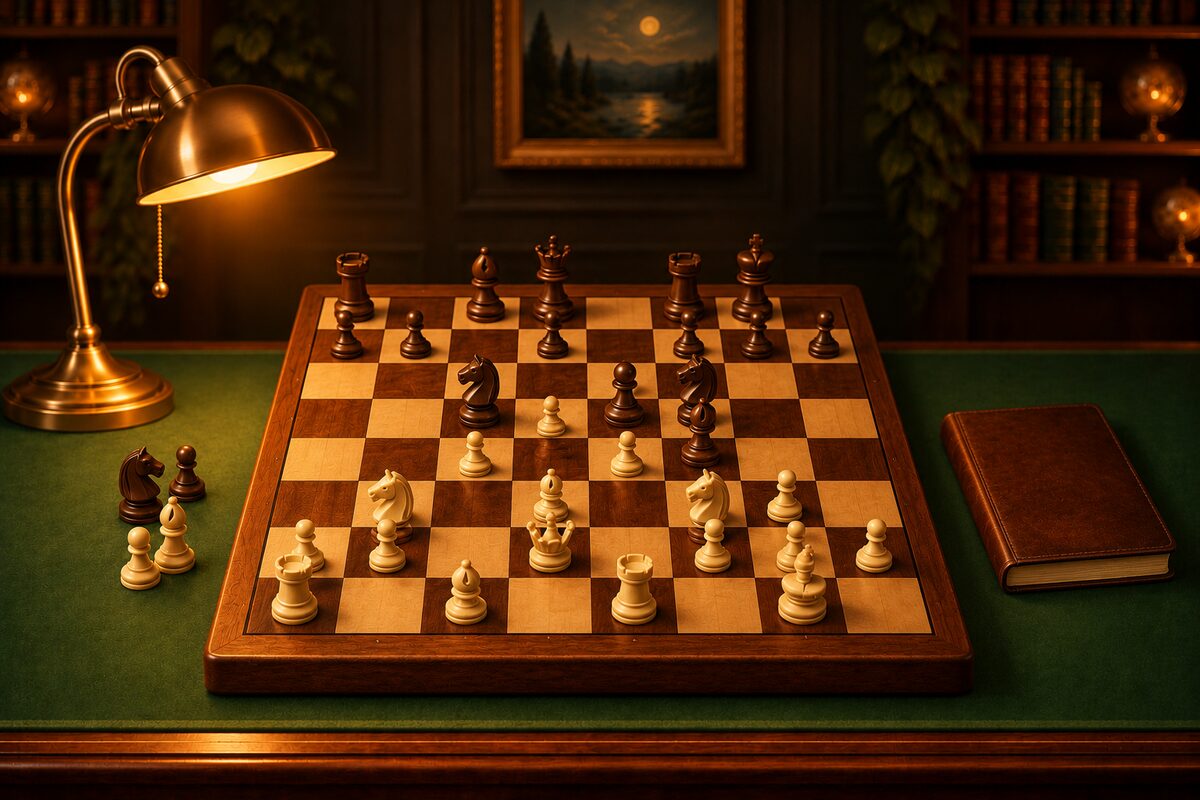
En passant is French for “in passing.” It is a special capture that only pawns can make, and many people are startled the first time they see it and wonder, “Isn’t that illegal?”
What Kind of Move Is It?
When an enemy pawn uses its first move to go two squares and lands right beside your pawn, your pawn may move diagonally to the square the enemy pawn passed over and capture that pawn. The rule makes it possible to capture the pawn after a two-square advance, just as you could have if it had moved only one square.
In the diagram below, Black has pushed the d7 pawn two squares to d5. It is right beside White’s pawn on e5.
White moves the e5 pawn to d6 and captures the Black pawn on d5. The captured piece is not on the destination square d6. It is the pawn that was on d5, behind it.
Conditions
- Both the capturing piece and the captured piece must be pawns.
- The enemy pawn must have just moved two squares.
- The enemy pawn must have stopped right beside your pawn.
This only happens when a White pawn is on the 5th rank, or a Black pawn is on the 4th rank.
Only on the Very Next Move
En passant can be played only on the very next move after the enemy pawn moves two squares. If you play any other move, the right to capture is gone.
The diagram above shows the position after White moved a knight instead of capturing en passant, and Black made one more move. The e5 pawn can no longer capture on d6 (it can still capture the knight on f6).
You don’t have to capture en passant. Whether to do it is up to you. But if it is the only move that gets you out of check, you must play it, as with any other move.
An Example With Black Capturing En Passant
Black can capture the same way. In the diagram below, White has pushed the f-pawn two squares next to Black’s pawn on e4. Black can capture with exf3.
How to Write It
It is written like an ordinary pawn capture, so in White’s example it is exd6. Sometimes “e.p.” is added at the end to show that it is en passant.
The move record in the Chess Board app uses the starting square and the destination square, so it shows e5d6.
A Rare Case: When En Passant Is Not Allowed
When you capture en passant, both pawns, the capturing one and the captured one, disappear from the same rank at the same moment. If that leaves your own king exposed to an attack along the rank, you can’t capture en passant.
In this diagram, if White captures on c6 with the b5 pawn, both b5 and c5 on the 5th rank become empty, and Black’s rook reaches White’s king on a5 in a straight line. You can’t make a move that leaves your own king in check, so en passant isn’t allowed here.
Why Does This Rule Exist?
Pawns being allowed to move two squares on their first move is said to have come after the original game of chess. A two-square move lets a pawn slip past an enemy pawn, so en passant is said to have been added to make it possible to capture a pawn that you could have captured had it advanced one square at a time.
In the App
The Chess Board app supports en passant. When you can capture, selecting the pawn shows the passed-over square as a place it can move, and selecting that square removes the enemy pawn from the board. It isn’t shown if you are a move late or in a position like the one above where it isn’t allowed.
Other special moves are covered in Castling Rules and The Rules of Chess.