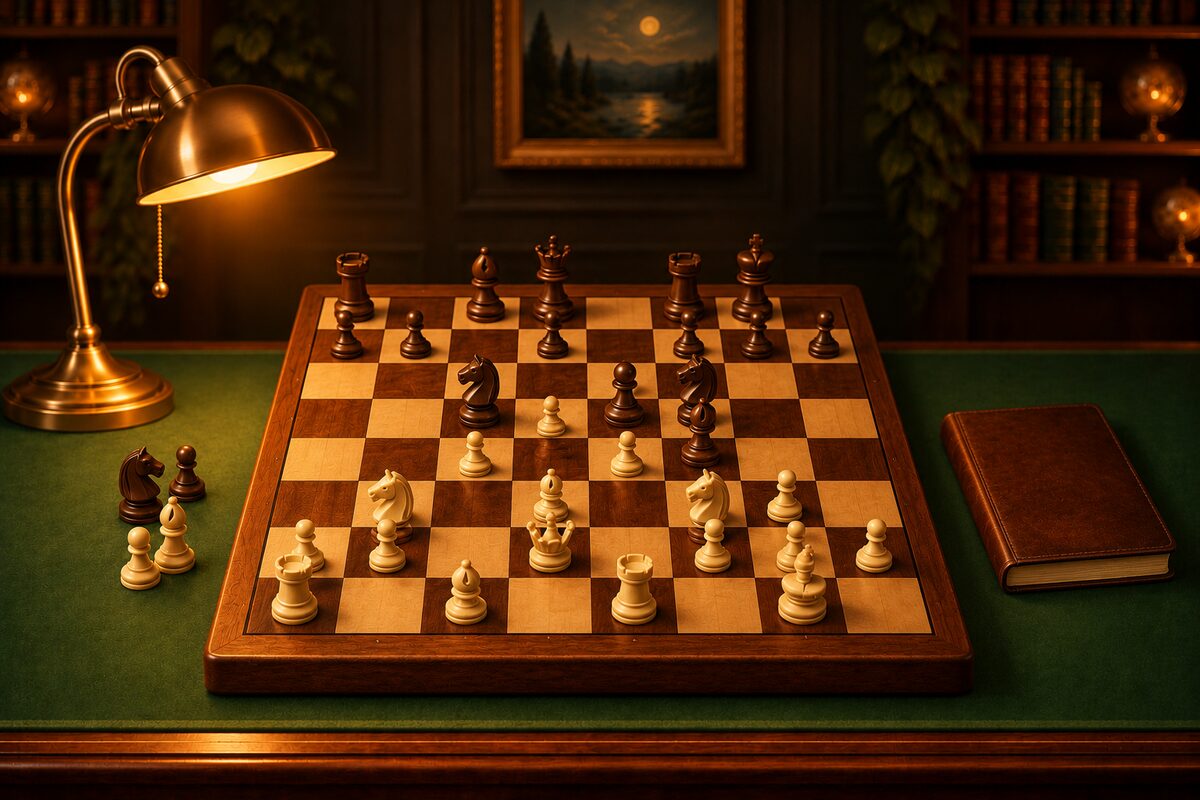
Chess is a game in which two players, White and Black, take turns moving pieces. The rules can look like a lot, but at first you only need to learn two things: how the pieces move and checkmate. Here are the rules a first-timer should know, in order.
The Board and Pieces
The board has 64 squares, 8 across and 8 down, with light and dark squares alternating. Each side has 16 pieces, and you start by setting them up as in the diagram below.
- Place the board so that the lower right corner is a light square.
- The white queen goes on a light square (d1), and the black queen on a dark square (d8).
- The columns across are called a to h from the left, and the rows are called 1 to 8 from White’s side. A square is named by its file and rank, like “e4.”
White Moves First, Then One Move Each
White starts, and White and Black alternate, one move each. You can’t pass. You move only one piece per turn (the one exception is castling, which moves the king and a rook at once).
How the Six Pieces Move
| Piece | Movement | Number |
|---|---|---|
| King | One square in any direction | 1 |
| Queen | Any number of squares along a rank, file, or diagonal | 1 |
| Rook | Any number of squares along a rank or file | 2 |
| Bishop | Any number of squares diagonally | 2 |
| Knight | Jumps in an L shape (can jump over pieces) | 2 |
| Pawn | One square forward, captures one square diagonally forward | 8 |
Pieces other than the knight can’t jump over other pieces. A pawn can’t move backward and can go two squares on its first move only.
Capturing Pieces
If an enemy piece is on the square you move to, you capture it and take it off the board. You can’t move to a square held by your own piece. Captured pieces can’t be reused, and you simply keep them off the board (you can’t drop them back in as in shogi).
Check and Checkmate
Putting the enemy king in a position where it could be captured is called check. The side in check must always deal with it on its next move. There are three ways to do so.
- Move the king to a safe square
- Capture the piece giving check
- Put a piece in between to block it
In the diagram below, Black’s rook is checking White’s king. White can deal with it by moving the king aside (such as Kf1), capturing the rook with the knight (Nxe5), or putting the bishop in between (Be2 or Be4).
A position where the check can’t be stopped no matter what is checkmate, and the checkmated side loses. The king is never actually captured. Also, you can’t make a move that leaves your own king capturable (a move into check).
The diagram below shows an example where Black checkmated on its second move. White’s two moves were terrible, and no game ends sooner than this.
Three Special Moves
- Castling: Move the king two squares sideways and bring the rook to the other side of the king. The conditions include that the king and rook have never moved.
- En passant: When an enemy pawn moves two squares and lands beside your pawn, you may, on the very next move only, move diagonally to the square it passed over and capture it.
- Promotion: When a pawn reaches the far rank, it becomes a queen, rook, bishop, or knight.
When the Game Is a Draw
Sometimes no one wins and the game is drawn.
- Stalemate: The side to move is not in check but has no legal move.
- Insufficient material: Neither side has enough pieces left to checkmate, such as king against king.
- Repetition of position: When the same position appears three times, a draw may be claimed. At five times, it is drawn automatically.
- 50-move rule: If both players go 50 moves without moving a pawn or capturing a piece, a draw may be claimed. At 75 moves, it is drawn automatically.
- Agreement: When both players decide to call it a draw.
The Order for Beginners to Learn
- Which way the board faces, and how to set up the pieces
- How the six pieces move, and how to capture
- Check, and how to answer a check
- Winning by checkmate
- Castling, promotion, and en passant
- The rules for draws
Once you understand 1 to 4, you can already play a game. For 5 and 6, it is enough to pick them up little by little as you play.
In tournaments, other rules apply, such as having to move a piece you touch (touch-move) and timing the players with a clock. When you play at home, agree on these with your opponent.
The Chess Board app only lets you play legal moves, so it is a good fit for learning the rules as you play. For how to use it, see How to Play Chess Board.