Chess Board is a board for two people who sit around one device and play chess face to face. It is not an app for playing against the computer. You can use it for games with family and friends, or to practice setting up game records from a book.
The App’s Screens
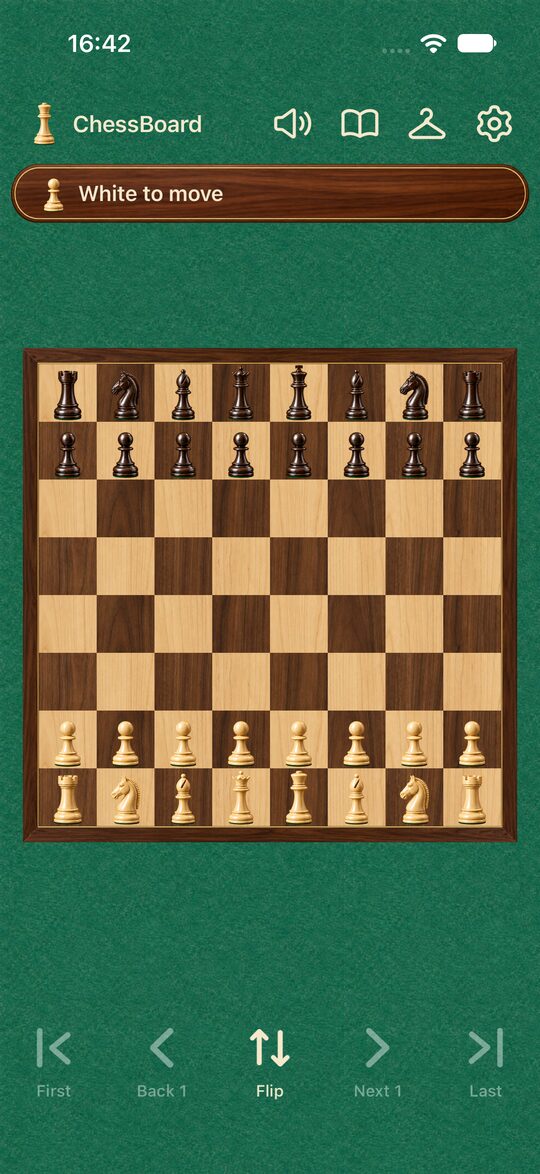
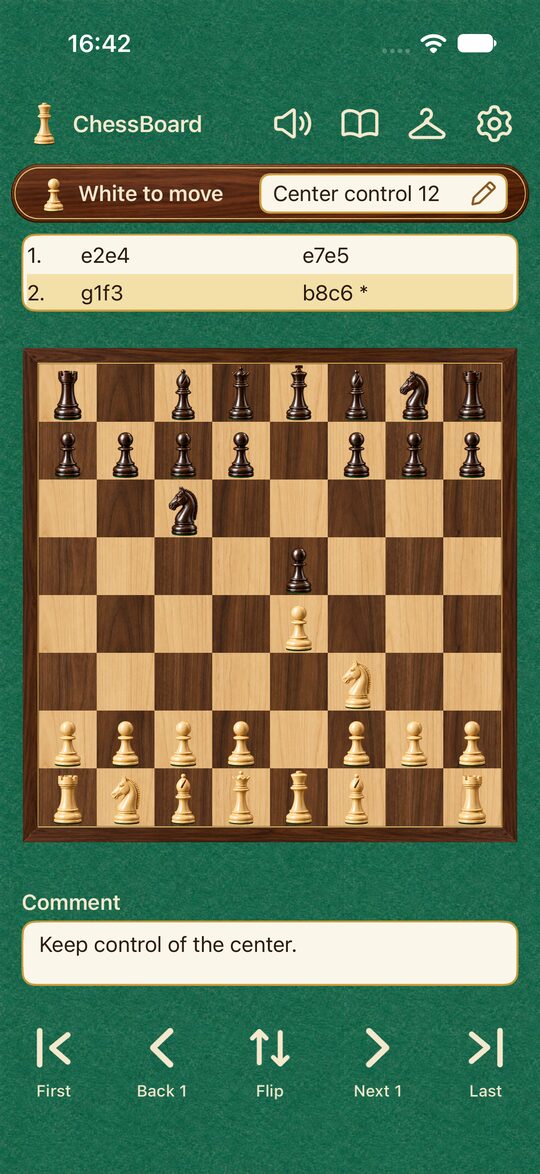
These are real screens from Chess Board.
Using the App
- Moving a piece: Select the piece you want to move and the squares it can go to are shown. Select the destination square and the piece moves.
- Promotion: When a pawn reaches the far rank, a screen appears to choose what it becomes.
- Flip: Turns the board around. Use it when playing face to face or when you want to see the board from Black’s side.
- Back 1 and Next 1: Take moves back, or step forward again through the moves you took back.
- Coordinates: In Settings, “Show board coordinates” puts the a to h and 1 to 8 coordinates on the edges of the board.
Games are saved on your device as game records, and you can resume them from the saved games list. You can save up to 3 games at no charge.
The Goal
You win by checkmating your opponent’s king. Checkmate means the king is under attack (check) and can’t escape no matter how it moves. White moves first, and White and Black alternate, one move each.
How the Pieces Move
| Piece | How it moves |
|---|---|
| King | One square in any direction |
| Queen | Any number of squares along a rank, file, or diagonal |
| Rook | Any number of squares along a rank or file |
| Bishop | Any number of squares diagonally |
| Knight | Two squares along a rank or file, then one square to the side (an L shape). It can jump over other pieces |
| Pawn | One square forward (two squares on its first move only). It captures one square diagonally forward |
Pieces other than the knight can’t jump over other pieces. If you move to a square with an enemy piece on it, you capture that piece.
Special Moves
- Castling: When the king and rook have never moved, there are no pieces between them, the king is not in check, and the squares it passes over are not attacked, you can move the king two squares sideways and move the rook to the other side of the king.
- En passant: When an enemy pawn lands beside your pawn after its first two-square move, you can, on the very next move only, move diagonally forward and capture that pawn.
- Promotion: When a pawn reaches the far rank on the opponent’s side, it becomes a queen, rook, bishop, or knight.
Draws
A game is drawn in the cases below. The app decides them automatically.
- Stalemate: The side to move is not in check but has no legal move.
- Insufficient material: Neither side has enough pieces left to checkmate (such as king against king).
- Fivefold repetition: The same position has appeared five times.
- 75-move rule: Both players have gone 75 moves without moving a pawn or capturing a piece.
Tips for Beginners
- Take the center in the opening: Controlling the squares in the middle of the board with pawns and knights makes your pieces easier to move.
- Get your pieces out early: Moving the knights and bishops early and then castling to tuck the king into a safe corner is the standard opening plan.
- Check for pieces that can be captured: After every move, get in the habit of checking whether the opponent can capture any of your pieces.
For a detailed explanation of the rules, see The Rules of Chess, and if you get stuck, see the Chess FAQ.