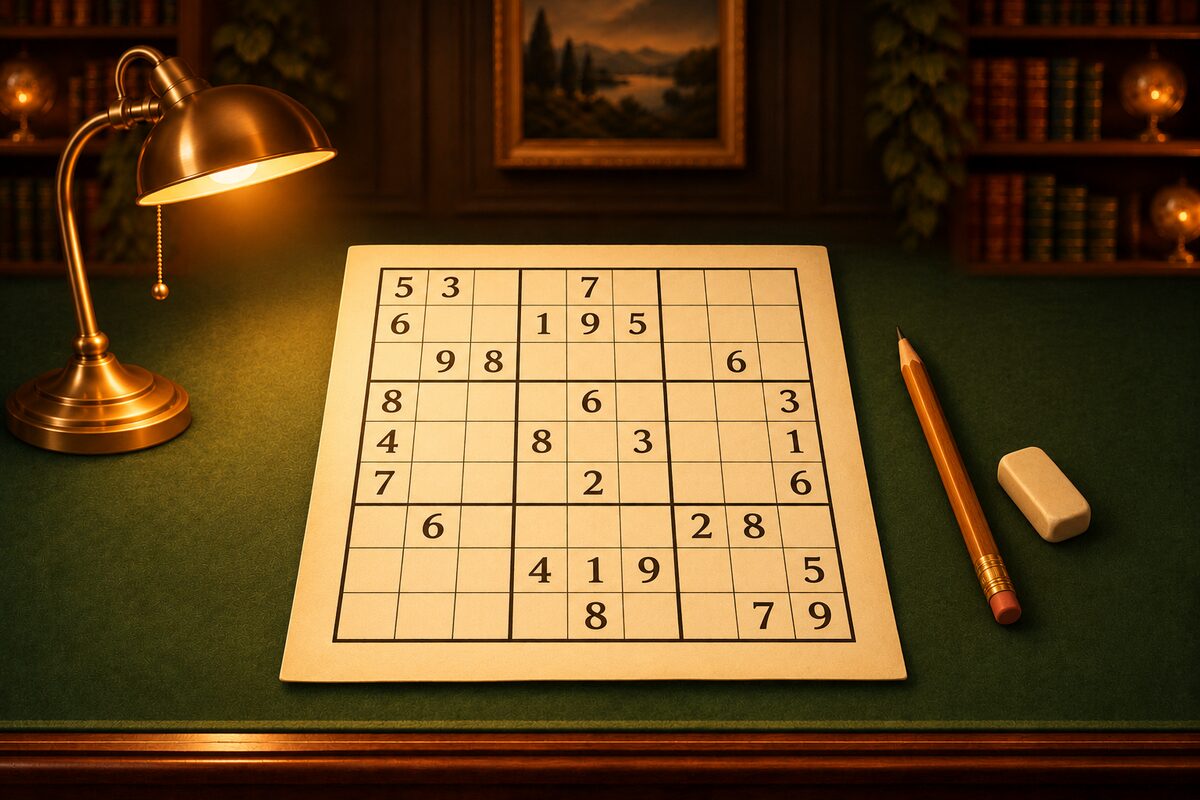
The set patterns for solving sudoku are called techniques. The NumberPlace app uses the following 15 techniques, divided into four tiers from easiest up. A puzzle’s stars are set by the hardest technique needed to solve it (How Is Difficulty Decided?).
Techniques fall broadly into those that settle digits (tier 1) and those that cross out candidates (tiers 2 to 4). After you use a technique that crosses out candidates, you go back to tier 1 to settle digits.
Tier 1: Singles (from ★1)
These are techniques that settle a digit down to one. For details, see The Three Single Techniques.
- Full House: If a row, column, or box has one empty square, the remaining digit goes in.
- Hidden Single: If a digit can go in only one square of a row, column, or box, it’s settled there.
- Naked Single: If only one digit can go in a square, it’s settled as that digit. Needed from ★2.
Tier 2: Locked Candidates and Pairs (from ★3)
These are techniques where you write notes and cross out the digits that can’t go in.
- Pointing: If the candidates for a digit in a box line up in one row (column), cross it out of the rest of that row outside the box.
- Claiming: If the candidates for a digit in a row (column) fit inside one box, cross it out of the rest of that box outside the row.
- Naked Pair: If two squares have the same two digits as their only candidates, cross those two out of the other squares in the same unit.
- Hidden Pair: If two digits can go in only the same two squares, cross out the other candidates in those two squares.
4 and 5 are in Locked Candidates, and 6 and 7 are in Pairs and Triples.
Tier 3: Triples, X-Wing, and Quads (★4 and ★5)
- Naked Triple: If the candidates of three squares add up to three kinds of digits, cross those three out of the other squares in the same unit.
- Hidden Triple: If three digits can go in only the same three squares, cross out the other candidates in those three squares.
- X-Wing: If in two rows the candidates for a digit lie only in the same two columns, cross it out of the other squares in those columns (it works the same with rows and columns swapped).
- Naked Quad: If the candidates of four squares add up to four kinds of digits, cross those four out of the other squares in the same unit.
- Hidden Quad: If four digits can go in only the same four squares, cross out the other candidates in those four squares.
8, 9, 11, and 12 are in Pairs and Triples, and 10 is in The X-Wing and the Swordfish.
Tier 4: XY-Wing, XYZ-Wing, and Swordfish (★4 and ★5)
- XY-Wing: Combine three squares with two candidates each (a pivot and two pincers), and cross out the digit the pincers share from squares that see both pincers.
- XYZ-Wing: The XY-Wing where the pivot has three candidates. Cross the digit out of squares that see all three squares.
- Swordfish: If in three rows the candidates for a digit lie only in the same three columns in total, cross it out of the other squares in those columns.
13 and 14 are in How to Solve Hard Sudoku, and 15 is in The X-Wing and the Swordfish.
In What Order Should You Learn Them?
It’s best to learn them in the order of the tiers.
- Get to where tier 1 alone solves ★1 and ★2 (How to Solve Sudoku).
- Write notes and solve ★3 with tier 2 (Advanced Sudoku).
- Learn tiers 3 and 4 one at a time, and take on ★4 and ★5 (How to Solve Hard Sudoku).
★4 is a puzzle that needs a technique from tier 3 or higher once, and ★5 needs one two or more times. After you use an advanced technique, singles from tier 1 often carry you through many squares again.
The App’s Hint and the Techniques
The app’s Hint tries these 15 techniques from easiest up, and looks for the next square it can settle. For the reason it gives, a tier 1 technique gets its own wording for each technique, and from tier 2 up it says “Narrowing down the candidates, this square must be 7”. Every puzzle is made so that it can be solved with these 15 techniques alone, so Hint can always point to the next square.