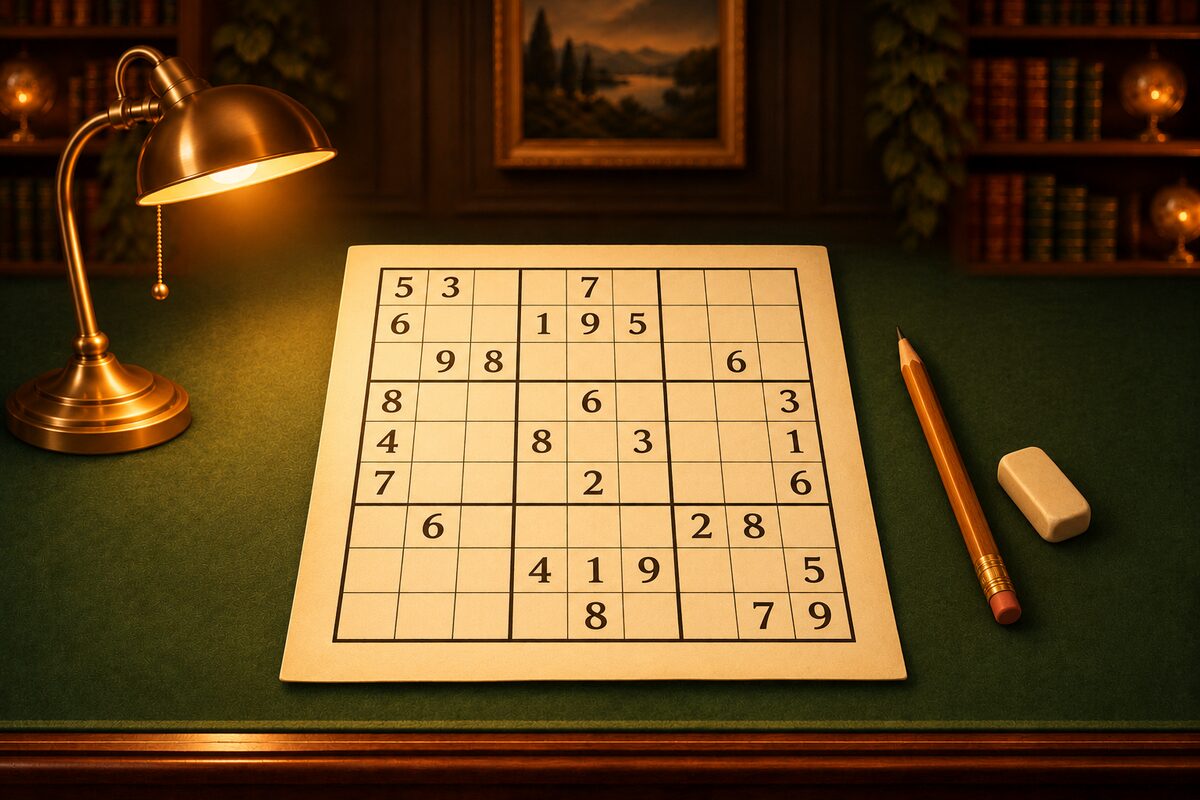
Beginner and intermediate sudoku puzzles can be solved all the way through with just two ideas: “only this square can hold this digit” and “only this digit fits in this square” (singles; see How to Solve Sudoku). In advanced puzzles, those two ideas run out partway through. From there, you use techniques that write down the candidates and cross out the digits that cannot go in.
The boards in this article are mid-game boards from puzzles made by the NumberPlace app. The indigo digits are ones that were already placed with singles.
How to Work Through an Advanced Puzzle
- Fill in every square that a single can place.
- In each empty square, write all the digits that could go in (the candidates).
- Look for a pattern that lets you cross out candidates. Try them in the order of this article, easiest first.
- Once candidates are gone, look for singles again.
For how to write candidates, see How to Use Notes. For the whole list of techniques, see All the Sudoku Techniques.
These techniques only cross out candidates. They don’t place a digit directly. But once you cross candidates out, you get squares left with one candidate, or units where a digit fits in only one square, and you can go back to singles.
Locked Candidates (Pointing)
If, within one box, the candidates for a digit all lie in a single row or column, you can cross that digit out of the rest of that row or column outside the box.
The board shows only the candidates for 8. The 8 in the bottom-left box goes either in row 8, column 3 or in row 9, column 3. Both are in column 3, so you can cross out the 8 in the other square of column 3 that holds it (row 1, column 3).
Locked Candidates (Claiming)
There is also a form that works the other way around. If, within one row or column, the candidates for a digit all fit inside a single box, you can cross that digit out of the other squares of that box.
In column 2, the only squares that can hold a 3 are row 7, column 2 and row 9, column 2. Both are in the bottom-left box, so that box’s 3 must go in one of these two squares of column 2. That means you can cross out the 3 in row 9, column 3. The candidates for row 9, column 3 were 3 and 6, so it must be 6.
Naked Pairs and Triples
If, within one row, column, or box, two squares have the same two digits and nothing else as candidates, those two digits are shared between the two squares. You can cross those two digits out of the other squares in the same unit (a Naked Pair; there is a diagram in the solving article).
It works the same way with three squares. If the candidates of three squares add up to only three digits, those three digits are shared among the three squares. It’s fine if a square doesn’t hold all three.
In row 2, row 2 column 3 (2, 8), row 2 column 4 (2, 7), and row 2 column 5 (2, 7, 8) together hold just three digits: 2, 7, and 8. Those three digits must go in these three squares, so you can cross 2, 7, and 8 out of the other squares in row 2. This is called a Naked Triple.
Hidden Pairs
Now look from the digit’s side. If, within one unit, two digits can go in only the same two squares, those two squares are settled for those two digits. You can cross out all the other candidates in those two squares.
In the center box, the only squares that can hold 2 and 3 are row 4, column 6 and row 6, column 6. The 2 and the 3 are shared between these two squares, so no other digit can go in them. You can cross out 6, 7, and 8. This is called a Hidden Pair. When squares have many candidates, it’s hard to spot, so try counting, digit by digit, “where in this unit can this digit go?”
X-Wing
The X-Wing is a technique that focuses on a single digit. When in two rows, the candidates for a digit lie in the same two columns and nowhere else, you can cross that digit out of the other rows in those two columns.
In row 2, the 8 goes only in column 3 or column 4. In row 7, the 8 also goes only in column 3 or column 4.
- If the 8 in row 2 is in column 3, the 8 in row 7 is in column 4.
- If the 8 in row 2 is in column 4, the 8 in row 7 is in column 3.
Either way, the 8s in columns 3 and 4 are used up by rows 2 and 7. So you can cross out the 8 in the other squares of columns 3 and 4 (row 8, column 3 and row 9, column 3). The four gold circles are the corners of a rectangle, and the crossing diagonals look like an X, which is where the name comes from. It also works with rows and columns swapped (in two columns, the candidates lie in the same two rows and nowhere else) (The X-Wing and the Swordfish).
How This Relates to the App’s Stars
In the 9×9 mode of the NumberPlace app, a puzzle that needs locked candidates and pairs is ★3, and a puzzle that needs a technique like a triple or an X-Wing once is ★4. A ★5 puzzle uses harder techniques as well, two or more times. The XY-Wing and Swordfish used in ★5 are extensions of the ideas in this article.
In the app, you can switch to Notes to write candidates. When you place a digit, that digit is automatically erased from the notes in the same row, column, and box, so you rewrite candidates less often. If you get stuck, press Hint and it shows you the next square that can be settled, with a message like “Narrowing down the candidates, this square must be 7”.