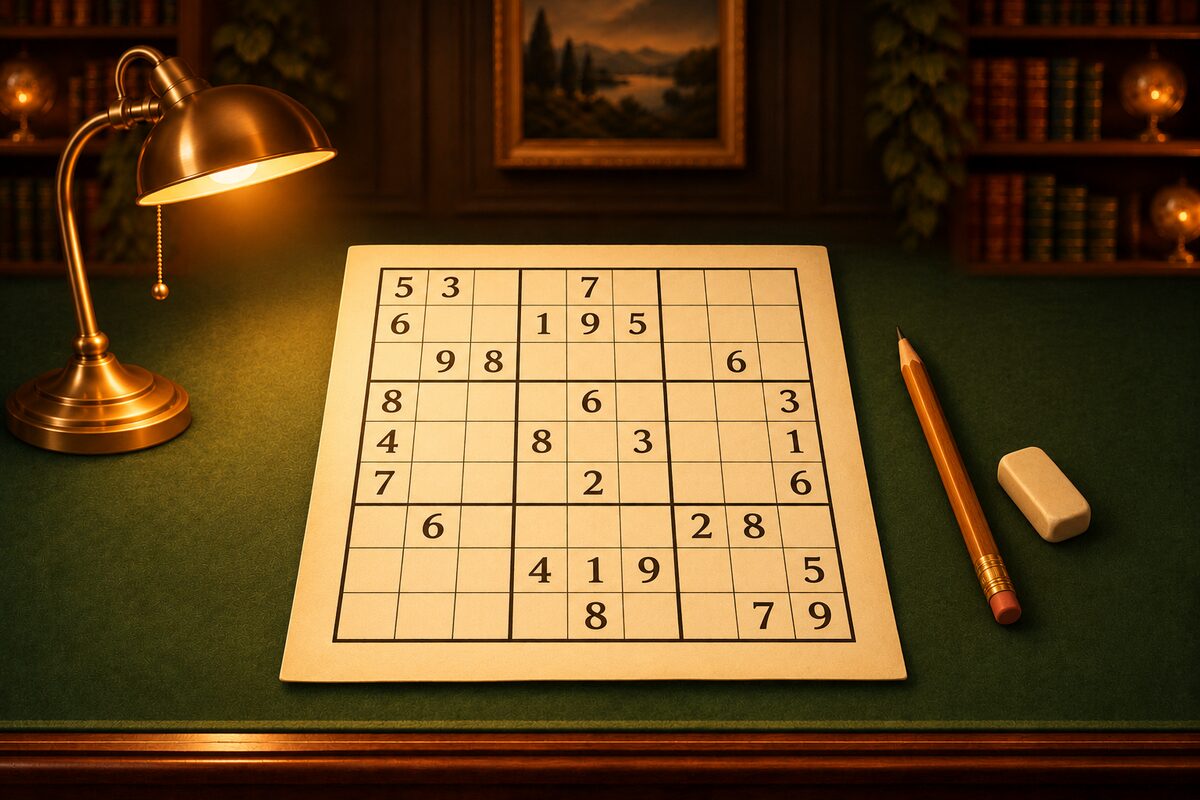
A “single” is a technique where a digit is settled down to one. In the NumberPlace app’s 9×9, ★1 and ★2 can be solved with just these three techniques. Even in hard puzzles, these three are what move the game forward in the end, so if you get quick at spotting them, you’ll solve every puzzle faster.
Every diagram is the middle of a puzzle made by the app. The indigo digits are the ones placed so far.
Full House (the Last Square)
When any row, column, or box is down to just one empty square, the remaining digit goes there.
The top-right box holds 1, 2, 3, 4, 5, 6, 8, and 9, and the only empty square is row 1, column 9. The missing 7 goes in. It’s the easiest technique, but it’s easy to overlook after you place a digit, so every time you place one, look again at the same row, column, and box.
Hidden Single (Only This Square Can Hold It)
When a digit can go in only one square in a row, column, or box, it’s settled there. It’s fine if that square still has candidates for other digits. It’s “hidden” among the other candidates, which is why it’s called a Hidden Single.
An example of looking in a box was shown in How to Solve Sudoku. Here, let’s look at examples for a row and a column.
Looking in a Row
Row 5 doesn’t have a 4 yet. The empty squares in row 5 are in columns 2, 3, 6, and 8, four of them.
- Row 5, column 2 can’t hold it, because there is a 4 in row 9, column 2.
- Row 5, column 3 can’t hold it, because there is a 4 in row 2, column 3.
- Row 5, column 6 can’t hold it, because there is a 4 in row 7, column 6.
The remaining square, row 5, column 8, gets the 4. This square has two candidates, 4 and 9, but this is the only place in row 5 where a 4 can go, so it’s settled as 4.
Looking in a Column
Column 1 has two empty squares, row 2, column 1 and row 8, column 1, and the missing digits are 3 and 9. In row 2, there is a 3 in row 2, column 8, so row 2, column 1 can’t hold a 3. So the 3 goes in row 8, column 1 (the remaining row 2, column 1 is 9).
Naked Single (Only This Digit Fits)
When you focus on one square and rule out every digit in the same row, column, and box, and only one digit is left to go in, it’s settled as that digit.
Let’s look at row 9, column 4. Row 9 has 2, 3, 6, 7, 8, and 9. Column 4 has 1, 5, and 7. The bottom-center box has 2, 3, and 7. Together that’s eight digits, 1, 2, 3, 5, 6, 7, 8, and 9, so only 4 is left to go in.
A Naked Single is obvious at a glance if you’ve written notes, but to spot it without notes you have to count the digits square by square. That’s why it’s often harder to spot than a Hidden Single, and why the app requires it from ★2.
The Order to Look
- After placing a digit, check that row, column, and box for a Full House.
- Go through the digits from 1 to 9 and look for Hidden Singles box by box. If you can’t find any, look in rows and columns too.
- If there are still none, look for Naked Singles in squares of the rows, columns, and boxes with few empty squares.
When you can’t find any of the three, write notes and move on to locked candidates.
The reasons that the app’s Hint gives match these three techniques. “This is the only empty square in the lit area” is the Full House, “This is the only square in the lit area where 7 fits” is the Hidden Single, and “Only 7 fits in this square” is the Naked Single.