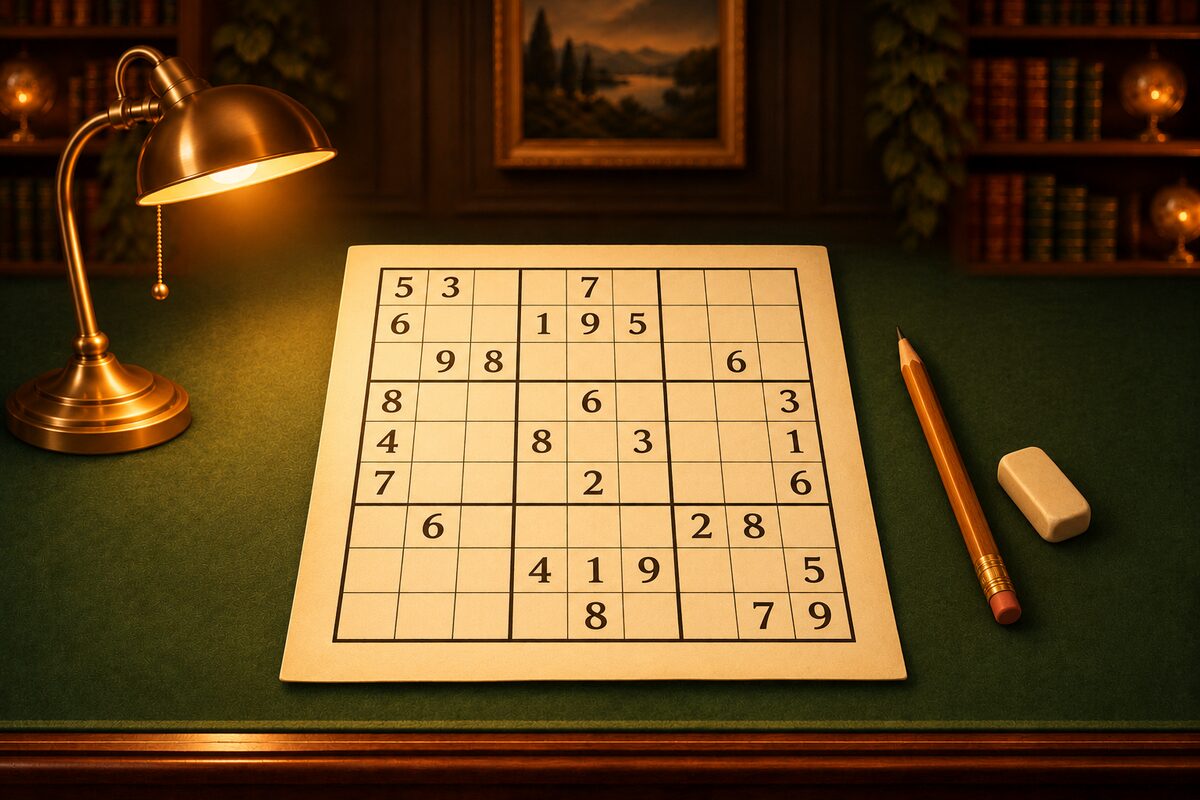
The way to solve sudoku comes down to trying the easier ideas first. Beginner puzzles can be solved all the way through with just two ideas. When you get stuck, you write down candidates and move on, bit by bit, to harder techniques. For the rules, see How to Play Sudoku.
In this article, we name squares like “row 3, column 9” (the third row from the top, the ninth column from the left). The numbers above and to the left of a diagram are the column and row numbers.
1. Look for “Only This Square Can Hold It” in a Box
The first thing to try is checking which square in a box a digit can go in. As you rule out squares whose row or column already has that digit, sometimes only one square is left.
The diagram below is a ★1 puzzle from the app. The dark gold squares hold the 8s. Let’s look for where an 8 can go in the top-left box.
- In row 2, there is an 8 in row 2, column 8. So an 8 can’t go in row 2 of the top-left box.
- Column 1 has an 8 in row 7, column 1, and column 2 has one in row 4, column 2. So it can’t go in columns 1 or 2 either.
The only square left is row 1, column 3. The 8 goes there. A move that is settled by the fact that no other square can hold the digit is called a Hidden Single.
If you go through the digits from 1 to 9 and look at the boxes one at a time, you’ll miss less. If you don’t find anything in the boxes, look at rows and columns in the same way.
2. Look for “Only This Digit Fits” in a Square
Now the other way around, focus on one square. If you rule out all the digits in the same row, column, and box as that square, sometimes only one digit is left that can go in.
The diagram below is the middle of a ★2 puzzle (the indigo digits are the ones placed so far). Let’s think about which digit goes in row 3, column 9.
Row 3 has 3, 5, 6, 7, and 9. Column 9 has 2, 5, and 7. The top-right box has 2, 3, 4, 5, 7, and 8. Together, that covers all eight of 2 to 9, so the only digit that can go in row 3, column 9 is 1. This is called a Naked Single.
Also, when a row, column, or box has just one empty square left, you simply put in the remaining digit (a Full House). These three together are called “singles” (The Three Single Techniques).
3. If You Get Stuck, Write Out the Candidates in Notes
When singles stop settling digits, write the digits that might go in (the candidates) as notes in the empty squares (How to Use Notes). Once you can see the candidates, you can use the next two techniques.
Locked Candidates (Pointing)
The diagram below is the middle of a ★3 puzzle, with only the candidates for 8 written. In the bottom-left box, the only squares that can hold an 8 are row 8, column 3 and row 9, column 3.
Both squares are in column 3. The 8 of the bottom-left box must go in one of these two squares of column 3. So an 8 can’t go in the other square of column 3 (row 1, column 3). You can cross out the candidates with the red slash (Locked Candidates).
Pairs (Naked Pair)
The diagram below is another ★3 puzzle, with the candidates of column 1 written out. The candidates of row 5, column 1 and row 8, column 1 are both just 7 and 9.
The 7 and the 9 can only be shared between these two squares. So you can cross 7 and 9 out of the other squares in column 1. Then the only candidate left in row 4, column 1 is 1, so it’s settled as 1 (Pairs and Triples).
4. If You Are Still Stuck, Advanced Techniques
When locked candidates and pairs don’t get you anywhere, use advanced techniques such as triples (three digits shared by three squares), the X-Wing, and the XY-Wing. All of them are tools for “crossing out candidates to create squares that singles can settle”. After using one advanced technique, singles often carry you through many squares again. For details, see Advanced Sudoku and How to Solve Hard Sudoku, and for every technique, All the Sudoku Techniques.
The Order of Solving and the App’s Stars
In the NumberPlace app’s 9×9, the number of stars is set by the hardest technique needed to solve the puzzle.
| Technique | Stars in 9×9 |
|---|---|
| Full House, Hidden Single | From ★1 |
| Naked Single | From ★2 |
| Locked candidates, pairs | From ★3 |
| Triples, X-Wing, and more | ★4 and ★5 |
★4 is a puzzle that needs an advanced technique once, and ★5 needs one two or more times. If you learn the techniques in the order of the table above, you can move up one star at a time.
When in Doubt, Use Hint
When you press Hint in the app, the next square you can settle lights up with a gold ring, and a reason such as “Only 7 fits in this square” appears. The wording of the reason matches the techniques in this article.
- “This is the only empty square in the lit area” … Full House
- “This is the only square in the lit area where 7 fits” … Hidden Single
- “Only 7 fits in this square” … Naked Single
- “Narrowing down the candidates, this square must be 7” … locked candidates, pairs, and so on
If a digit you entered is wrong, it points to that square first. Every puzzle is made so that it can be solved with techniques alone, so with Hint you can always get all the way through.