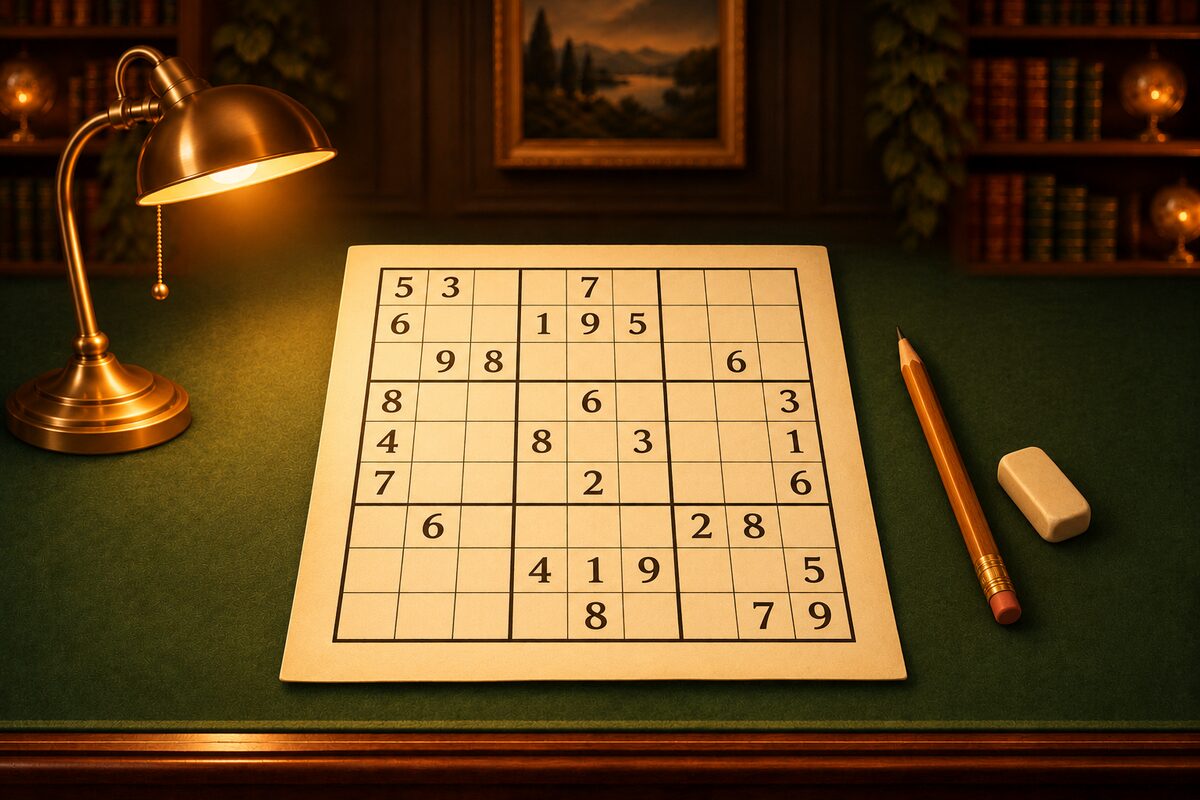
When you stall on a hard sudoku, it helps to decide on an order of things to check instead of staring blindly at the board. Try the easy techniques first, and whenever you find one, go back to the start.
The boards in this article are mid-game boards from ★5 (master) puzzles in the NumberPlace app. The indigo digits are the ones placed so far.
What to Try When You Are Stuck
- Look for missed singles: Go through the digits from 1 to 9, and for each box, row, and column ask “where can this digit go?” (How to Solve Sudoku). Even in hard puzzles, this is the most common thing people miss.
- Check your notes again: Make sure you haven’t left out any candidates, or forgotten to erase one after placing a digit. If your notes are wrong, none of the techniques will work properly.
- Locked candidates: Do the candidates in a box lie in a single row or column? Do the candidates in a row or column fit inside a single box?
- Pairs and triples: Two digits shared by two squares, or three digits shared by three squares. Look from both the square side (Naked) and the digit side (Hidden).
- X-Wing: Pick one digit and look for two rows (columns) where it has only two candidates each.
These are explained with diagrams in Advanced Sudoku. The whole list of techniques is in All the Sudoku Techniques. The next three are what you use when you still aren’t getting anywhere.
XY-Wing
This technique combines three squares that have only two candidates each.
The board shows only the candidates of the squares involved.
- The candidates of row 1, column 1 (the pivot, with the gold ring) are 3 and 5.
- Row 1, column 6, in the same row as the pivot, has 2 and 3, and row 2, column 2, in the same box, has 2 and 5.
If the pivot is 3, row 1, column 6 becomes 2. If the pivot is 5, row 2, column 2 becomes 2. Either way, either row 1, column 6 or row 2, column 2 is a 2. So a 2 can’t go in any square that shares a unit with both of these squares (row 1, column 2 and row 2, column 6).
To look for the shape, pick a square with two candidates as the pivot, then look in the same units as the pivot for “wing” squares that each hold one of the pivot’s two digits. It works if the two wings share the same digit (the 2 in the diagram).
XYZ-Wing
This is the XY-Wing where the pivot has three candidates.
- The pivot, row 8, column 9, has 3, 7, and 9.
- Row 1, column 9, in the same column, has 7 and 9, and row 9, column 8, in the same box, has 3 and 7.
If the pivot is 7, it’s a 7 right there. If it’s 9, row 1, column 9 is 7. If it’s 3, row 9, column 8 is 7. In every case, a 7 goes in one of these three squares. You can cross out the 7 in the square that shares a unit with all three squares (row 7, column 9). Unlike the XY-Wing, the pivot also holds the 7, so the only squares you can cross it out of are those in the same units as the pivot.
Swordfish
This technique widens the X-Wing to three lines. You look at just one digit.
Only the candidates for 7 are written. In columns 3, 5, and 9, the 7 can go only in rows 5, 6, and 7.
- Each of the three columns holds one 7.
- Those three 7s are somewhere in rows 5, 6, and 7, one per row.
In other words, the 7s of rows 5, 6, and 7 are used up by these three columns. So you can cross out the 7 in the other squares of these three rows (row 5, column 6; row 5, column 7; row 6, column 6; and row 7, column 4). It’s fine if a column has two candidates or three (The X-Wing and the Swordfish).
Do You Need to Guess (Place a Trial Digit)?
When you really can’t make progress, there’s also a method where you try “put a 3 here, and if it leads to a contradiction, it’s wrong”. But when you’re wrong it’s hard to go back, and on paper you end up with eraser marks everywhere.
Every puzzle in the NumberPlace app is made so that it can be solved all the way with techniques alone, so you never need a trial digit. A ★5 puzzle is one that uses advanced techniques, such as triples, the X-Wing, and the ones in this article, two or more times.
If You Still Can’t Find Anything
In the app, press Hint and the next square to settle lights up with a gold ring, and the unit that is the reason is lit. When it’s settled by an advanced technique, it says “Narrowing down the candidates, this square must be 7”. If a digit you entered is wrong, it points to that square first, so you can use it when you think you may have made a mistake somewhere.