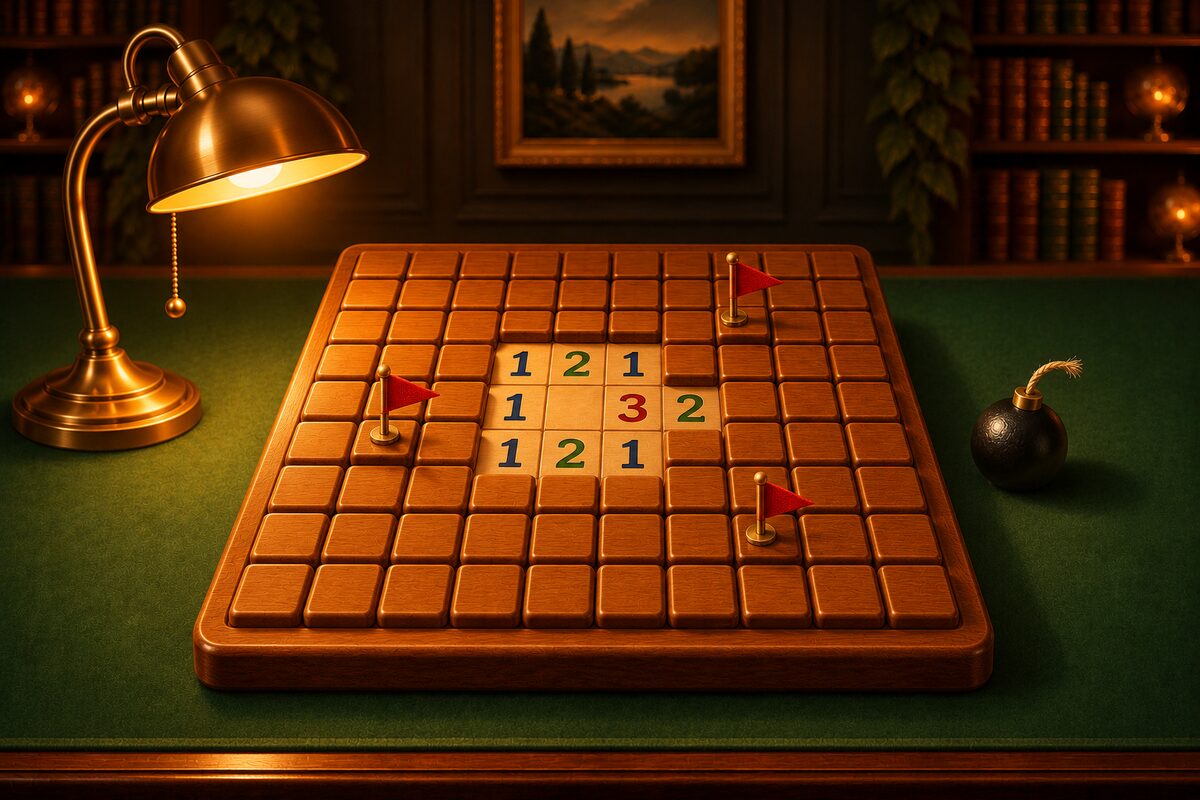
Minesweeper is a game of adding settled squares one at a time. Here are 10 tips for moving along quickly and surely.
1. Open Near the Middle First
You have no clues for the first square, so anywhere looks the same. If you open near the middle, there is plenty of room to spread around it, and you can work on the edge of the opened area from all four sides. The Minesweeper app’s “Hint” also recommends the middle square at the start. The calculation comparing the middle, an edge, and a corner is in Where Should You Open the First Square?.
In the app, the first square is always safe, and the area around it opens at once.
2. Look Only at the “Edge” of the Opened Area
The clues for deduction are the numbers along the edge of the opened area. You can ignore, for now, numbers that touch no covered square and covered squares far from the edge. Narrowing where you look to the edge cuts down on confusion.
3. Look for a “1” with Only One Covered Square
If a number has only as many covered squares around it as its value, they are all mines. The easiest to spot is a “1” with only one covered square around it.
Look at the “1” with the gold ring at row 4, column 4. Of the 8 squares around it, only row 3, column 3 is covered. There is one mine, so row 3, column 3 is a mine. Using the same method, the 4 squares with red circles on this board are settled as mines.
4. When the Number and Flags Match, the Rest Are Safe
When you place a flag on a square you know is a mine, the next clues come into view. If a number has as many flags around it as its value, all the remaining squares around that number are safe.
For example, the “1” at row 6, column 6 has one flag around it, at row 7, column 5, so row 7, column 6 and row 7, column 7 are safe. From just the 4 flags placed, you can tell that the 12 squares with green circles are safe.
5. Chord When the Flags Match the Number
In the app, if you tap a number whose flags are complete, the rest of the squares around it open at once. It moves much faster than opening one square at a time. If a flag is wrong, you open a mine, so place flags only when you are sure.
6. Numbers in Corners and on Edges Are Strong Clues
A square on the edge of the board has only 5 squares around it, and a corner has only 3. With fewer covered squares, the numbers settle things more easily. When you get stuck, look at the numbers on the edges and in the corners first.
7. Compare Neighboring Numbers
Even when one number alone cannot settle it, comparing two neighboring numbers sometimes can (Combining Two Numbers). When two numbers see the same covered squares, think about “how many mines fit in the shared part,” and you can tell whether the squares only one of them sees are safe or mines. Common shapes such as “1-2-1” are shown in diagrams in Minesweeper Patterns.
8. When in Doubt, Look Somewhere Else
Rather than thinking about one spot for a long time, looking at another edge of the board is often faster. Numbers on squares opened elsewhere can become clues for the place where you were stuck. The app’s boards are made to be solvable by logic alone, so there is a clue somewhere. Easy-to-miss moves are collected in When You Think You Are Stuck.
9. In the Endgame, Use the Mines Left
When few covered squares remain near the end, “Mines left” in the top bar is also a clue. For example, if no mines are left, all the covered squares without flags are safe, and if the number of covered squares without flags equals the mines left, they are all mines. The app’s “Mines left” is the number of mines minus the number of flags you placed, so you can use it only when your flags are right (Endgames Solved by the Mine Count).
10. When Stuck, Use “Hint” and “Undo”
The app has two features to help.
- Hint: the next square you can work out by logic lights up with a gold ring. If there is a wrong flag, it points that out first.
- Undo: even if you open a mine, you can go back to before you opened it.
When a square lights up from a Hint, think about “why you can tell that square,” and you will be able to find it yourself next time (How to Use Hints).
Summary
- Open near the middle first
- Look only at numbers along the edge
- A “1” with only one covered square
- When the number and flags match, the rest are safe
- Chord
- Corners and edges
- Compare neighboring numbers
- When in doubt, look elsewhere
- In the endgame, the mines left
- Hint and Undo
If you want to check the rules again, see Minesweeper Rules.