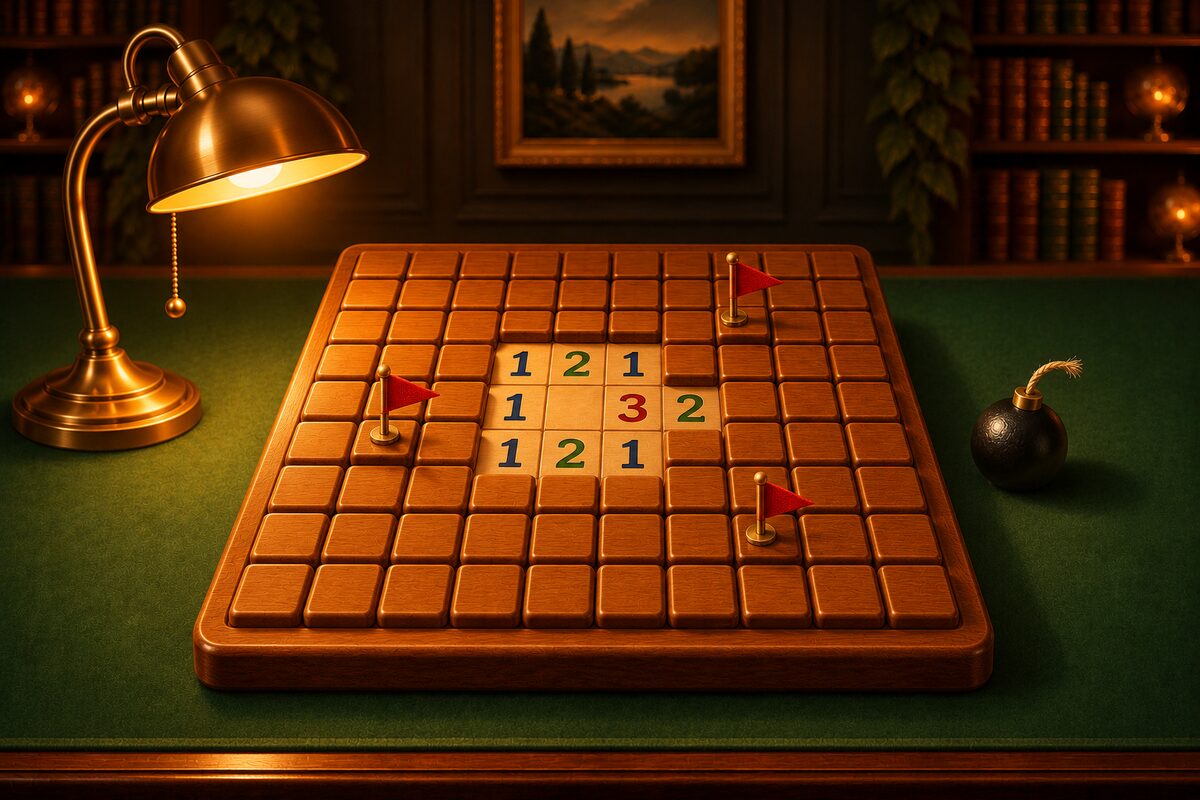
When looking at one number does not settle anything, the next thing to try is “combining two numbers.” The bigger the board, the more you need this kind of deduction.
The Idea: How Many Mines Fit in the Shared Squares?
Two nearby numbers sometimes see the same covered squares. Let us call these squares the “overlap.” There are three steps in the order of thinking.
- Separate the overlap of the two numbers from the squares only one sees for each number.
- Work out at least how many and at most how many mines can go in the overlap.
- “The number minus the mines in the overlap” is the number of mines in the squares only one sees. If this is always 0, all the squares only one sees are safe, and if it always equals the number of those squares, they are all mines.
It sounds hard in words, but it is easy with a diagram.
Example 1: A 1 and a 1, with 3 Safe Squares
Look at the two pale gold “1”s.
- The covered squares the “1” at row 5, column 3 sees are only row 4, column 2 and row 5, column 2. One mine is there.
- The “1” at row 4, column 3 sees those two squares and also row 3, columns 2, 3, and 4.
From the 1 at row 5, column 3, exactly one mine goes in row 4, column 2 and row 5, column 2 (the overlap). The 1 at row 4, column 3 also has just one mine, so that already accounts for it. So the 3 squares at row 3, columns 2 to 4, which only the 1 at row 4, column 3 sees, are safe.
You still cannot tell which of the two overlap squares is the mine. Even so, you can open the 3 squares safely. The numbers on the opened squares become your next clues.
Example 2: A 4 and a 1, with 3 Mines
This is the same shape, with different numbers.
- From the “1” at row 5, column 3, the overlap (row 4, column 2 and row 5, column 2) holds at most one mine.
- The “4” at row 4, column 3 has 4 mines among its 5 covered squares.
- If only one mine fits in the overlap, the remaining three or more go in row 3, columns 2 to 4, which only the 4 sees. There are only 3 squares there, so all 3 are mines.
Even with the same board shape, in Examples 1 and 2 the answer splits into “all safe” and “all mines” just because the numbers differ.
Common Shapes Become “Patterns”
The common shapes among two-number deductions have names, such as 1-1 along a wall, 1-2, 1-2-1, and 1-2-2-1. The diagrams for each shape are in Minesweeper Patterns. Once you learn the patterns, you can make this deduction at a glance.
How Often Do You Need It?
We generated 3,000 boards of each level that can be solved by logic alone, in the same way as the Minesweeper app, solved them by logic from the start, and counted the share of boards that needed a two-number deduction (when a square could be settled by one number, we used that first when counting).
| Board | Share that needed it |
|---|---|
| Level 1 9×7 | about 24% |
| Level 2 12×9 | about 41% |
| Level 3 15×10 | about 78% |
| Level 4 20×12 | about 91% |
| Level 5 26×15 | about 96% |
At Level 1, about three in four boards can be solved with one-number deductions alone, but from Level 3 up, most boards need it. Be sure to learn it before moving on to big boards.
The App’s Second Rule of Deduction
The app’s board building and “Hint” use three rules of deduction. This “combining two numbers” is the second one, and it checks pairs of numbers within two squares of each other, vertically and horizontally. The third is the mines left, used in the endgame.