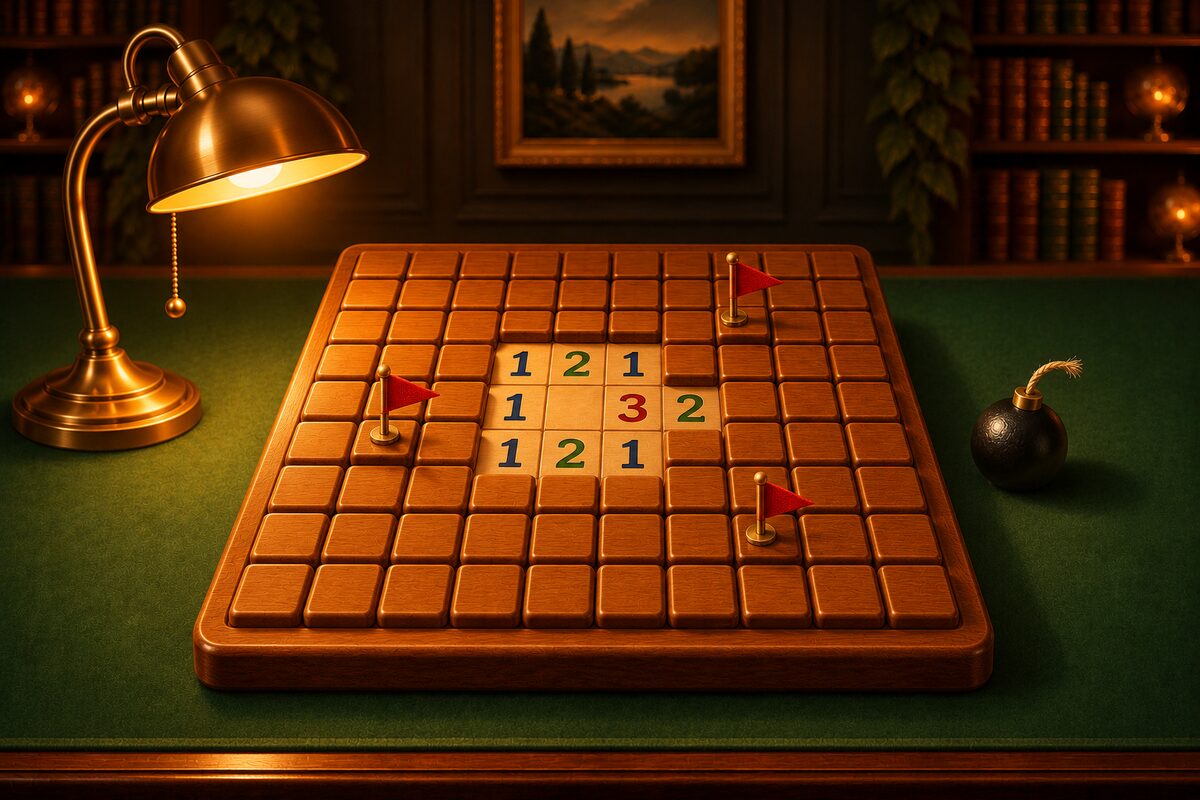
In Minesweeper, some number sequences show up again and again. If you remember the shapes, you can tell the safe squares and mines without thinking. These are called “patterns.”
Here we look at a situation where the covered squares form one row, with numbers lined up in front of them. The squares in front of the numbers (below, in the diagrams) are already open, and the only covered squares the numbers see are the single row above.
In the diagrams, a green circle marks a square settled as safe, and a red circle marks a square settled as a mine. The pale gold squares are the numbers to focus on.
The Idea Behind Patterns: “Subtracting” Two Numbers
Every pattern is built on the same idea.
When two neighboring numbers see some of the same covered squares, the difference between the two numbers tells you about the squares that only one of them sees.
For example, if the squares the left number sees are completely contained in the squares the right number sees, then the number of mines you get by subtracting the left number from the right number lies in the squares only the right number sees. Let us check this subtraction in the four patterns below.
1-1 (From a Wall)
From the left edge (the wall) of the board, a “1” and a “1” are lined up.
- The “1” at row 2, column 1 sees two covered squares: row 1, column 1 and row 1, column 2. One mine is there.
- The “1” at row 2, column 2 sees three squares, row 1, columns 1, 2, and 3, and has one mine.
- The other mine is already in row 1, columns 1 and 2, so row 1, column 3 is safe.
In terms of subtraction, 1 − 1 = 0, so there is no mine at row 1, column 3, which only the right 1 sees. Remember: when a 1-1 lines up along a wall, the third square is safe.
On this board, you still cannot tell which of row 1, column 1 and row 1, column 2 is the mine.
1-2 (From a Wall)
This time, a “1” and a “2” are lined up from the wall.
- The “1” at row 2, column 1 has one mine in row 1, columns 1 and 2.
- The “2” at row 2, column 2 has two mines in row 1, columns 1, 2, and 3.
- Only one mine fits in the first two squares, so the remaining one is at row 1, column 3.
Since 2 − 1 = 1, there is one mine in the squares only the 2 sees. “With a 1-2, the mine is beyond the 2.”
1-2-1
A “1,” “2,” and “1” are lined up in the middle of row 2. The conclusion is that the squares directly above the 1s are mines, and the square directly above the 2 is safe.
- Compare the left “1” (row 2, column 2) and the “2” (row 2, column 3). The 1 sees row 1, columns 1 to 3, and the 2 sees row 1, columns 2 to 4. Because of the 1, the shared squares at row 1, columns 2 and 3 can hold at most one mine. The 2 has two mines, so row 1, column 4, which only the 2 sees, is a mine.
- Think the same way about the right “1” and the “2,” and row 1, column 2 is a mine.
- The mines around the 2 are now complete, at row 1, columns 2 and 4. The middle square, row 1, column 3, is safe.
- The left 1 is complete with the mine at row 1, column 2, so row 1, column 1 is safe too. The same goes for the right side, so row 1, column 5 is safe.
This reasoning holds no matter what is to the left or right of the 1-2-1.
1-2-2-1
When you see “1,” “2,” “2,” “1” in a row, the two squares directly above the 2s are mines, and the squares above the 1s are safe.
- Looking at the 1-2 from the left (the 1 at row 2, column 1 and the 2 at row 2, column 2), row 1, column 3, beyond the 2, is a mine.
- Looking at the 1-2 from the right (the 1 at row 2, column 4 and the 2 at row 2, column 3), row 1, column 2, beyond the 2, is a mine.
- The left 1 is complete with the mine at row 1, column 2, so row 1, column 1 is safe. The right 1 is also complete with the mine at row 1, column 3, so row 1, column 4 is safe.
The diagram shows the shape from one end of the board to the other, but even for a 1-2-2-1 in the middle of a board, the squares above the 2s are mines and the squares above the 1s are safe.
When Patterns Do Not Apply
Patterns are the shapes you get when the squares in front of the numbers are open and there is only one row of covered squares. If there are covered squares in front of the numbers too, or flags mixed in, you cannot use them as they are.
In that case, subtract the flags you placed from the number. For example, if there is one flag around a “3,” you can treat the rest as a “2.” If you look again using the “remaining number,” which is the number minus the flags, you will often find a familiar 1-2 or 1-2-1.
The Minesweeper app’s board building and “Hint” also use this idea of “combining two numbers” as one of their rules of deduction.
Summary
- 1-1 (from a wall): the third square is safe
- 1-2: the mine is beyond the 2
- 1-2-1: the squares above the 1s are mines, and the square above the 2 is safe
- 1-2-2-1: the squares above the 2s are mines, and the squares above the 1s are safe
More tips are collected in Minesweeper Tips.