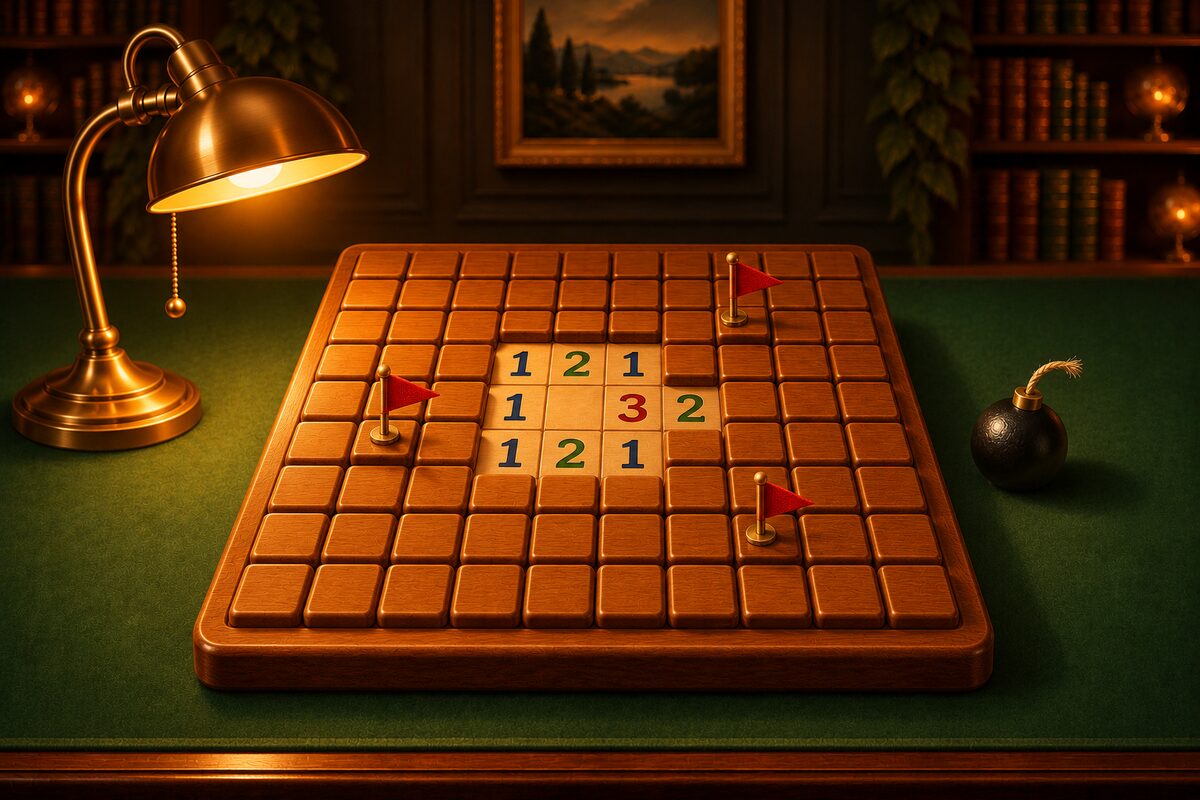
On the first square in Minesweeper, you have no clues at all. Where is the best place to open?
In the App, the First Square Is Always Safe
In the Minesweeper app, no mines are placed on the first square you tap or around it. The board is built the moment you make your first tap.
- Since there are no mines around the first square, it is always a “0,” and the area around it opens at once.
- On top of that, only boards that can be fully opened by logic alone from the first square are chosen.
You cannot lose no matter where you start. What differs is how much opens at the start.
Comparing the Middle, an Edge, and a Corner
We generated 1,000 boards for each case in the same way as the app and calculated the average number of squares opened by the first tap for each starting spot. “Edge” is the middle row of the left edge, and “corner” is the top-left corner.
| Board | Middle | Edge | Corner |
|---|---|---|---|
| Level 1 9×7 | about 37 squares | about 31 squares | about 25 squares |
| Level 3 15×10 | about 40 squares | about 29 squares | about 22 squares |
| Level 5 26×15 | about 48 squares | about 31 squares | about 21 squares |
On every board, starting in the middle opened the most squares. At Level 5, it is more than double what you get from a corner.
When fewer squares open at the start, you get fewer clue numbers. If you start in a corner, you may open only the first square and a few around it. On Level 5 boards started from a corner, about 1 in 4 opened 9 squares or fewer on the first tap. For boards started from the middle, it was about 3%.
The app’s “Hint” also recommends the middle square if you press it before your first move. When in doubt, start in the middle.
Why the Middle Opens More
A middle square has 8 squares around it. With no mines on the first square and its 8 neighbors, 9 squares in all, the 0 squares easily connect and spread from there. A corner square has only 3 squares around it. With only 4 squares kept free of mines, there is less to get the spread started.
Also, an area opened from the middle can spread in any direction: up, down, left, or right. When you open from a corner, the walls limit the directions it can spread.
In Ordinary Minesweeper
In a Minesweeper that places mines at random, without a way to protect the first square, you can hit a mine on your first tap. The probability is the number of mines divided by the number of squares. For example, on a 9×7 board with 8 mines, the same as Level 1, it is 8 ÷ 63, about 13%.
Many versions of Minesweeper are made so that the first square cannot be a mine. The rules differ depending on what you play, so if you lose right on the first square, assume that is how it was built.
From the Second Move, It Is Logic
Once the first square is open, it is your turn to deduce. Look at the numbers along the edge of the opened area and open the squares you are sure about. We explain the thinking in Minesweeper Tips and What One Number Tells You.