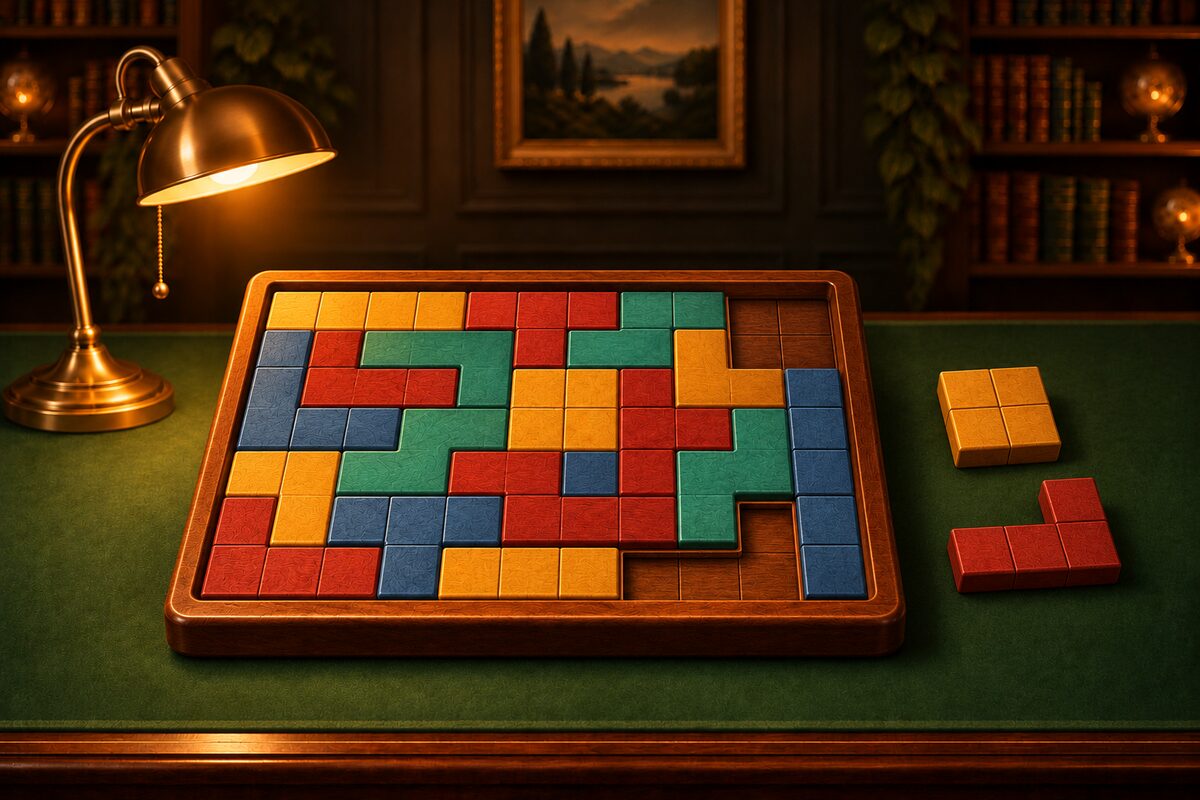
When you are stuck on a block puzzle, look at the corners and dents. Those are spots where only a few placements work.
The Difference Between Corners and the Middle
In an empty 6×6 frame, I counted how many ways, on average, one piece can cover a corner cell, and how many ways it can cover a cell near the middle (row 3, column 3).
| Piece | Corner | Middle |
|---|---|---|
| 3 cells | 2.5 | 9.0 |
| 4 cells | 1.9 | 10.6 |
| 5 cells | 2.1 | 15.6 |
At a corner, every piece has only about 2 placements. In the middle, there are about 5 times as many for 4 cells and about 7 times as many for 5 cells. The middle is a spot that you can fill later with all sorts of pieces.
Dents Have Even Fewer
As you place pieces, dents appear in the frame (cells blocked on three sides). A dent cell has even fewer placements than a corner.
The cell with the gold ring in the diagram above is blocked by P above and to the right, and the frame’s edge is on its left. In the example puzzle in the article on solving, there were only 4 ways to cover this cell with the remaining pieces, and only 1 of them, the T placed upright, could be completed all the way.
Tips for Filling
- Ask, “Which piece fits this cell?”: Pick one corner or dent cell and picture every piece and orientation that fits there.
- If there is only one way, place it right away: If only one piece fits, commit to it without hesitating.
- Straight pieces for thin bumps: In a long, one-cell-wide bump, the end of an I or L piece often fits.
Frames in Shapes mode have lots of bumps and dents. For how to approach those frames, see How to Solve Shapes Mode.