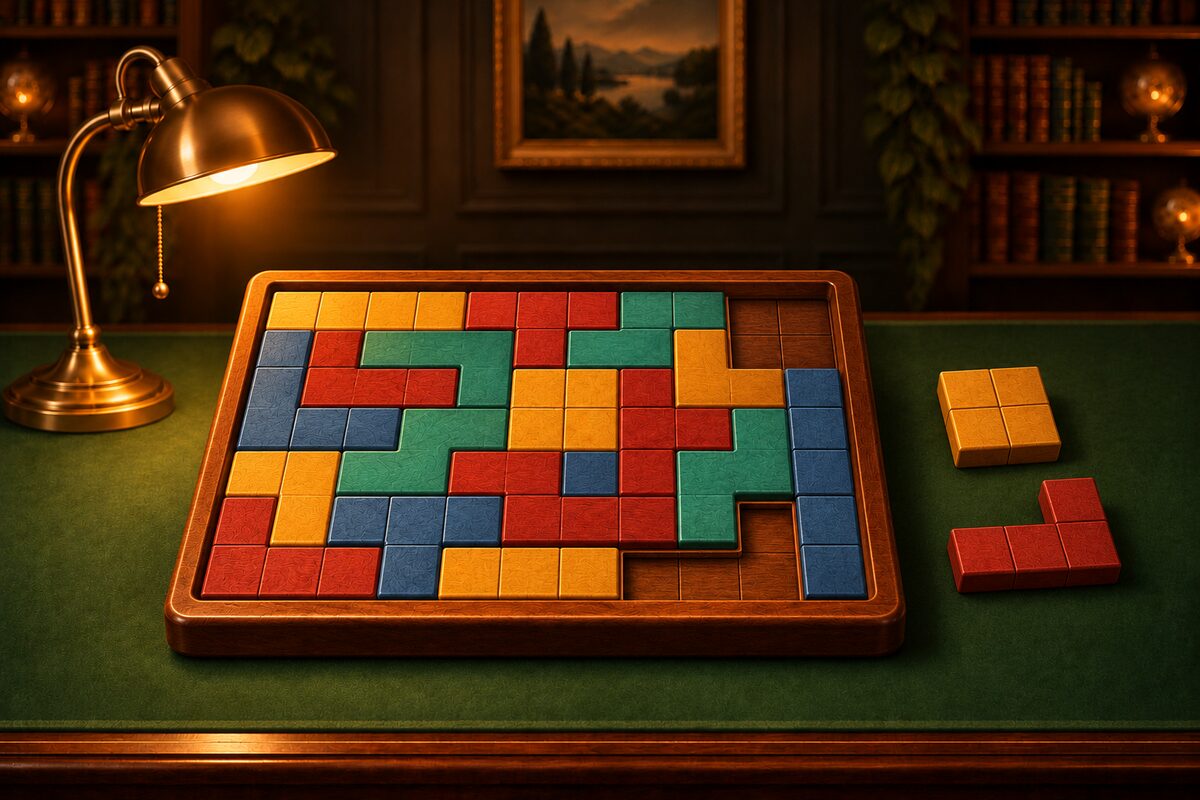
When you are stuck on a block puzzle, sometimes “the number of cells matches, but it just will not fill.” In that case, a helpful method is counting with a checkerboard pattern.
Color It Black and White
Color the cells of the frame black and white in turns, like a chessboard. Neighboring cells always have different colors.
A 4×4 frame has 8 black cells and 8 white cells.
Black and White for Each Piece
When you place a piece, the number of black and white cells it covers is fixed. For 4-cell pieces, it works like this.
- I, O, S, and L always cover 2 black and 2 white, wherever and however you place them.
- Only T covers 3 black and 1 white, or 1 black and 3 white.
Example: The Cell Count Matches, but It Will Not Fill
A T has been placed on a 4×4 frame. The remaining 12 cells are to be filled with three pieces, L, S, and O (4 × 3 = 12 cells).
The cell count matches. But if you count the remaining 12 cells, there are 7 black and 5 white.
L, S, and O each cover 2 black and 2 white, so together the three always cover 6 black and 6 white. A spot with 7 black and 5 white cannot be filled however you place them. Even when a computer tried every placement, there were 0 ways (and 0 ways even if flipping is allowed).
In this way, counting with a checkerboard can sometimes tell you it is impossible before you try placing anything.
If a T Remains, It Can Match
If one T is among the remaining pieces, the T can take care of 3 black and 1 white, so the black and white counts can match. A matching count only means “it might fill”; it does not mean it always will. Even so, you can rule out placements whose counts do not match early, which cuts down the number of things to try.
With 5-Cell Pieces
A 5-cell piece has an odd number of cells, so its black and white counts always differ. Of the 12 pentominoes, 11 cover 3 black and 2 white or 2 black and 3 white, and only the cross-shaped X covers 4 black and 1 white or 1 black and 4 white. Every 3-cell piece covers 2 black and 1 white, or 1 black and 2 white.
Which color has more switches depending on where you place it, so you cannot be as definite as with 4-cell pieces. Even so, if the difference between black and white among the remaining cells is larger than the difference the remaining pieces can make, you know it cannot be filled.
Using It in the App
Every puzzle in the Wood Block Fit app is made so that it can always be solved. The checkerboard never fails to match in the starting frame.
The checkerboard is useful when you get stuck partway through. Count the remaining gaps in black and white, and if the remaining pieces cannot match, one of the pieces you have already placed is wrong. Go back with “Undo,” or let “Hint” tell you which piece to take out.
The reason five kinds of tetrominoes cannot make a rectangle can also be explained with the same counting (What Is a Tetromino?).