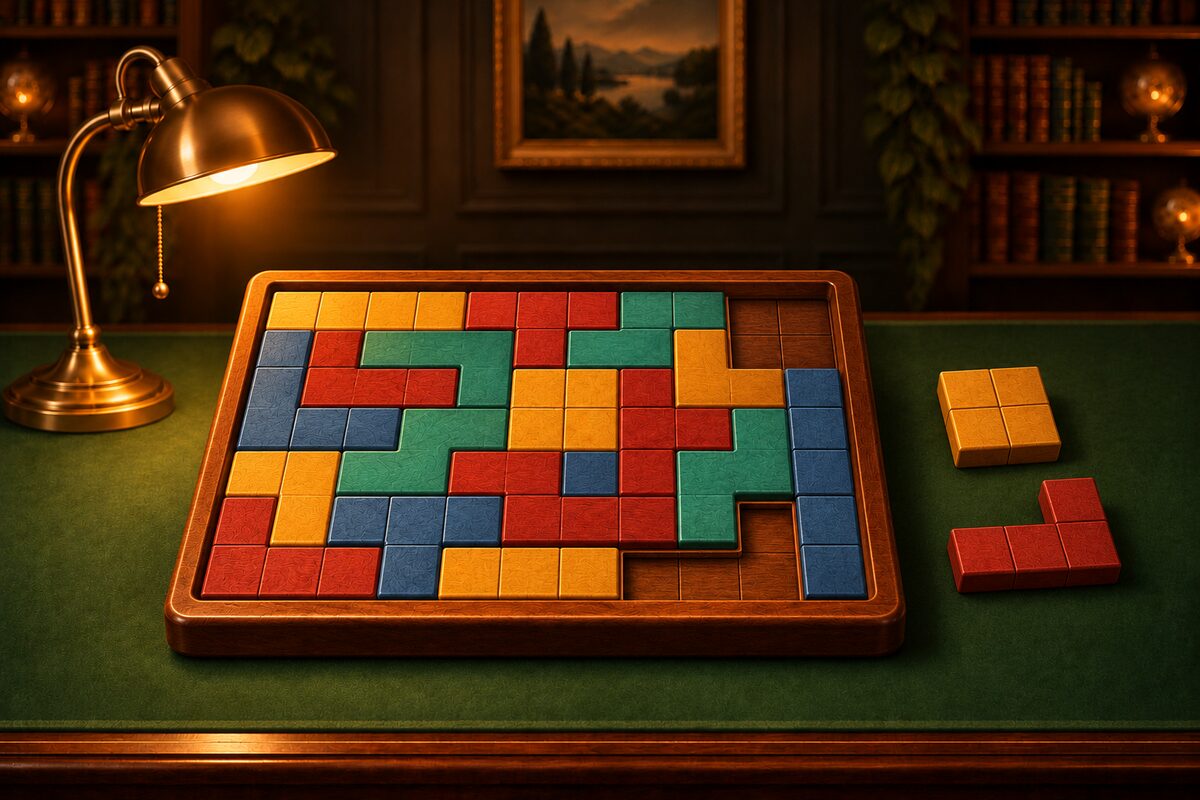
A block puzzle is a puzzle where you pack pieces of various shapes into a frame with no gaps. If you place pieces at random, you end up with a gap that nothing fits into at the end.
In this article, we test the idea of filling the cells with the fewest placements first on an example puzzle.
Example: 5 Pieces in a 4×5 Frame
We will pack the following 5 pieces into a 20-cell, 4×5 frame. Pieces may be rotated but not flipped over (the same as in the Wood Block Fit app).
5 + 4 + 4 + 4 + 3 = 20 cells, so the total matches the frame exactly.
Counting Placements for Each Cell
For each cell of the empty frame, I counted how many ways there are to place a piece covering that cell. I tried all 5 pieces in every rotation and every position.
A corner cell has only 12 placements, but a middle cell has as many as 63. You can fill the middle later with all sorts of pieces. At a corner, only a few piece orientations fit.
That is why deciding from the corners first leaves you fewer choices to agonize over.
Move 1: A Big Piece in the Corner
In the top-left corner, we place the biggest piece, the 5-cell P.
The numbers on the empty cells are the placement counts, recounted with the remaining 4 pieces. The dent cell below the P (row 2, column 1) has only 4 placements, making it the hardest cell to fill.
Move 2: Fill the Dent
Of the 4 placements that fit into the dent, only 1, the T placed upright, can be completed all the way.
Now the gap that formed at the bottom right of the T (row 4, column 2) has 2 placements.
Moves 3 and 4: Fill From Where It Is Settled
Of the 2 placements for row 4, column 2, the one that can be completed is the S placed sideways.
The 7 cells on the right remain. The bottom-right corner (row 4, column 4) has 2 placements, and only the 4-cell L can be completed.
The remaining 3 cells take the 3-cell L in exactly one way.
Done! From move 2 on, just choosing the cell with the fewest placements filled the frame with almost no hesitation.
Summary of How to Solve
1. Fill Corners and Dents First
Corner cells, dents, and thin bumps fit only a few piece orientations. Deciding from there leaves you fewer choices. Ask yourself, “Which pieces fit this cell?”
2. Place Big Pieces First
A 5-cell piece has limited places to go. If you save it for last, it tends to have nowhere to fit. The small 3-cell piece is handy for filling the last gap.
3. Do Not Leave Small Gaps
An enclosed gap of 1 or 2 cells fits no piece (the pieces in the app have 3 or more cells). Before you place a piece, look at what gaps it will leave around it.
If an enclosed gap forms, it is a sign that the current placement can no longer be completed. Go back early.
4. If It Does Not Fit, Go Back One
When you are stuck, moving not only the last piece you placed but the one before it often solves it. In the app, you can use “Undo” to go back one move at a time.
The App’s Hint Uses the Same Idea
When you can still fill the frame from your current placement, the Wood Block Fit app’s “Hint” makes the piece covering the hardest empty cell to fill, and where it goes, glow. It is the same idea as the one in this article.
When you cannot fill the frame from your current placement, it makes the piece you should take out glow and tells you, “Take out the glowing piece to get back on track.”