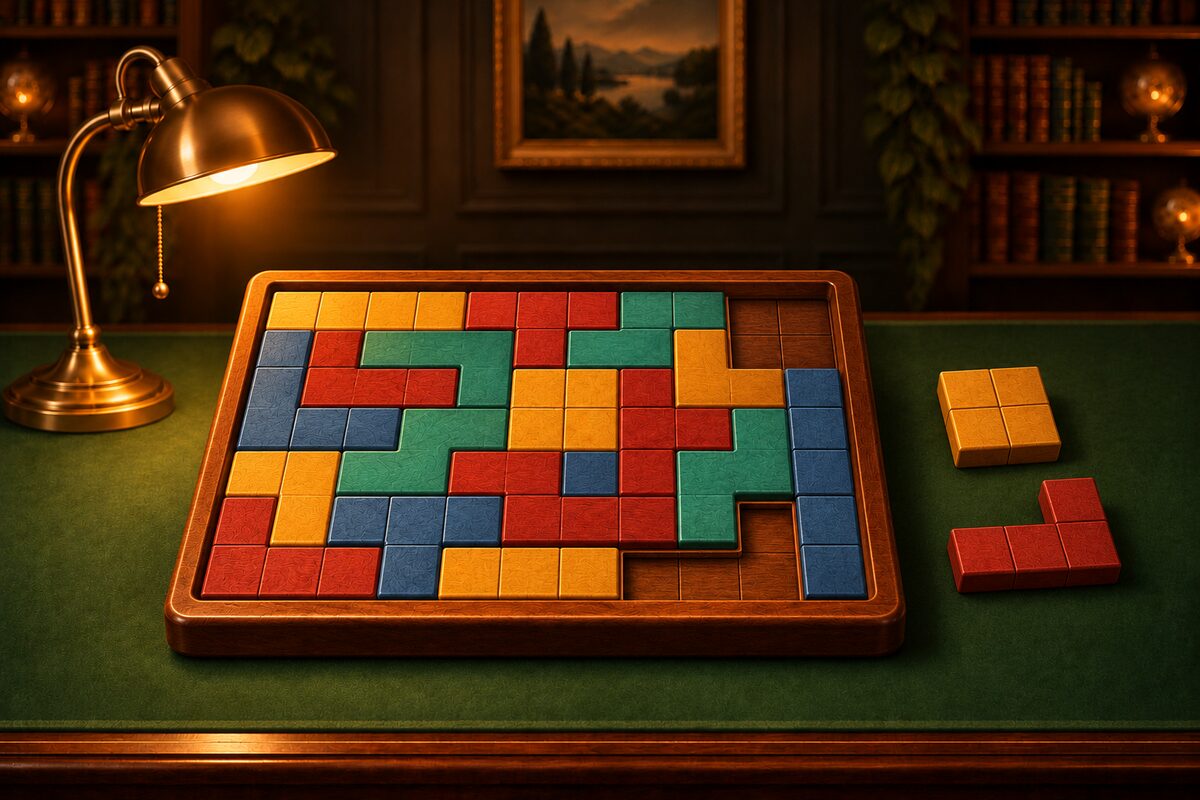
Wood Block Fit has two modes: Rectangles, where you fill a rectangular frame, and Shapes, where you fill an irregular frame. You switch with “Mode” in Settings.
How Shapes Frames Are Made
A Shapes frame is made by cutting away outer cells of a square. ★1 is cut from a 5×5 square, ★2 from a 6×6, ★3 from a 7×7, and ★4 and ★5 from an 8×8.
- Corner and bump cells are the easiest to cut away, and when the middle of an edge is cut, it becomes a dent.
- About half of the puzzles are cut symmetrically, left to right.
- Cells are only cut from the outside, so there are no holes inside the frame. The frame also never breaks apart into two.
For example, cutting 8 cells from a 5×5 gives a 17-cell frame like this.
Fill From Bumps and Dents
In a Shapes frame, cells that stick out and cells next to a dent are the spots where only a few pieces fit. As with the corners of a rectangular frame, you fill from there.
Here is the frame above filled with 3-cell and 4-cell pieces.
- The bump at the top left (row 1, column 2) has only 2 open cells around it, so a 3-cell L fits it perfectly.
- At the bottom-right bump (row 5, column 4), a 4-cell S also fits along the dent.
Symmetric Frames
In a left-right symmetric frame, the combination of pieces can look similar on the left and right. But pieces cannot be flipped, so you cannot always use the same piece on the left and right as if in a mirror.
Here is a symmetric 24-cell frame cut from a 6×6, and an example of how to fill it.
Tips for Shapes Mode
- Fill from bumps: A bump with only 2 open cells is a spot where few pieces fit.
- Watch out for narrow passages: A narrow spot one cell wide fits only straight pieces or the end of a bent piece.
- Count the cell numbers: Even in a cut-away frame, the number of cells always equals the total cells of the pieces. Count the sizes of gaps and check whether the remaining pieces can fill them.
For how to solve rectangular frames, see How to Solve Block Puzzles, and for other tips, see Block Puzzle Tips.