 Chess Board
 Peg Solitaire
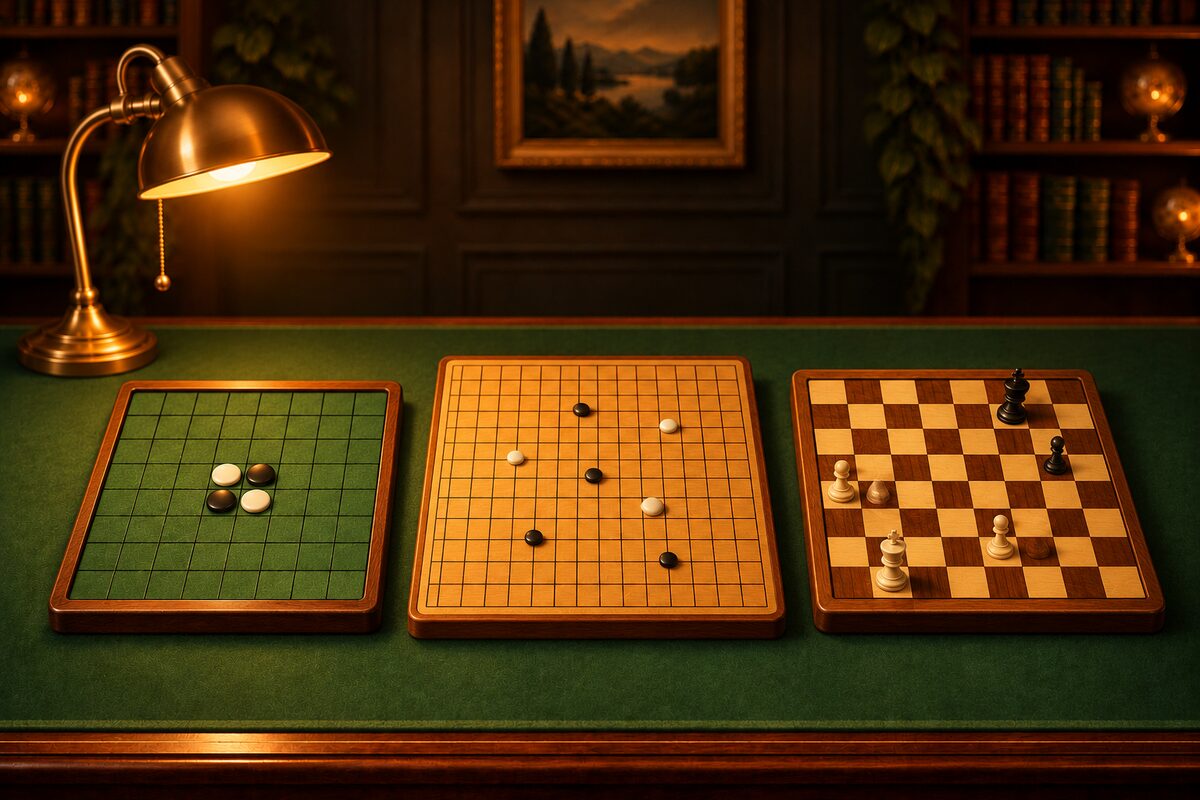
If you’d like to get into board games but don’t know where to start, here are classic board games with short rules that you can enjoy for a long time, in order from easiest to learn. Each has a long history and is played all over the world.
In Order of How Easy They Are to Learn
| Game | Time to explain | Players |
|---|---|---|
| Gomoku | 1 minute | 2 |
| Reversi | 2 minutes | 2 |
| Peg Solitaire | 2 minutes | 1 |
| Mancala | 3 minutes | 2 |
| Backgammon | 10 minutes | 2 |
| Chess | 15 minutes | 2 |
1. Gomoku
Players take turns placing stones, and whoever first gets five in a row, across, down, or diagonally, wins.
- Common stumbling point: Missing that your opponent is about to get four in a row. Get in the habit of checking your opponent’s lines before you make your own move.
2. Reversi
When you trap your opponent’s stones between your own, the trapped stones flip over and become your color. Whoever has more stones at the end wins.
- Common stumbling point: Taking too many stones early on. The more stones you have, the more places you give your opponent to play. At first, if you just focus on “taking the corners,” you’ll get much stronger.
3. Peg Solitaire
A board puzzle you play alone. You remove pegs by jumping over a neighboring peg, and try to leave just one at the end.
- Common stumbling point: Taking every peg you can right in front of you. Pegs left at the edges can’t be removed, so clear out the corner and edge pegs early. We explain the rules in Peg Solitaire Rules.
4. Mancala
You scoop up the stones in a pit and drop them one at a time into the next pits. At the end, whoever has gathered more stones in their own store wins. The rules vary from region to region.
- Common stumbling point: Miscounting where your last stone will land. Until you get used to it, count the stones with your finger as you sow them.
5. Backgammon
You move your pieces by the numbers on two dice, and whoever first bears off all 15 pieces wins.
- Common stumbling point: Leaving a single piece on its own, where your opponent can hit it and send it back to the start. Stacking two or more pieces together keeps them safe.
6. Chess
You use six kinds of pieces, and whoever checkmates the opponent’s king wins. There’s a little more to learn, but once you’ve learned it, the fun is like nothing else.
- Common stumbling point: When you’ve just learned how the pieces move, it’s easy to lose your queen for nothing. Before you move, check “Can this piece be captured?” We explain how to set up the board in How to Set Up a Chess Board and how to practice in Chess Practice for Beginners.
Tips for Enjoying Your First Game
- Play one game before worrying about winning: At first, play while teaching each other.
- Start with short games: If a game is short, you can play it many times and get the hang of it quickly.
- Think of just one reason you lost: You don’t have to review everything. Noticing one thing is enough.
Even without a chess board, the Chess Board app turns a phone or tablet into a board so two people can play. You can play Peg Solitaire in an app, too (both on iPhone and Android, free, with ads).