 Chess Board
 Peg Solitaire
 Tower of Hanoi
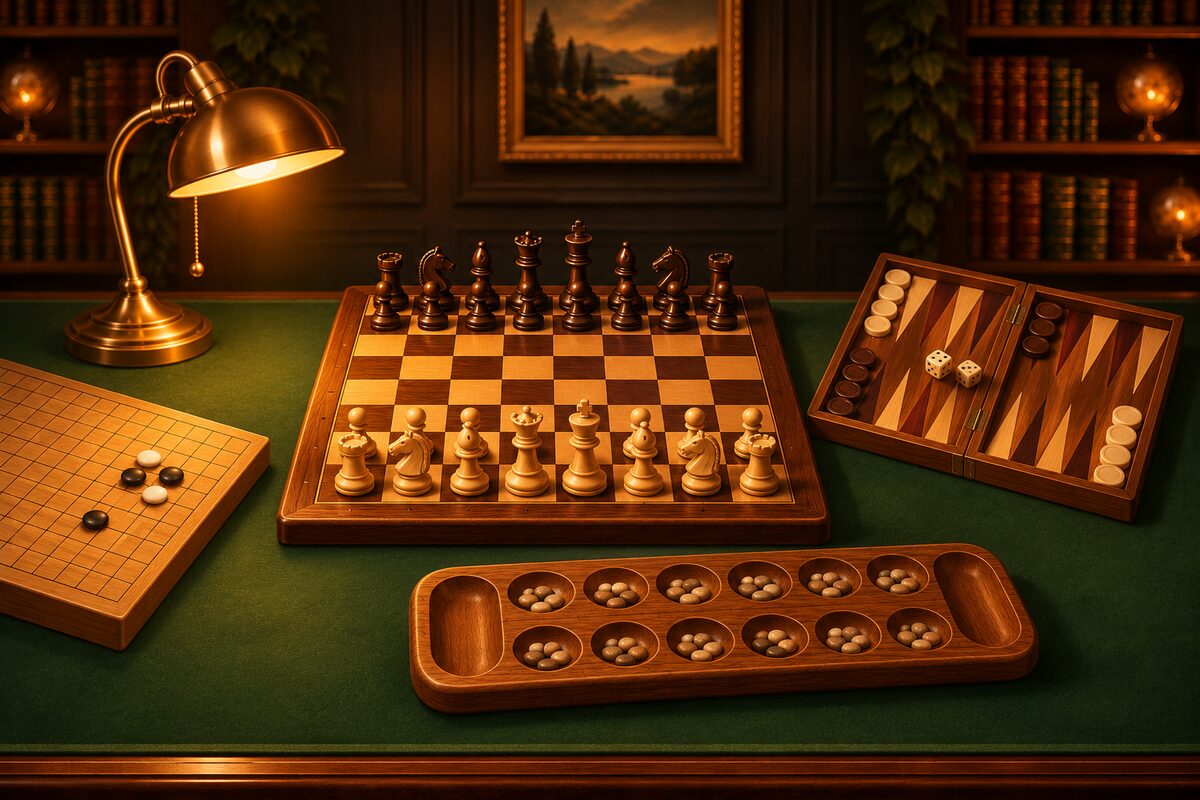
Board games are games you play by moving pieces or stones on a board. People around the world have played them for thousands of years, and there are more kinds than anyone can count. Here we sort them into six broad groups by how they play and introduce the classic games in each.
Six Types
| Type | Classic games | Luck |
|---|---|---|
| Two-player games with no luck | Chess, shogi, Go, reversi, gomoku | None |
| Games with dice | Backgammon, race games (sugoroku) | Yes |
| Sowing games | Mancala | None |
| Solo board puzzles | Peg Solitaire, Tower of Hanoi | None |
| Deduction games | Number guessing, mystery games | A little |
| Modern board games | Territory, resource gathering, co-op, and more | Varies |
Two-Player Games with No Luck (Abstract Games)
These are games for two with no luck from dice or cards, where everything on the board is in plain view. Only your thinking decides who wins.
- Chess: A game where you use six kinds of pieces to trap your opponent’s king (checkmate). It grew out of an old board game from India and is now played all over the world. We explain the rules in The Rules of Chess.
- Shogi: Japan’s cousin of chess. Its big feature is that you can use the pieces you capture as your own. We sum up the differences in Chess vs. Shogi.
- Go: Players take turns placing white and black stones and compete for the most territory surrounded. The rules are simple, but the game is very deep.
- Reversi: You trap your opponent’s stones between your own to flip them over, and whoever has more stones at the end wins.
- Gomoku: Whoever gets five of their stones in a row, across, down, or diagonally, wins.
Games with Dice
You move your pieces by the numbers you roll, so both luck and strategy matter.
- Backgammon: You roll two dice to move your 15 pieces, and whoever bears off all of their pieces first wins. It’s a worldwide game with very old roots.
- Race games (sugoroku): You move ahead by the number you roll, and whoever reaches the goal first wins. Even young children can play.
Sowing Games (Mancala)
In these games, you scoop up the stones in one of the pits on the board and drop them one at a time into the next pits. They have been played in Africa and Asia for a very long time. There’s no luck, and they test your ability to count and think ahead.
Solo Board Puzzles
These are board-and-piece puzzles you can play without an opponent.
- Peg Solitaire: You remove pegs on the board by jumping over a neighboring peg, and try to leave just one at the end. We cover it in detail in What Is Peg Solitaire?.
- Tower of Hanoi: You move disks of different sizes to another peg while following the rules.
We cover board games you can play alone in detail in Board Games You Can Play Alone.
Deduction Games
These are games where you use clues to work out what your opponent is hiding. Number-guessing games, where you guess numbers or colors, can also be played with paper and pencil. We introduce them in Deduction and Number-Guessing Games.
Modern Board Games
Starting around the 1990s, many new board games began to be made in Europe, led by Germany. They work in all sorts of ways: gathering resources to build things up, fighting over territory, or working together to win as a team. Many are played by three or four people over about an hour, and people enjoy them at places like board game cafés.
Where Should You Start?
- Two players, taking your time: No-luck games like chess and Go.
- With family or kids: Games with short rules, like race games, reversi, and gomoku. Board Games to Play with Kids can help too.
- On your own: Peg Solitaire and the Tower of Hanoi.
Even without a board or pieces, you can start right away with a phone app. On this site, we offer the Chess Board app, which lets two people play around one device, and Peg Solitaire and Tower of Hanoi, which you can play alone, all for free.