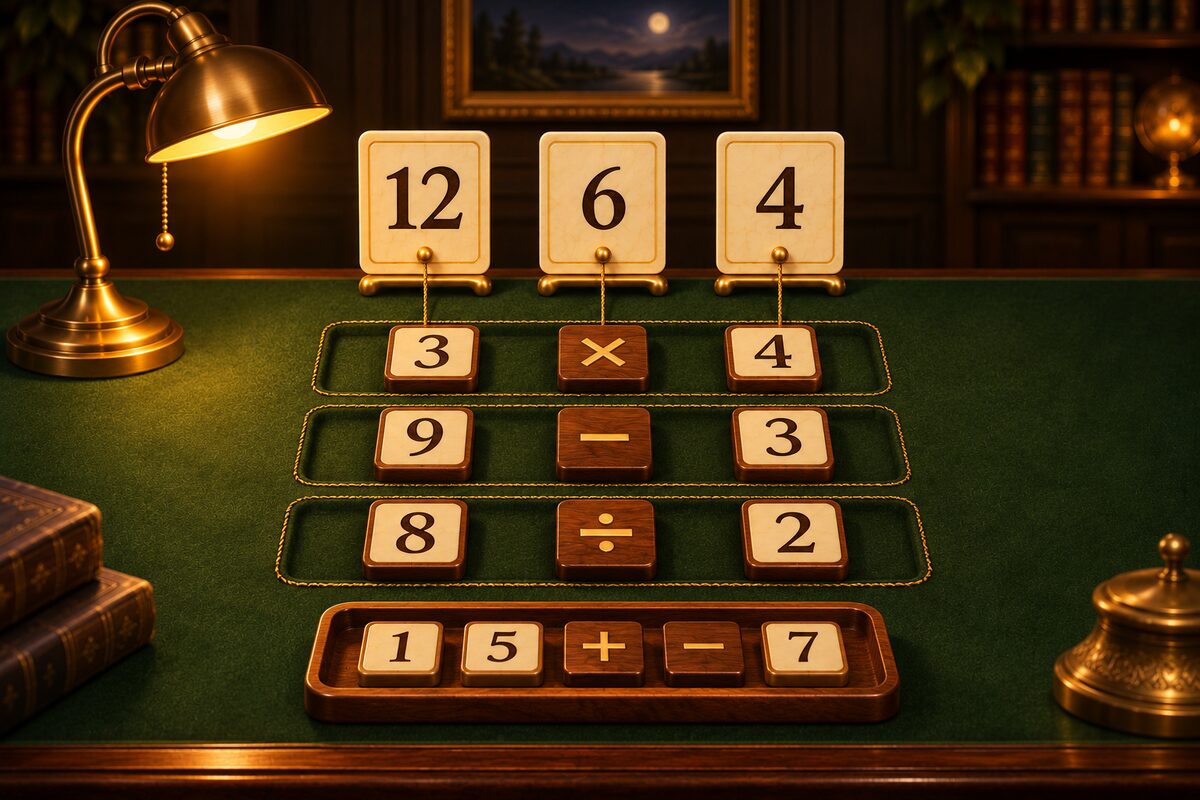
The Tsumezan rules are made of a basic framework, “make the goal numbers with equations that use every tile exactly once,” plus a few conventions. This framework still works when you swap out the signs or tiles. Here we think about what happens when you widen or narrow the rules, running the numbers as we go.
The Current Rules
The Tsumezan app makes its puzzles with these conventions:
- Number tiles are single digits from 1 to 9.
- There are four signs: +, −, ×, ÷. No parentheses.
- × and ÷ come before + and −, and operations of the same rank go from left to right.
- ÷ only when it divides evenly. Nothing below zero, along the way or at the end.
- Goals are 0 to 99, with 1 to 4 goals and 3 to 8 numbers.
Every one of these conventions is a “dial” you can turn.
Estimates: Changing the Signs or Tiles
We counted the puzzles with exactly one answer for puzzles with 3 numbers and 1 goal (the small ★1 format) and puzzles with 4 numbers. The counts for the current rules were all counted with the same rules the app uses to check answers. The rows that change the signs or tiles are estimates, counted with the same calculation engine plus one added convention.
| Rules | 3 numbers, 1 goal | 4 numbers, 2 goals | 4 numbers, 1 goal |
|---|---|---|---|
| + and − only | 255 | 5,432 | 546 |
| +, −, × | 1,000 | 15,314 | 4,699 |
| Current rules (+, −, ×, ÷) | 1,274 | 18,842 | 6,834 |
| Add remainder (%) | 2,775 | 31,913 | 19,869 |
| Add power (^) | 1,914 | 25,627 | 12,759 |
| Tiles from 1 to 12 | 2,704 | 55,345 | 17,551 |
Narrowing: Only + and − for Kids
With only + and −, the number of good puzzles (puzzles with exactly one answer) drops sharply. With 3 numbers and 1 goal, there are 255. That’s because + and − tend to give the same value even when rearranged, so many puzzles end up with two or more answers. Even so, there are plenty for kids who have just learned addition and subtraction. Add signs as they learn new operations, and the same game gets harder.
Widening: Adding Signs
Remainder (%, modulo). “8 % 3” is 2, the remainder when you divide 8 by 3. If you give it the same rank as × and ÷, the following puzzle has exactly one answer:
- Goal 4, numbers 8, 3, 2, signs % and + → 8 % 3 + 2 = 4
Unlike ÷, the remainder works even when the division isn’t even. That lets you make more equations, and the number of good puzzles with 3 numbers and 1 goal more than doubled.
Power (^, exponent). “2 ^ 5” is 32, 2 multiplied by itself 5 times. If you calculate it before everything else, the following puzzle has exactly one answer:
- Goal 30, numbers 2, 5, 2, signs ^ and − → 2 ^ 5 − 2 = 30
Powers make numbers grow fast, so even small number tiles can make big goals.
“In what order to calculate” an added sign is also a convention you have to decide. This time, we gave remainders the same rank as × and ÷, and powers the top rank. Change the order, and the puzzles you can make change too.
Widening: Changing the Tiles
Two-digit tiles. With number tiles from 1 to 12, good puzzles with 3 numbers and 1 goal went from 1,274 to 2,704. For example, the following puzzle has exactly one answer:
- Goal 47, numbers 12, 4, 1, signs × and − → 12 × 4 − 1 = 47
Other tiles are possible too:
- A 0 tile: ×0 turns anything into 0, and ÷0 can’t be calculated. If you add it, you need a convention for where it can go.
- Fraction or decimal tiles: Adding a tile like ½ means rethinking the “÷ only when it divides evenly” convention.
Extensions We Haven’t Tried Yet
There are still plenty of math symbols.
- Root (√): A sign that acts on a single number, as in √9 = 3. You’d first need to figure out how to fit a sign that acts on one number into the current “alternate numbers and signs” convention.
- Factorial (!): 3! = 3 × 2 × 1 = 6. Like the root, it acts on a single number.
- Parentheses: Allowing parentheses would make it closer to the Make 10 puzzle. The number of equations you can make would jump, so getting a single answer looks harder.
- Goals of 100 and up: Combined with powers or two-digit tiles, you’d want to widen the range of goals, too.
Rules That Fit the Player
The Tsumezan rules aren’t one finished form. Small puzzles with only + and − for kids, puzzles with more signs for people who are good at math: being able to widen or narrow the rules to fit the player is, we think, the most interesting thing about this format.
Which conventions, when changed, create how many good puzzles? How do you find puzzles with exactly one answer? We’ve only just started exploring the structure of this format. When we try new signs or tiles, we’ll share them on this page.
For how many puzzles can be made under the current rules, see How Many Puzzles Can Be Made?. To make puzzles on paper, see Make Your Own Puzzles.