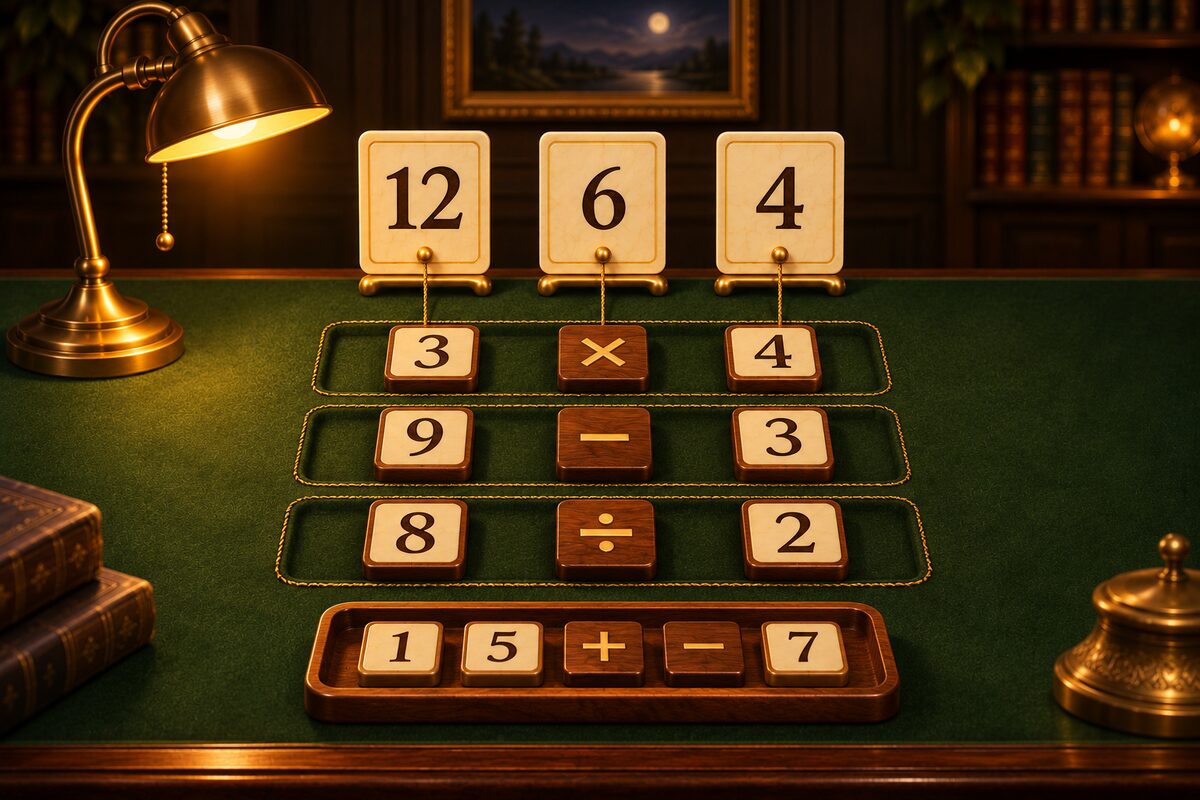
The Make 10 puzzle is a game where you make 10 using four digits and +, −, ×, ÷. In Japan it’s called the “ten puzzle” or “make ten.” Many people play it with the four-digit number printed on a train ticket or the digits on a car’s license plate, and it’s a popular way to pass the time with no equipment needed.
Rules
- Use all four digits, once each.
- Choose freely from +, −, ×, and ÷ (you can use the same sign as many times as you like).
- Parentheses are allowed.
- Rearranging the digits is usually allowed, too.
For example, with 1, 2, 3, 4: 1 + 2 + 3 + 4 = 10. Some sets, like 3, 4, 7, 8, are hard to crack right away.
Famous Hard Sets
Sets that can only reach 10 by passing through a fraction along the way are known as the hard ones.
- 1, 1, 9, 9 → (1 + 1 ÷ 9) × 9 = 10
- 1, 1, 5, 8 → 8 ÷ (1 − 1 ÷ 5) = 10
The key is using a division that doesn’t come out even, like 1 ÷ 9 or 1 ÷ 5, partway through. Checking every set of four digits from 0 to 9, we found four sets that can’t be done with whole numbers alone and need a fraction along the way: 1, 1, 5, 8; 1, 1, 9, 9; 1, 3, 3, 7; and 3, 4, 7, 8.
How Many Sets Can Make 10?
There are 715 sets of four digits from 0 to 9 (ignoring order). Checking them all by computer under the rules with parentheses and fractions, 552 of them can make 10. For sets using only 1 to 9 (no 0), it’s 447 out of 495.
How It Differs from Tsumezan
Tsumezan is also a math puzzle where you make set numbers with digits and signs. But a few of the rules are different.
| Make 10 | Tsumezan | |
|---|---|---|
| Number to make | Only 10 | The card’s number (0–99) |
| How many numbers to make | 1 | 1–4 |
| Signs | Choose freely | Set by the tiles |
| Parentheses | Allowed | Not allowed |
| ÷ | Fractions are OK | Only when it divides evenly |
| Going below zero along the way | OK | Not allowed |
| Answers | Any number is fine | Exactly one |
In Tsumezan, the signs are handed to you as tiles too, so the puzzle isn’t “which sign to use” but “which tile goes where.” In puzzles with two or more goals, you also think about how to split the tiles among the equations. Each puzzle is built to have exactly one answer, so when you find it, you know “this is the only way.”
Under Tsumezan’s rules with no parentheses or fractions, but letting you choose the signs freely, 343 of the 495 sets of four digits from 1 to 9 can make 10. Without parentheses, fewer sets work than in the Make 10 puzzle.
If You Like the Make 10 Puzzle
If you enjoy figuring out “how to combine these to make 10,” you’ll probably like Tsumezan too. There’s the satisfaction of using up every tile, and the back-and-forth of working out how to split the tiles when there are more goals. For similar math puzzles, see What Are Calculation Puzzles?