Calculation puzzles are puzzles you solve with addition, subtraction, multiplication, and division. They’re also called “number puzzles,” “arithmetic puzzles,” or “math puzzles.” Even when the math itself is only what you learn in elementary school, there’s fun in figuring out what goes where, and they’ve long been enjoyed in books and newspapers. Here are some of the best-known kinds.
Komachi-zan
A puzzle where you line up the digits 1 to 9 in this order, then insert + or − between them or join digits together to make 100. The Japanese name, Komachi-zan, is said to come from the poet Ono no Komachi.
- Example: 1 + 2 + 3 − 4 + 5 + 6 + 78 + 9 = 100
Counting every equation you can make with only + and − (with no sign in front of the first digit), there are 11.
Cryptarithms
In a cryptarithm (verbal arithmetic), the digits in an equation are replaced by letters, and you work out the original digits. The same letter stands for the same digit, and different letters stand for different digits. The English SEND + MORE = MONEY is famous, and its only answer is 9567 + 1085 = 10652.
Missing-Digit Puzzles
In a missing-digit puzzle, some of the digits in an equation are blank, as if eaten away by bugs (the Japanese name means “worm-eaten arithmetic”). They’re often shown as written column arithmetic, and you fill in the blanks using carrying and borrowing as clues.
The Make 10 Puzzle
A game where you make 10 using four digits, +, −, ×, ÷, and parentheses. You can play it with the number on a ticket and the like. For more, see What Is the Make 10 Puzzle?
Magic Squares
A puzzle where you fill a grid, such as 3×3, with numbers so that every row, column, and diagonal adds up to the same total. A 3×3 magic square using 1 to 9 has only one solution if you count rotations and reflections as the same.
Tsumezan
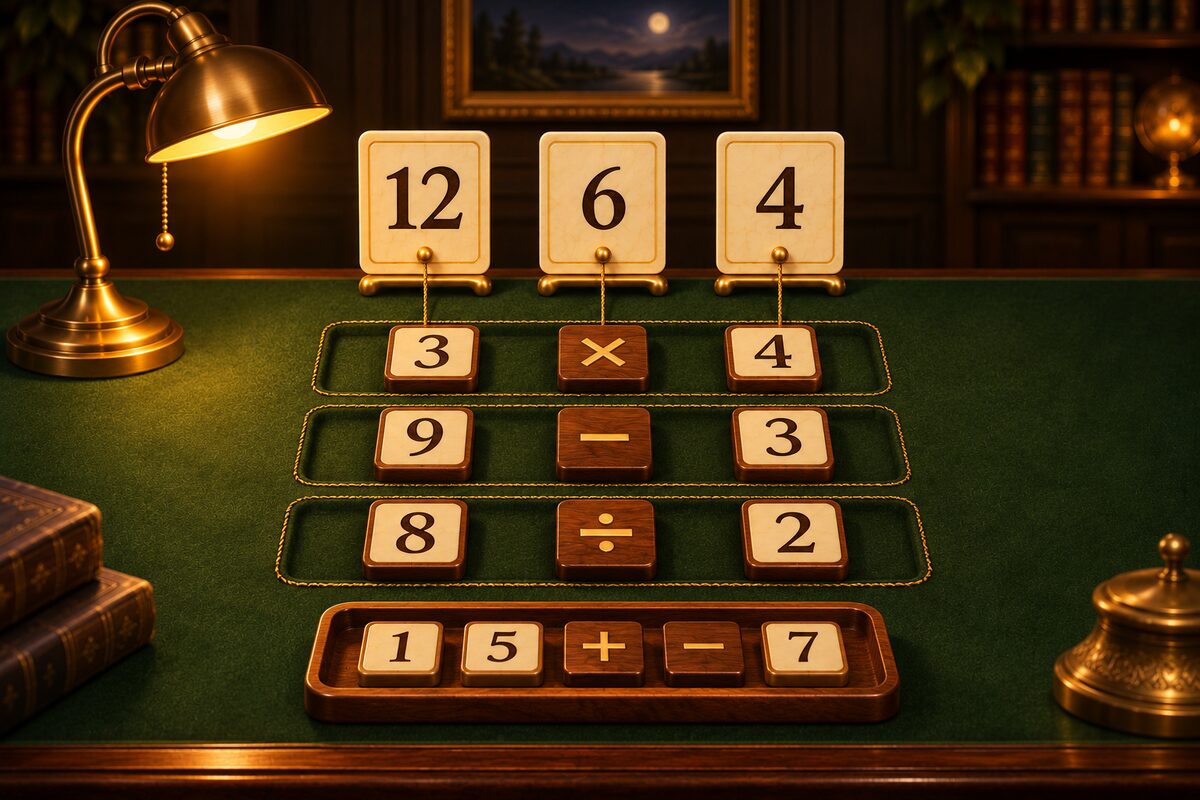
A puzzle where you make the goal numbers written on the cards at the top using every number and sign tile exactly once. There are no parentheses, and × and ÷ come before + and −.
- Example: goals 12, 6, 4, numbers 3, 4, 9, 3, 3, 8, 8, signs ×, −, +, ÷
- Answer: 3 × 4 = 12, 9 − 3 = 6, 3 + 8 ÷ 8 = 4
Compared with other calculation puzzles, it has these three features:
- The signs are handed to you as tiles too. You think not about which sign to use, but where to put it.
- There are 1 to 4 goals. How to split the tiles among the equations is the heart of the puzzle.
- Each puzzle is built to have exactly one answer. When you find it, you can be sure there’s no other possibility.
The rules are in How to Play Tsumezan.
Which One Should You Try?
| Puzzle | Math needed | Good for |
|---|---|---|
| Komachi-zan | + and − (× and ÷ too) | People who like trial and error |
| Cryptarithms | + (column arithmetic) | People who like deduction |
| Missing-digit puzzles | All four (column arithmetic) | Practicing column arithmetic |
| Make 10 | All four plus parentheses | Spare moments |
| Tsumezan | All four (order of operations) | People who like working out combinations |
With any of these calculation puzzles, you can make your own problems with paper and a pen. To make Tsumezan puzzles, see Make Your Own Puzzles.