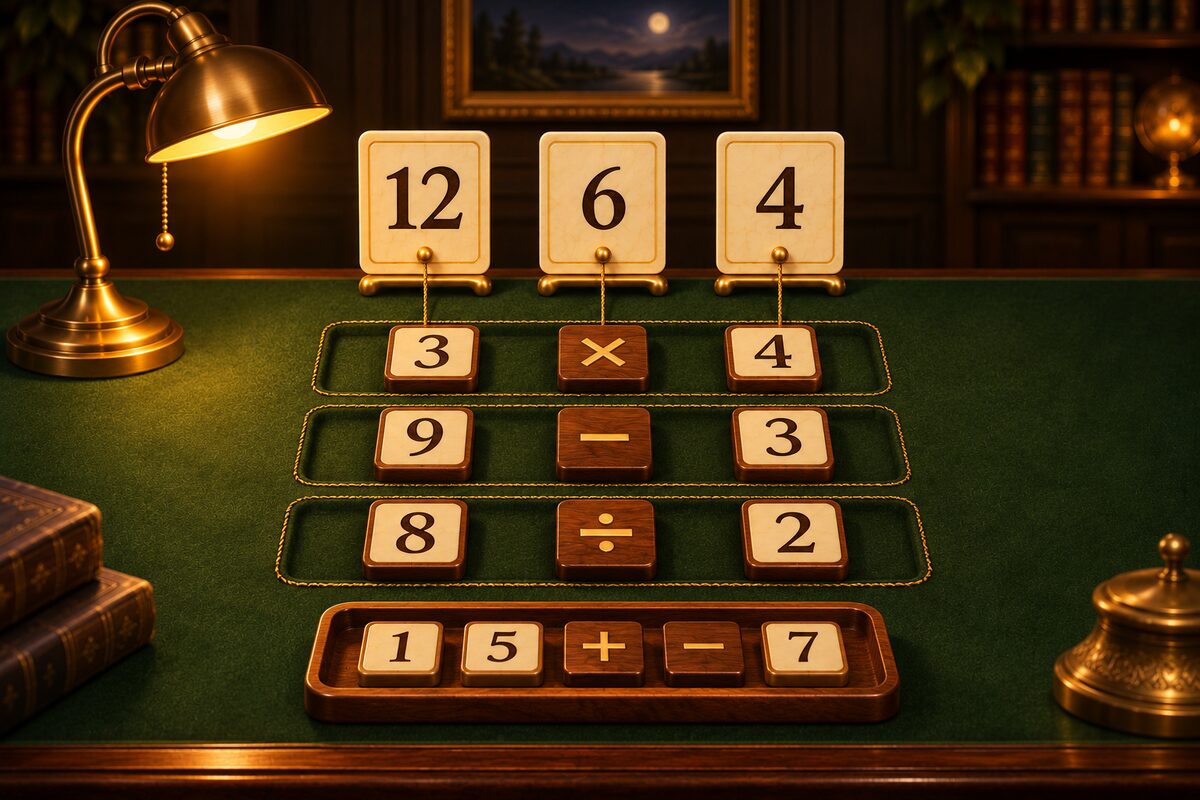
How many Tsumezan puzzles can be made in all? Rather than guessing, we counted them with a program that checks puzzles by the same rules as the Tsumezan app.
What We Counted
A Tsumezan puzzle is made of a set of goals, a set of number tiles, and a set of sign tiles. We counted these three things:
- Tile sets: combinations of number tiles (1 to 9, with any number of the same digit) and sign tiles (+ − × ÷, with any number of the same sign). The number of signs is always “the number of numbers − the number of goals.”
- Solvable puzzles: tile sets paired with a set of goals from 0 to 99 that have at least one answer that follows the rules.
- Unique-answer puzzles: among those, the ones with exactly one answer. Only these can be used as Tsumezan puzzles.
The rules are the same as in How to Play. There are no parentheses, × and ÷ come before + and −, ÷ only works when it divides evenly, and nothing may go below zero, along the way or at the end. When counting answers, equations that only swap the order of addition or multiplication, like 4 + 6 and 6 + 4, count as the same answer. And when two goals are the same number, which equation goes in which row doesn’t make a different answer either.
How We Counted
We took the tile sets one at a time and tried every way to split the tiles into as many equations as there are goals, and every way to order each equation. To calculate equations and decide whether two equations are the same, we used the checks from tsumezan-core, the program that serves as the official source of the app’s rules, without changes. We also took 680 puzzles from the app, counted them again, and confirmed that every one was judged to have exactly one answer.
For formats with up to 6 numbers, we counted every tile set. Formats with 7 or 8 numbers have so many tile sets that counting them all would take far too long, so we picked 1,200 to 20,000 tile sets at random, counted those, and estimated the total. Numbers marked “about” in the table are estimates, with a sampling error of a few percent up to about 10%.
Results
In the table, “Solvable” is the number of puzzles that have an answer, and “Unique” is the number of puzzles with exactly one answer.
| Goals | Numbers | Tile sets | Solvable | Unique |
|---|---|---|---|---|
| 1 | 3 | 1,650 | 1,956 | 1,274 |
| 1 | 4 | 9,900 | 20,301 | 6,834 |
| 1 | 5 | 45,045 | 176,412 | 28,485 |
| 1 | 6 | 168,168 | about 1.28 million | about 110,000 |
| 2 | 3 | 660 | 1,350 | 1,278 |
| 2 | 4 | 4,950 | 25,541 | 18,842 |
| 2 | 5 | 25,740 | 364,242 | 184,645 |
| 2 | 6 | 105,105 | 4,160,702 | 1,294,542 |
| 2 | 7 | 360,360 | about 38.3 million | about 6.7 million |
| 2 | 8 | 1,081,080 | about 270 million | about 28 million |
| 3 | 4 | 1,980 | 6,630 | 6,318 |
| 3 | 5 | 12,870 | 161,076 | 126,306 |
| 3 | 6 | 60,060 | 2,870,814 | 1,681,851 |
| 3 | 7 | 225,225 | about 39.9 million | about 16.1 million |
| 3 | 8 | 720,720 | about 420 million | about 110 million |
| 4 | 5 | 5,148 | 24,090 | 23,118 |
| 4 | 6 | 30,030 | 691,973 | 559,359 |
| 4 | 7 | 128,700 | about 14.5 million | about 9.2 million |
| 4 | 8 | 450,450 | about 230 million | about 110 million |
All together, there are about 280 million puzzles with exactly one answer. Even if you solved one a day, you couldn’t finish them in a lifetime.
What We Found
The more goals, the more likely a puzzle has exactly one answer. With 1 goal and 3 numbers, about 65% of the solvable puzzles have exactly one answer, but with 4 goals and 5 numbers it’s about 96%. More goals add more conditions on which tiles go into which equation, so other answers are harder to make work.
With 1 goal, adding numbers makes a single answer less likely. With 1 goal, the share drops from about 65% with 3 numbers to about 34% with 4, about 16% with 5, and about 9% with 6. More tiles mean more ways to arrange them, so it’s easier to find a different equation that reaches the same goal.
Few tile sets, but lots of puzzles. With 1 goal and 3 numbers, there are only 1,650 tile sets. There are 165 ways to choose 3 numbers from 1 to 9 (the same number is OK) and 10 ways to choose 2 signs from + − × ÷, and 165 × 10 = 1,650. But from a single tile set, you can make many puzzles by changing the goal.
The 100,000 Puzzles in the App
The Tsumezan app contains 100,000 puzzles that have been checked to have exactly one answer. Next to the numbers in the table above, that’s just a tiny fraction.
From the puzzles with exactly one answer, the app picks puzzles using conditions like these:
- The answer doesn’t include a one-number equation (a row where you just place one number tile equal to the goal).
- At most one goal of 0 or 1 per puzzle.
- Puzzles are scored on how they feel to solve, and the high scorers are picked, while making sure the answers don’t all have similar shapes.
Some formats, like the 1,278 puzzles with 2 goals and 3 numbers in the table, have exactly one answer but are full of one-number equations, so they aren’t much of a game. Not every puzzle we counted is a good puzzle.
How would these numbers change if you changed the rules? Our estimates for adding signs or using two-digit tiles are in Extending the Tsumezan Rules. With small formats, you can also check by writing everything out by hand. If you’d like to make this a school research project, see Math Puzzles for a School Research Project.