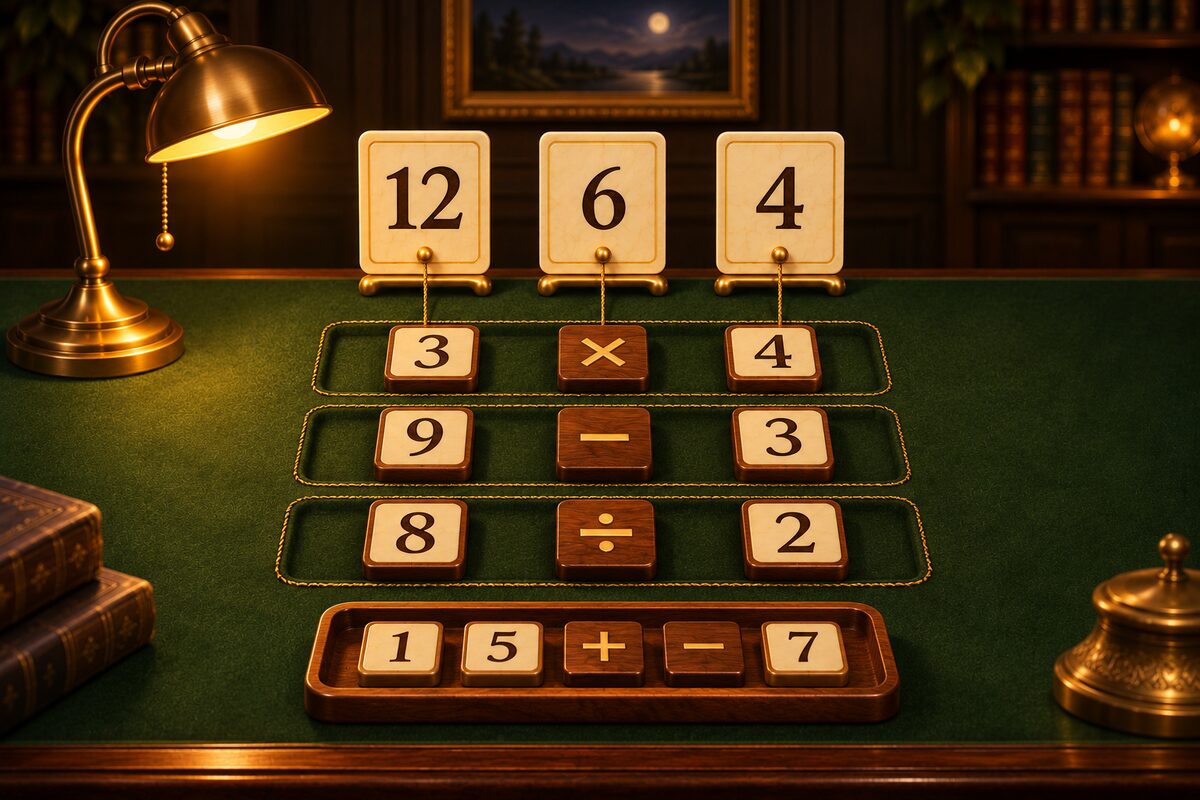
Tsumezan isn’t just fun to solve. It’s fun to make, too. All you need is addition, subtraction, multiplication, and division, plus paper and a pen. Even elementary school kids can make puzzles to give to family and friends.
What You Need
- Paper and a pen (graph paper makes writing easier)
- Card stock and scissors for tiles (you can also play just by writing on paper)
If you make tiles, two of each number from 1 to 9 and two or three each of +, −, ×, and ÷ will cover lots of different puzzles. You can also use the A through 9 cards from a deck of playing cards in place of number tiles.
Work “Backward”
You can make a Tsumezan puzzle by writing the answer equation first, then breaking it apart.
- Write one equation. To start, 3 numbers and 2 signs works well. Example: 4 + 6 − 8 = 2
- Break it apart. The number tiles are 4, 6, and 8, the sign tiles are + and −, and the goal card is 2.
- Mix and lay out. Shuffle the order of the tiles and set them out with the goal card.
- Check for other answers. This is the most important step (see the next section).
The rules are the same as in How to Play: × and ÷ come first, ÷ only works when it divides evenly, and an equation that drops below zero along the way isn’t allowed.
Check That There’s Only One Answer
A good puzzle has only one answer. If there are two, an answer the puzzle maker never thought of still counts as correct.
With 3 numbers and 2 signs, there are 12 arrangements in all (6 ways to order the numbers × 2 ways to order the signs). Write them all out and check that no other equation makes the goal. Splitting the search among the family is fun, too.
The earlier puzzle, “4, 6, 8, + and −, goal 2,” has no equation other than 4 + 6 − 8 that makes 2. For example, 6 − 8 + 4 isn’t allowed, because 6 − 8 drops below zero.
If There Are Two or More Answers
If you make a puzzle from “3, 4, 6, + and −, goal 7,” you’ll find three answers.
- 4 + 6 − 3 = 7
- 4 − 3 + 6 = 7
- 6 − 3 + 4 = 7
Equations that only swap the order of addition, like 4 + 6 and 6 + 4, count as the same answer. But the three above differ in “which number is subtracted from which,” so they’re different answers.
The trick for fixing it is to make the number you subtract the biggest one. With 8 + 8 − 9 = 7, trying to subtract the 9 earlier gives 8 − 9, which drops below zero, so there’s only one answer.
You can also fix it in these ways:
- Change one sign to ×. The only answer to “2, 3, 4, + and ×, goal 10” is 2 × 3 + 4.
- Change one number. Changing just one often makes the other answers disappear.
Once You’re Used to It, Try Two Goals
With two goals, the puzzle also becomes about which tiles go in which row. Try making one with 4 numbers and 2 signs.
- Example: goals 18 and 3, numbers 2, 3, 6, 9, signs − and ×. The only answer is 2 × 9 = 18 and 6 − 3 = 3.
With the same tiles and goals of 12 and 3, the answer becomes 2 × 9 − 6 = 12 and 3 = 3, with a single 3 placed by itself. A row with just one number is a perfectly good answer.
Tips for Making Puzzles with Kids
- Start with only + and −. But with only +, you just add everything up, so put in one − to give the puzzle something to think about.
- Let the maker be the quizmaster. Have adults or siblings solve the puzzle. If two answers turn up, fix it together.
- Add × once they’ve learned multiplication, and ÷ once they’ve learned division. Being able to add signs to match what they’ve learned is one of the nice things about Tsumezan.
For ways to play with different rules, see Extending the Tsumezan Rules. For how many puzzles can be made, see How Many Puzzles Can Be Made?. The Tsumezan app has 100,000 puzzles, each checked to have exactly one answer.