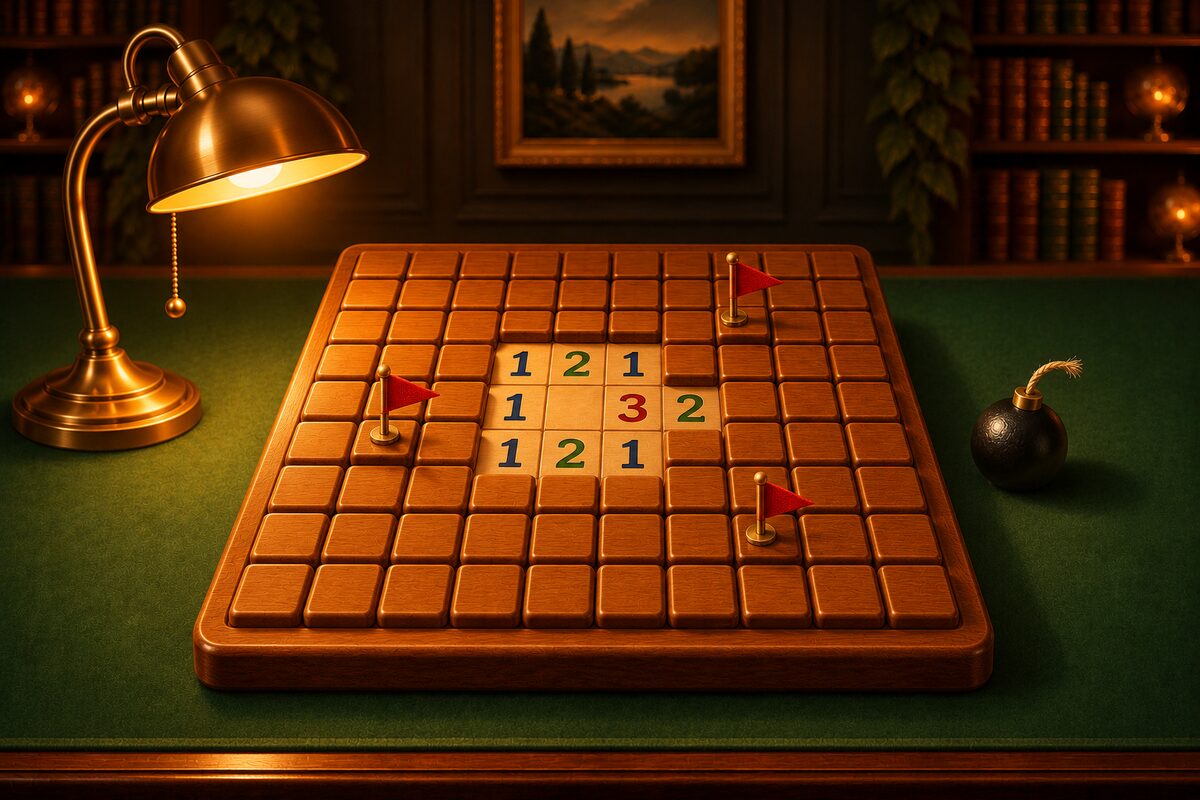
Ordinary Minesweeper places mines at random, so you can get a “50/50” that logic cannot settle (Is Minesweeper a Game of Luck?). A board built so that this never happens is called “no-guess.” Every board in the Minesweeper app is no-guess.
The Steps for Building a Board
The app builds a board with these steps.
- Wait for the first tap: the board is built the moment you tap your first square.
- Decide the safe area: no mines are placed on the tapped square or the squares around it.
- Place the mines: the set number of mines is placed at random on the remaining squares.
- Try solving by logic: the app opens the first square and checks whether it can open every safe square using only three rules that people use.
- Fix it if it gets stuck: if nothing more can be settled partway, the app moves one mine touching the opened area to a deeper square that nobody has touched yet, and checks again from step 4. The number of mines does not change.
- Place them again if it cannot be fixed: if it still cannot be solved after moving mines, the app places them again from step 3.
When a board can be solved to the end, you start playing that board. The first square is already open at that point.
The Three Rules of Deduction
Step 4 uses only these three kinds of deduction, which a person can do in their head.
- What you can tell from one number
- What you can tell from a combination of two numbers
- What you can tell from the mines left on the whole board
It does not use heavy calculation like counting every layout. Only boards solvable with these three are given to you, so you can always make it to the end with these three kinds of deduction. The app’s “Hint” also looks for the next move using the same three rules.
Why Move Mines “Deeper”
What gets you stuck is the mines along the edge of the opened area. If you move one of them to a deeper square away from the opened area, the numbers along the edge change, and squares that logic can settle may appear.
The deeper square it moves to touches none of the opened squares, so placing a mine there does not change any opened number. Only the numbers around the square where the mine was removed change. After moving, the app solves it again from the start to check.
How Many Times Do Mines Get Moved?
Using the same steps as the app, we generated 2,000 boards for each level, starting from the middle of the board, and counted how many times mines were moved.
| Board | Solved without moving | Average number of moves |
|---|---|---|
| Level 1 9×7 | about 82% | about 0.1 |
| Level 2 12×9 | about 71% | about 0.3 |
| Level 3 15×10 | about 41% | about 1.0 |
| Level 4 20×12 | about 31% | about 1.6 |
| Level 5 26×15 | about 22% | about 2.7 |
At Level 1, most boards can be solved by logic alone with the mines just as first placed. At Level 5, only about 20% can be solved as they are, and most are made solvable by moving mines a few times. When there were many moves, it was about 15.
Even so, the calculation finishes very quickly. When we tried the same steps on this site, building one Level 5 board took a few milliseconds on average on a computer. You never wait between tapping and the board being ready.
Do No-Guess Boards Make the Game Easy?
You no longer lose by luck, but you still need logic. If anything, since you never end on a 50/50, you have to solve all the way to the last square by logic. On big boards, there are places where you use combinations of two numbers and the mines left in the endgame.
You can try no-guess boards right away on the boards on this page.