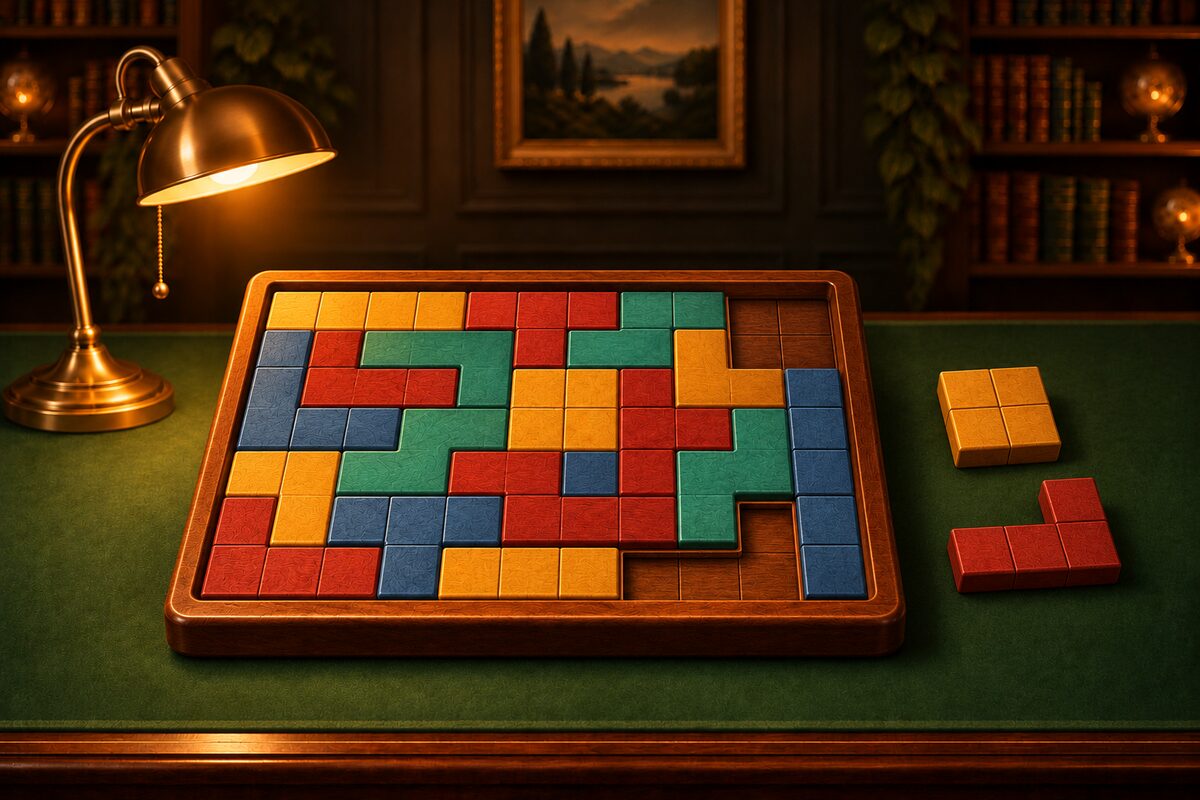
When you make puzzles, the biggest trouble is serving up one that cannot be solved. The Wood Block Fit app prevents this by making the puzzle from the answer.
Cutting a Frame into Pieces
The method has three steps.
- Make a frame: Depending on the difficulty, make a rectangular frame (Rectangles) or an irregular frame cut from a square (Shapes).
- Cut the frame into pieces: Cut the frame into connected chunks of 3 to 5 cells.
- Line the pieces up in the tray: Shuffle the order of the cut chunks, rotate each one to a random orientation, and put them in the tray.
If you put the cut shapes back where they came from, the frame is filled perfectly. That is why every puzzle has an answer. You do not need to flip pieces over. Rotating alone is enough to put them back.
For example, cutting the 4×5 frame above into five pieces gives pieces shaped like P, T, L, S, and L. In the tray, they are lined up in scattered orientations.
Cut the Easily Stranded Cells First
When cutting, you grow the pieces one at a time, starting from the cell with the fewest empty neighbors. These are corners, and cells whose surroundings have already been cut.
Because you use these easily stranded cells first, awkward leftover gaps are less likely to remain at the end. It is exactly the reverse of the idea “fill the cells with the fewest placements first” in the article on solving.
Never Leave a Gap That Cannot Be Filled
Each time you cut out one piece, you check the size of the chunks that remain.
If you cut out a T as in the diagram above, the single cell at the top left is closed off. There is no 1-cell piece, so this cut is not used.
A closed-off chunk must be a size that can be made from combinations of the remaining pieces’ cell counts. Sizes that cannot be made depend on the sizes of the pieces in use.
- 3-cell and 4-cell pieces (★1): Chunks of 1, 2, and 5 cells cannot be made.
- 3 to 5 cells (★2): Chunks of 1 and 2 cells cannot be made.
- 4-cell and 5-cell pieces (★3 to ★5): Chunks of 1, 2, 3, 6, 7, and 11 cells cannot be made.
For example, with 4-cell and 5-cell pieces, chunks of 6 or 11 cells can never be made, however you combine them (4 + 4 = 8, 4 + 5 = 9, 5 + 5 = 10, 4 + 4 + 4 = 12, and so on). From 12 cells up, every size can be made.
Not Too Many Identical Shapes
In ★1 to ★3, the cutting is done so that up to 2 pieces have the same shape (matching after rotation), and in ★4 and ★5, so that each shape appears once. With many identical shapes, you could just swap them to get an answer, and the puzzle would become too easy.
Same Seed, Same Puzzle
Puzzles are made from a random “seed.” The same seed with the same mode and difficulty always produces the same puzzle. Even if you close the app and reopen it, you can continue the puzzle you were playing (any pieces you had in the frame start back in the tray).
Making a puzzle takes only a few milliseconds. Puzzles are not made ahead of time; a new one is made on the spot every time you play.
Try It in Your Browser
The board in Where to Play Block Puzzles on this site also makes its puzzles by cutting a rectangular frame into pieces with the same ideas (cutting the easily stranded cells first, never leaving a gap that cannot be filled, and at most 2 identical shapes). The random numbers and fine details differ, so you will not get the same puzzles as in the app.