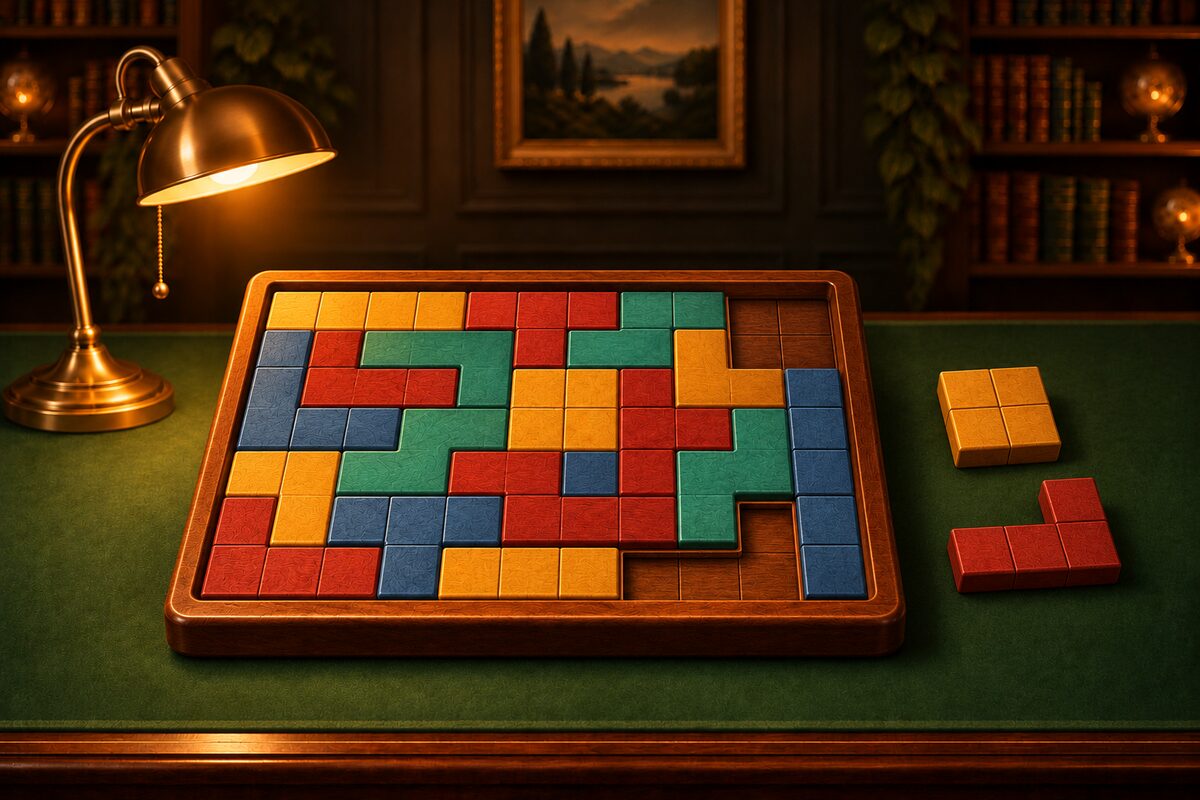
A shape made of squares joined edge to edge is called a polyomino. Every piece in Wood Block Fit is a polyomino. Shapes that touch only at corners are not counted as connected.
Names
Each number of cells has a name.
| Name | Cells |
|---|---|
| Monomino | 1 |
| Domino | 2 |
| Tromino | 3 |
| Tetromino | 4 |
| Pentomino | 5 |
| Hexomino | 6 |
| Heptomino | 7 |
| Octomino | 8 |
The names come from Greek numbers (mono = 1, tri = 3, tetra = 4, penta = 5, and so on) with the “omino” of domino added.
Three Ways of Counting
“How many kinds are there?” changes depending on which shapes you count as the same.
- Free (flipping counts as same): Shapes that match after rotating or flipping are the same.
- One-sided (flipped is different): Shapes that match after rotating are the same, but a flipped shape is different.
- Fixed (orientation matters): Shapes in different orientations are different (only shapes that match by sliding are the same).
For example, there are 2 kinds of trominoes of 3 cells if flipping counts as the same.
If you tell every orientation apart, the straight shape has 2 (horizontal and vertical) and the L shape has 4, making 6.
From 1 to 10 Cells
A computer built every shape made by adding one cell at a time, then grouped the shapes that match and counted them.
| Cells | Free | One-sided | Fixed |
|---|---|---|---|
| 1 | 1 | 1 | 1 |
| 2 | 1 | 1 | 2 |
| 3 | 2 | 2 | 6 |
| 4 | 5 | 7 | 19 |
| 5 | 12 | 18 | 63 |
| 6 | 35 | 60 | 216 |
| 7 | 108 | 196 | 760 |
| 8 | 369 | 704 | 2,725 |
| 9 | 1,285 | 2,500 | 9,910 |
| 10 | 4,655 | 9,189 | 36,446 |
Past 5 cells, each extra cell multiplies the count by roughly 3 to 4. Every number matched the values known in mathematics.
As the number of cells grows, counting gets harder and harder. A simple formula that works for any number of cells is said not to have been found.
Holes Appear at 7 Cells
At 7 cells, a shape with a hole in the middle appears for the first time. Of the 108 kinds of 7 cells, there is just one.
The dark cell in the middle is the hole. In a block puzzle, no piece fills this hole, so a shape with a hole is a hard piece to use.
Shapes with holes grow to 6 kinds at 8 cells, 37 at 9 cells, and 195 at 10 cells.
The Pieces in Wood Block Fit
The pieces in the app are polyominoes of 3 to 5 cells. Pieces only rotate and are not flipped, so the “one-sided” way of counting applies. There are 2 kinds of 3 cells, 7 kinds of 4 cells, and 18 kinds of 5 cells, so 27 shapes are possible in all.
A single puzzle uses some of those shapes. In ★1 to ★3, up to 2 pieces of the same shape appear, and in ★4 and ★5, no identical shapes appear.
To look more closely at the 4-cell and 5-cell shapes, see What Is a Tetromino? and What Is a Pentomino?.